


For nearly a decade, one NFL franchise had grown accustomed to stability. In a league defined by rapid turnover, coaching changes, and short-term thinking, this organization prided itself on continuity, patience, and a long-term vision built around consistent leadership. That sense of steadiness came to a sudden end this week following yet another heartbreaking postseason defeat.
On Monday morning, the team made a decisive move, parting ways with the man who had overseen its rise from irrelevance to perennial contender. The decision followed a dramatic overtime loss in the divisional round of the AFC playoffs — a defeat that proved to be the final chapter in a tenure defined as much by progress as by unfulfilled expectations.
League insiders described the atmosphere inside the building as tense and unsettled in the days leading up to the announcement. While the regular season had once again been successful by most measures, the organization’s inability to clear its postseason hurdles had become impossible to ignore.
A Loss That Reopened Old Wounds
Saturday night’s playoff game was emblematic of the team’s recent history. After battling through four quarters of high-stakes football, the contest spilled into overtime, where momentum swung back and forth before one controversial sequence shifted everything.
With the score tied and a chance to seize control, the offense faced a critical third-down situation. The quarterback launched a deep pass toward the sideline, where the receiver appeared to secure the ball before contact sent both players tumbling to the turf. What happened next became the focal point of debate.
Officials ruled that the receiver did not maintain possession through the ground, allowing the ball to remain live. A defender ultimately emerged with it, ending the drive and setting up the opposing team’s winning sequence. Fans erupted, analysts dissected the replay from every angle, and frustration boiled over across social media.
For many, the call symbolized more than a single missed opportunity. It represented years of postseason heartbreak, near-misses, and the lingering sense that something always went wrong when it mattered most.
Internal Pressure Reaches a Breaking Point
By the time the final whistle blew, questions about leadership were already swirling. While the head coach had delivered sustained success during the regular season, critics argued that situational decisions, clock management, and late-game execution had repeatedly faltered in playoff moments.
Within the organization, that frustration had reportedly been building for some time. According to league sources, concerns about the team’s inability to adapt in critical moments had been discussed internally, even as public messaging remained supportive.
NFL insiders suggested the decision to move on was not solely about one game or one call, but rather a cumulative judgment about the program’s ceiling under its current leadership. The loss merely accelerated what had become an unavoidable reckoning.
A Long Era Comes to an End
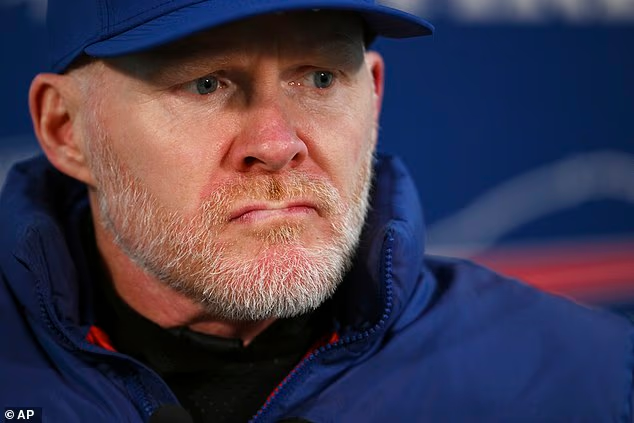
The coach dismissed on Monday was Sean McDermott, ending a nine-year tenure as head coach of the Buffalo Bills.
McDermott’s time in Buffalo was, by many metrics, a success. He transformed a struggling franchise into a consistent playoff participant, compiling a 98–50 regular-season record and reaching the postseason in all but one year. Under his guidance, the Bills developed a strong defensive identity and helped nurture the rise of one of the league’s most dynamic quarterbacks.
Yet despite those accomplishments, the ultimate goal remained elusive. Buffalo never returned to the Super Bowl during McDermott’s tenure, and postseason exits became increasingly painful. Saturday’s overtime defeat marked the sixth time his Bills lost a playoff game in the fourth quarter or overtime — a statistic that loomed heavily over his legacy.
The Controversy That Defined the Final Chapter
McDermott did not hide his frustration after the divisional-round loss. In what would prove to be his final press conference as head coach, he questioned the officiating decision that swung the game’s momentum.
He emphasized the importance of slowing down pivotal plays and ensuring accuracy, noting that the ruling directly impacted field position and potentially cost the team a game-winning opportunity. His remarks resonated with fans who felt the team had once again fallen victim to forces beyond its control.
Still, within the league, such explanations carried diminishing weight. Playoff football leaves little margin for error, and organizations often judge leaders on results rather than circumstances.
Stability Elsewhere in the Front Office
While McDermott’s dismissal marked a significant shift, the Bills opted for continuity in other areas. General manager Brandon Beane will remain in his role, signaling the organization’s belief that the roster itself remains capable of championship contention.
That decision suggests the franchise views coaching — not personnel — as the missing ingredient. With a reigning MVP quarterback, a strong core of veteran leaders, and a modern stadium set to open in Orchard Park next season, the Bills believe their championship window remains open.
However, that optimism is tempered by financial realities. The team faces a looming salary-cap crunch, including more than $30 million in dead money on the 2026 books. Navigating those constraints while pursuing a new coaching vision will be one of the front office’s most significant challenges.
What Comes Next for McDermott
McDermott’s future in the NFL remains an open question. Before his time in Buffalo, he built a strong reputation as a defensive coordinator, with stints in Philadelphia and Carolina. Several teams around the league are either actively searching for defensive leadership or could soon be doing so.
There is also the possibility that McDermott resurfaces as a head coaching candidate. Multiple franchises entered the offseason seeking new leadership after disappointing campaigns, though several high-profile vacancies have already been filled.
Whether he returns immediately or takes time away from the sidelines, McDermott’s body of work ensures he will remain a respected figure in league circles.
A New Direction for a Familiar Contender
For the Bills, the focus now turns to the future. Finding a coach capable of maximizing the prime years of their star quarterback is paramount. The organization must determine whether it wants continuity with a similar philosophy or a bold departure that emphasizes offensive innovation and aggressive decision-making.
Fans, long accustomed to heartbreak, are once again asked to trust the process — even as skepticism lingers. The franchise has climbed too high to accept anything less than a championship, and patience is no longer infinite.
The next hire will not simply be about schemes or playbooks. It will be about mentality, adaptability, and the ability to thrive under postseason pressure.
End of One Era, Beginning of Another
Sean McDermott’s departure closes a defining chapter in Buffalo football. His tenure restored credibility, relevance, and pride to a franchise that once struggled for identity. Yet in a results-driven league, progress without ultimate success often proves insufficient.
As the Bills turn the page, they do so with both opportunity and urgency. The question now is whether a new voice can finally push them over the line — or whether the cycle of promise and disappointment will continue.
One thing is certain: stability has given way to change, and the road ahead will define the next era of football in Buffalo.

Emily Johnson is a critically acclaimed essayist and novelist known for her thought-provoking works centered on feminism, women’s rights, and modern relationships. Born and raised in Portland, Oregon, Emily grew up with a deep love of books, often spending her afternoons at her local library. She went on to study literature and gender studies at UCLA, where she became deeply involved in activism and began publishing essays in campus journals. Her debut essay collection, Voices Unbound, struck a chord with readers nationwide for its fearless exploration of gender dynamics, identity, and the challenges faced by women in contemporary society. Emily later transitioned into fiction, writing novels that balance compelling storytelling with social commentary. Her protagonists are often strong, multidimensional women navigating love, ambition, and the struggles of everyday life, making her a favorite among readers who crave authentic, relatable narratives. Critics praise her ability to merge personal intimacy with universal themes. Off the page, Emily is an advocate for women in publishing, leading workshops that encourage young female writers to embrace their voices. She lives in Seattle with her partner and two rescue cats, where she continues to write, teach, and inspire a new generation of storytellers.