Long before primary ballots are cast or campaign slogans unveiled, the battle for the Republican Party’s next chapter may already be taking shape behind closed doors. Donor meetings, private conversations, and subtle ideological critiques are beginning to hint at an internal struggle that could define the GOP’s direction after President Donald Trump leaves office.
At the center of the speculation is a growing sense that not everyone in the party is prepared to rally around a single heir apparent. While one figure has rapidly emerged as the favorite among grassroots activists and MAGA-aligned organizations, murmurs from Washington suggest that at least one heavyweight Republican is quietly testing the waters for a future showdown.
According to recent reporting, a senior Republican lawmaker has been privately voicing concerns about the party’s trajectory and, more pointedly, about the worldview of the man many assume will carry the torch in 2028. These conversations have largely taken place out of public view—among donors, allies, and longtime power brokers—well ahead of any formal campaign announcements.
The criticism centers on foreign policy, national identity, and what some Republicans see as unresolved tensions between the party’s traditional instincts and its newer populist energy. While these debates are not new, the fact that they are now being framed in personal terms has caught the attention of strategists across the political spectrum.
An Heir Apparent—But Not Without Dissent
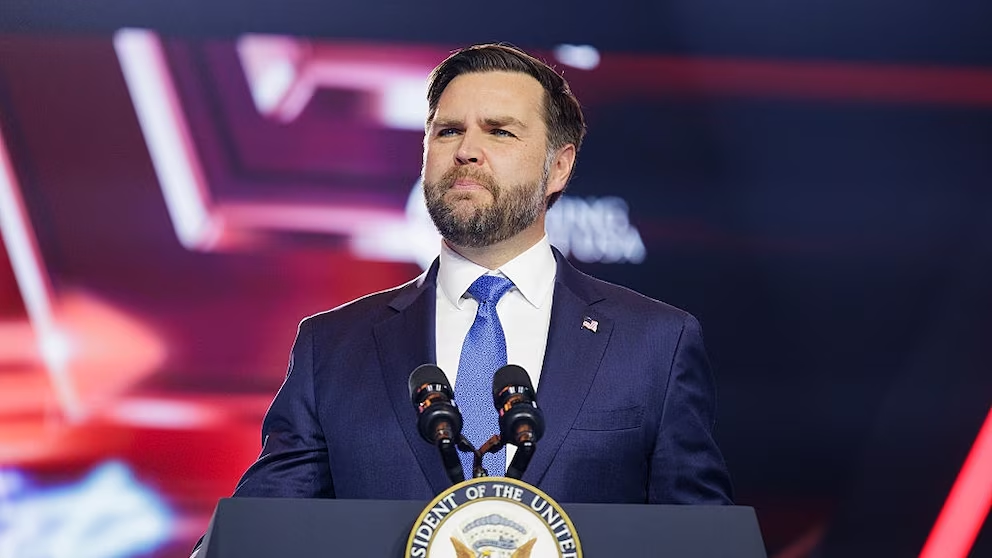
Since the 2024 election, Vice President JD Vance has been widely viewed as the natural successor to Donald Trump within the Republican Party. His rise from author and venture capitalist to U.S. senator and then vice president has been meteoric, fueled by strong alignment with Trump’s agenda and deep loyalty from the MAGA base.
Yet Trump himself has not formally endorsed a successor, leaving room—however narrow—for alternative ambitions to emerge. That opening appears to have encouraged quiet positioning among those who believe the party may still be persuadable.
In private conversations, the unnamed senator is said to have expressed unease with what he characterizes as an overly isolationist foreign-policy posture taking hold within parts of the GOP. The concern, according to people familiar with the discussions, is not merely about policy details but about whether the party risks abandoning long-held principles in favor of a narrower worldview.
A Familiar Figure Steps Into Focus
Midway through these behind-the-scenes maneuvers, the identity of the lawmaker at the center of the intrigue becomes clear: Ted Cruz, the longtime senator from Texas and a former presidential contender.
Cruz, now in his mid-50s, is no stranger to national campaigns. He was the last major challenger standing against Trump during the 2016 Republican primaries, building a formidable grassroots operation and positioning himself as a constitutional conservative with deep ties to evangelical voters and traditional GOP donors.
While Cruz has not publicly acknowledged any intention to run for president again, multiple sources suggest he is actively weighing the possibility. According to reports, he has been “running down” Vance in private donor conversations, questioning whether the vice president’s approach to foreign affairs and national security reflects a durable governing philosophy.
Those close to Cruz say he has been energized in recent months by his outspoken criticism of what he describes as rising hostility toward Israel within parts of the conservative movement—an issue that has placed him at odds with prominent right-wing commentators, including Tucker Carlson.
https://twitter.com/Independent/status/2003311075794583916
Ideology, Identity, and a Party in Transition
Political scientists note that the brewing tension is less about personal rivalry and more about the unresolved identity of the Republican Party. Is the GOP primarily a populist movement centered on cultural grievance and economic nationalism, or can it still accommodate elements of its pre-Trump foreign-policy and institutional traditions?
Daron Shaw, a political science professor at the University of Texas, has suggested that reconciling these competing impulses would be a formidable challenge for any candidate not fully embraced by the MAGA grassroots. Cruz, he noted, would face a “heavy lift” trying to bridge that divide.
Complicating matters further is the evolving stance of other Republican figures. Outgoing Georgia congresswoman Marjorie Taylor Greene, once a reliable MAGA ally, has become more openly critical of party leadership and suggested that Cruz would struggle to build congressional support against Vance.
Her blunt assessment—that Republicans are headed for an internal fight over their identity—underscored the skepticism many activists hold toward Cruz, despite his long conservative résumé.
Donor Signals and Grassroots Power
Perhaps more telling than activist skepticism is the reaction of major Republican donors. Hal Lambert, a key financier of Cruz’s 2016 presidential bid, has reportedly expressed doubt about Cruz’s viability in a direct contest with Vance.
Lambert’s remarks—that he would back Vance if the vice president runs and struggles to see what Cruz’s platform would be—highlight a shifting donor landscape increasingly aligned with MAGA priorities rather than traditional conservative orthodoxy.
That alignment was on full display at Turning Point USA’s AmericaFest conference, where Turning Point USA demonstrated its continued influence over the party’s grassroots base. At the event, Erika Kirk, who assumed leadership of the organization after the death of her husband Charlie Kirk, delivered a high-profile endorsement of Vance’s anticipated 2028 bid.
Her remarks were met with thunderous applause, signaling that among younger conservatives and activist networks, Vance already enjoys a formidable head start.
What Comes Next
Despite the mounting speculation, Vance himself has not said whether he intends to run for president after Trump’s term concludes. Republican strategists expect any announcement to come after the 2026 midterm elections, allowing the administration to focus on governance while preserving political flexibility.
For Cruz, time may be both an ally and an enemy. Early maneuvering allows him to test donor sentiment and refine a message, but it also risks reinforcing perceptions that the party has already moved on.
Whether this quiet rivalry evolves into an open primary battle remains uncertain. What is clear, however, is that the Republican Party’s post-Trump future is far from settled—and the debates unfolding now, largely out of public view, may determine not just who leads the ticket in 2028, but what the GOP ultimately stands for.