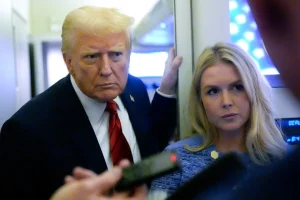
Recent polling data suggest that President Donald Trump’s approval ratings, particularly among white non-Hispanic Americans, may be slipping, raising questions about his political standing as he continues his second term in office.
The president, who returned to the White House last year, has been the subject of numerous surveys measuring public perception of his leadership. Many of these recent polls, however, have shown mixed or negative results, indicating that even among demographics traditionally considered supportive of Trump, his approval is no longer as solid as it once was.
Pew Research Center Findings
A recent survey conducted by the Pew Research Center found that Trump’s overall approval rating among U.S. adults stands at 37 percent, down from 40 percent in the fall of last year. Of those polled, only 14 percent said they had confidence in Trump’s performance as the leader of the free world, highlighting concerns among voters about his ability to manage complex domestic and international issues effectively.
While these numbers may appear modest, they are particularly notable because white non-Hispanic Americans have historically been among Trump’s strongest base. The decline in support within this demographic signals a potential shift in his core constituency, which could have implications for upcoming elections.
Marquette Law School Supreme Court Poll
Further insights come from a separate survey conducted by Marquette Law School Supreme Court, which involved 1,003 U.S. adults. Participants were asked whether they approved or disapproved of the way Trump is handling his job as president.
Among white non-Hispanic respondents, 49 percent said they approved of Trump’s performance, while 50 percent disapproved. This near-even split marks a sharp departure from previous levels of support, suggesting that uncertainty and dissatisfaction may be growing within a demographic long considered a political stronghold for the president.
The same poll revealed starker trends among minority groups. Among Black respondents, 78 percent disapproved of Trump’s performance, while 69 percent of Hispanic participants expressed disapproval. These numbers are consistent with historical trends showing low levels of support for Trump among nonwhite voters, but they underscore the challenges the president faces in broadening his appeal beyond his core base.
Context and Public Reaction
These findings follow a series of reports suggesting that Trump’s political standing is more vulnerable than previously thought. In a CNN report, political director David Chalian described Trump’s approval ratings as being at a “perilous point.”
“Compared to less than a year ago, he was at the best political ratings of his career,” Chalian noted. “And that has just gone away. It is really hard to find even a sliver of good news for President Trump in this poll.”
The survey of 1,209 respondents highlighted additional concerns for the president. Fifty-eight percent of participants described Trump’s first year back in office as a “failure,” while 55 percent said his policies have worsened economic conditions in the United States. Only 35 percent of respondents reported feeling proud to call him their president, a metric that speaks to broader concerns about public perception and leadership credibility.
White House Response
In response to these polling results, White House spokesperson Anna Kelly defended the president’s record. Speaking to Newsweek, Kelly emphasized that Trump is “delivering on his promises” and argued that mainstream media polling does not fully capture public sentiment.
“The American people remain firmly aligned with the President’s agenda to Make America Great Again, regardless of the Mainstream Media’s so-called polling,” Kelly said. Her statement sought to frame the negative polling as an incomplete picture, highlighting the administration’s ongoing efforts to connect with its base and promote policy achievements.
Despite these reassurances, the data suggest that even Trump’s core demographic—white non-Hispanic voters—may be reassessing their support. Political analysts note that disapproval in this group, combined with historically low support among minority populations, could pose significant challenges in future elections.
Implications for the Trump Administration
The decline in approval ratings raises questions about how the president will navigate the remainder of his term. Public opinion affects not only electoral prospects but also the political capital available to the president to advance key policy initiatives.
If current trends persist, Trump may face difficulties passing legislation or garnering widespread support for initiatives in areas such as economic policy, immigration, and national security. Analysts point out that the near-even split among white non-Hispanic voters could signal increased polarization and reduced enthusiasm within the president’s traditional base.
Broader Political Landscape
These polling results also reflect broader political dynamics in the United States. In an era of heightened partisanship, public opinion is volatile, with approval ratings influenced by economic conditions, national crises, and media coverage. Trump’s high-profile initiatives and polarizing rhetoric continue to shape public perception, contributing to both strong support and strong opposition.
Moreover, demographic trends in the U.S. suggest that minority populations will play an increasingly important role in determining electoral outcomes. Given Trump’s historically low support among Black and Hispanic voters, maintaining enthusiasm among white non-Hispanic voters may be critical for sustaining political influence.
Future Outlook
While recent polls indicate challenges for the president, it is important to note that public opinion is fluid. Approval ratings can shift in response to policy successes, economic improvements, or political events. The administration may focus on outreach to key demographics, messaging campaigns, and highlighting policy achievements to bolster support ahead of future votes.
For now, the surveys underscore a political reality: even among traditionally supportive groups, Trump’s standing is not guaranteed. Analysts suggest that careful attention to public sentiment, targeted messaging, and policy responsiveness will be key to reversing or stabilizing these trends.
As the political landscape continues to evolve, the president’s ability to maintain support across multiple demographics will be closely watched by both allies and opponents. With recent data showing a nearly even split among white non-Hispanic voters and substantial disapproval among minority groups, Trump faces a complex set of challenges in consolidating his base and appealing to broader constituencies.

Emily Johnson is a critically acclaimed essayist and novelist known for her thought-provoking works centered on feminism, women’s rights, and modern relationships. Born and raised in Portland, Oregon, Emily grew up with a deep love of books, often spending her afternoons at her local library. She went on to study literature and gender studies at UCLA, where she became deeply involved in activism and began publishing essays in campus journals. Her debut essay collection, Voices Unbound, struck a chord with readers nationwide for its fearless exploration of gender dynamics, identity, and the challenges faced by women in contemporary society. Emily later transitioned into fiction, writing novels that balance compelling storytelling with social commentary. Her protagonists are often strong, multidimensional women navigating love, ambition, and the struggles of everyday life, making her a favorite among readers who crave authentic, relatable narratives. Critics praise her ability to merge personal intimacy with universal themes. Off the page, Emily is an advocate for women in publishing, leading workshops that encourage young female writers to embrace their voices. She lives in Seattle with her partner and two rescue cats, where she continues to write, teach, and inspire a new generation of storytellers.