Investigators in Arizona have made a chilling discovery in the ongoing search for 84-year-old Nancy Guthrie, who vanished from her suburban home on February 1. DNA evidence collected from outside her residence is now revealing troubling details about the circumstances surrounding her disappearance, as the search enters its second week.
Authorities confirmed that forensic analysis of blood droplets found near Guthrie’s front door and driveway is providing critical insight into what may have occurred during the early hours of her disappearance. The findings have prompted both law enforcement and forensic experts to raise the possibility of a violent encounter prior to her abduction.
Forensic Evidence and Expert Analysis
Images obtained by media outlets show blood scattered across the porch and driveway outside Guthrie’s home, some droplets bearing distinctive “donut” shapes. According to forensic pathologist Dr. Michael Baden, these patterns are indicative of bleeding from the nose or mouth, often associated with coughing up blood rather than an external injury.
“Nancy Guthrie is bleeding from some area, either the hands or the face,” Dr. Baden explained. “The nature of the blood spots, with little pale centers or donut shapes, is typical for drops that come from the nose or mouth because they’re mixed with air.”
Dr. Baden further described the blood’s distribution as “active and untreated,” suggesting that it was not the result of minor injury or accidental bleeding. “This blood dropped onto the porch area during an abduction,” he said. “They indicate that it did not occur by innocent means…It did not happen in a normal, innocent way where it could be covered up or treated with iodine and bandages.”
The expert emphasized that the characteristics of the blood are “consistent” with a violent encounter, reinforcing the theory that Guthrie may have been harmed as she left her home.
Timeline of Disappearance
Nancy Guthrie was reported missing after failing to attend a regular livestream church service on February 1. Law enforcement believes she was taken against her will and has stressed that she relies on multiple medications, which could pose a serious risk to her health if she is not found promptly.
Although authorities have yet to name any suspects, they continue to appeal to the public for assistance. The FBI has offered a $50,000 reward for information leading to her recovery and maintains that all tips can be submitted confidentially.
“We appreciate the assistance and support we have received from the Tucson community,” an FBI spokesperson said. “The search continues, and any information, no matter how small, could be critical to locating Nancy Guthrie safely.”
Surveillance Footage and Other Evidence
The discovery of blood droplets coincides with the analysis of disturbing surveillance footage captured on Guthrie’s doorbell camera. Authorities describe the video as showing a masked, armed individual outside her residence on the morning of her disappearance. According to FBI Director Kash Patel, the footage was previously inaccessible but has now been released to investigators.
“Working with our partners, as of this morning, law enforcement has uncovered these previously inaccessible images showing an armed individual appearing to have tampered with the camera at Nancy Guthrie’s front door,” Patel said on X, highlighting the continued efforts to piece together the sequence of events.
While the identity of the individual in the footage has not been disclosed, the presence of a weapon and deliberate interference with surveillance equipment has intensified concerns about the nature of Guthrie’s disappearance.
https://www.youtube.com/watch?v=BRhHg67zbEU&pp=ygUzcGhvdG8gc2hvd3MgYmxvb2QgYW5kIHBsYW50IG9uIGZyb250IHBvcmNoIG9mIG5hbmN5
Expert Observations and Implications
Forensic experts note that the patterns of blood provide critical clues about the timing and mechanism of any assault. Dr. Baden suggested that the configuration of droplets may indicate that Guthrie was moving or struggling during the initial stages of her abduction. “The droplet locations suggest she was not stationary and that the bleeding was ongoing,” he said.
Experts also emphasize that these findings are not merely academic. Understanding the origin and distribution of the blood can help investigators determine possible escape routes, potential points of struggle, and the degree of force used against the victim.
Public Concern and Community Response
The case has drawn significant attention from both the Tucson community and a broader national audience. Social media platforms have been flooded with messages urging Nancy Guthrie’s safe return, while local neighborhood groups have organized search parties and canvassing efforts.
The heightened attention has also brought perspectives from individuals familiar with the trauma of high-profile disappearances. Joe Petito, whose daughter Gabby Petito was murdered in 2021, spoke about the similarities between the two cases during a Fox & Friends interview.
Petito emphasized the difficulty families face when confronting widespread public scrutiny while authorities attempt to investigate sensitive cases. “It’s humbling to see so many people try to help your family, which is what Savannah is getting right now with her mom,” he said.
He also highlighted the potential dangers of misinformation. “If someone does a bad report and doesn’t give accurate information, a lot of times other people just copy and paste it. And next thing you know, something’s out there that’s not true at all,” Petito explained.
Medical Urgency and Risk
Petito underscored the urgent need for medical attention for Guthrie, given her reliance on several critical medications. “Nancy Guthrie needs some medicine and care that she might not be getting,” he said. “I hope this ends with Nancy coming home safe and sound and whoever did this behind bars.”
Authorities have reiterated the need for public vigilance and cooperation, noting that even seemingly minor tips could provide essential leads.
Forensic Breakthrough and DNA Confirmation
Midway through the investigation, law enforcement confirmed that DNA testing from the blood found outside the home matches Nancy Guthrie. This development provides a grim but critical piece of evidence that reinforces the hypothesis of foul play.
Experts stress that the presence of Guthrie’s DNA outside the residence, combined with the surveillance footage and the characteristics of the blood, paints a picture consistent with a forced removal from her home rather than an accidental fall or medical emergency.
“This DNA evidence changes the scale of the investigation,” Dr. Baden said. “It confirms that Nancy was present at the scene and that her blood was shed in a manner consistent with a violent encounter.”
Ongoing Investigation and Next Steps
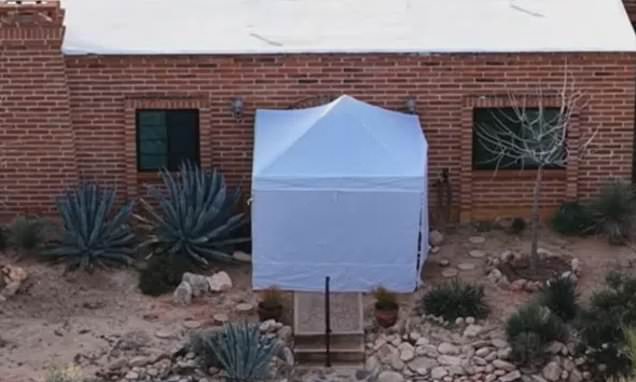
Law enforcement agencies continue to canvas the neighborhoods surrounding Guthrie’s home, placing particular emphasis on brush areas, sheds, and other locations where evidence may have been discarded. White tents remain erected around her property as forensic teams carefully comb through potential clues.
The FBI has repeatedly requested that anyone with information contact their tips line, emphasizing that the reward remains active and that confidentiality will be protected.
Officials have declined to speculate publicly about possible suspects, but the combination of physical evidence, DNA confirmation, and surveillance footage is expected to play a central role in guiding investigative leads.
Broader Reflections and Public Response
The case has prompted discussions about vulnerability among elderly individuals living alone and the importance of neighborhood vigilance. Community leaders in Tucson have called for increased safety measures, especially in suburban areas where elderly residents may be at higher risk.
Families affected by disappearances, including the Guthries and Petito, have emphasized the need for compassion, accuracy, and patience during ongoing investigations. Social media campaigns continue to circulate, urging individuals to report any relevant sightings or information that could aid authorities.
As the investigation progresses, the combination of DNA evidence, surveillance footage, and public cooperation offers hope that Nancy Guthrie will be found safely. Meanwhile, authorities remain focused on piecing together the timeline of events and identifying those responsible for her disappearance.
Conclusion
The discovery of DNA splatter outside Nancy Guthrie’s home represents a pivotal moment in a case that has captured national attention. Forensic experts assert that the evidence suggests a violent encounter, and law enforcement continues to follow leads provided by both the public and investigative analysis.
The case underscores the fragility of safety for vulnerable individuals, the importance of timely forensic work, and the challenges faced by families during high-profile missing-person investigations. As authorities continue their efforts, the priority remains locating Nancy Guthrie and ensuring she receives the medical care and protection she needs.

Emily Johnson is a critically acclaimed essayist and novelist known for her thought-provoking works centered on feminism, women’s rights, and modern relationships. Born and raised in Portland, Oregon, Emily grew up with a deep love of books, often spending her afternoons at her local library. She went on to study literature and gender studies at UCLA, where she became deeply involved in activism and began publishing essays in campus journals. Her debut essay collection, Voices Unbound, struck a chord with readers nationwide for its fearless exploration of gender dynamics, identity, and the challenges faced by women in contemporary society. Emily later transitioned into fiction, writing novels that balance compelling storytelling with social commentary. Her protagonists are often strong, multidimensional women navigating love, ambition, and the struggles of everyday life, making her a favorite among readers who crave authentic, relatable narratives. Critics praise her ability to merge personal intimacy with universal themes. Off the page, Emily is an advocate for women in publishing, leading workshops that encourage young female writers to embrace their voices. She lives in Seattle with her partner and two rescue cats, where she continues to write, teach, and inspire a new generation of storytellers.