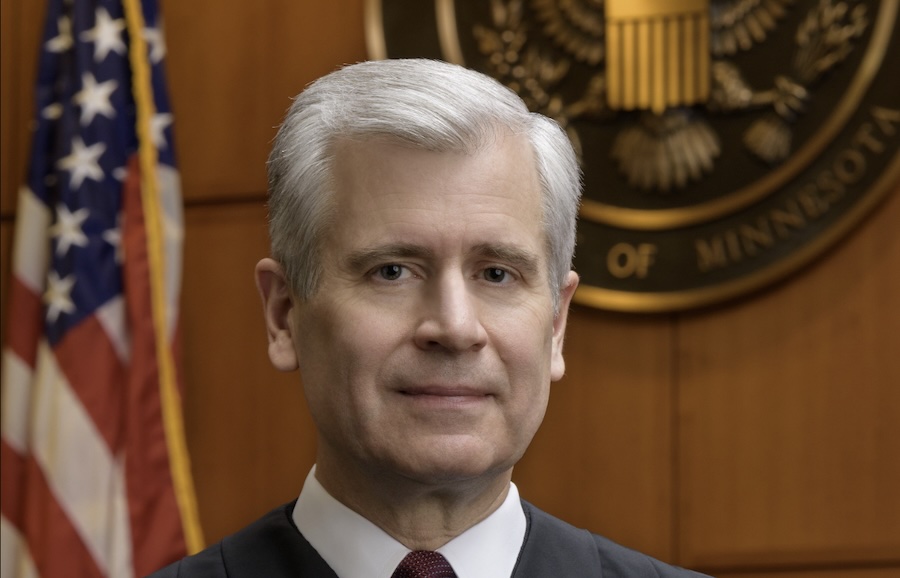
A federal judge who has played a decisive role in several high-profile immigration-related cases is now facing renewed scrutiny following disclosures about his past affiliations with a prominent immigration advocacy organization. The revelations have intensified an already heated debate over the boundaries between judicial impartiality, personal civic involvement, and the enforcement of federal immigration law.
At the heart of the controversy is a series of rulings that have placed the judge squarely in the national spotlight. Those decisions have affected federal immigration authorities, protesters opposing immigration enforcement, and a widely publicized attempt by the Justice Department to pursue criminal charges connected to a protest inside a Minnesota church. For supporters of aggressive immigration enforcement, the rulings reflect troubling judicial overreach. For critics of federal enforcement tactics, they represent a necessary check on executive power.
The latest development adds a new layer to that debate.
Records reviewed by national media outlets indicate that the judge was previously listed as both a donor and a volunteer for the Immigrant Law Center of Minnesota, a nonprofit organization that provides free legal services and advocacy for individuals living in the United States without legal status. The organization has a long history of challenging federal immigration policies in court and publicly opposing Immigration and Customs Enforcement operations.
Although the involvement dates back several years and predates the judge’s most recent rulings, critics argue that the connection raises legitimate questions about perceived bias—particularly given the judge’s central role in cases directly involving immigration enforcement and protests against it.
The judge’s defenders, however, caution against conflating past civic engagement with present judicial misconduct. They argue that federal judges routinely have backgrounds that include advocacy, nonprofit work, or legal representation tied to controversial issues, and that ethical rules focus on current conflicts of interest rather than past affiliations.
Still, the timing of the disclosure has proven politically combustible.
The judge has recently become a focal point of national attention after threatening to hold the sitting director of Immigration and Customs Enforcement in contempt of court. That move followed a dispute over federal immigration operations in Minnesota, where enforcement actions triggered protests, legal challenges, and sharp criticism from state and local activists.
In ordering the ICE director to appear personally in federal court, the judge signaled a willingness to directly confront executive branch officials—a step immigration advocates applauded and enforcement supporters condemned as unprecedented judicial interference.
Critics argue that the threat of contempt represents an aggressive escalation against federal officials carrying out laws passed by Congress. Supporters counter that federal agencies are not immune from judicial oversight and must comply with court orders, regardless of political pressure.
The judge’s decisions have also drawn attention because of his role in a separate case involving a controversial protest at a church in St. Paul. The incident involved demonstrators who entered the church during services to protest the pastor’s role as a federal immigration official. Among those present was a well-known media figure who documented the protest while also participating in it.
Federal prosecutors sought arrest warrants, arguing that the protesters interfered with the civil rights of churchgoers. A magistrate judge initially declined to find probable cause. The Justice Department then pursued further judicial review, an unusual step that underscored how seriously it viewed the matter.
The case ultimately landed before the chief judge, who declined to authorize the arrest warrants. In doing so, he effectively halted the Justice Department’s effort to pursue immediate criminal charges against the protesters.
In his ruling, the judge acknowledged that the request from prosecutors was highly irregular for his district. He noted that the Justice Department retained other legal options, including presenting the case to a grand jury, rather than seeking emergency judicial intervention. The ruling emphasized procedural norms and judicial restraint, rather than endorsing the protest itself.
An appeals panel later declined to intervene, marking a rare instance in which multiple levels of the judiciary rebuffed a federal prosecution effort. While the Justice Department has indicated that it could still pursue charges through other means, the episode underscored the judge’s influence over the trajectory of the case.
It is against this backdrop that the judge’s past ties to the Immigrant Law Center of Minnesota have taken on heightened significance.
The organization is explicit about its mission. It provides free legal representation to individuals facing deportation, advocates for expanded legal protections for non-citizens, and routinely challenges ICE actions in court. Its public messaging frames immigration enforcement as a civil rights issue and calls for systemic reform of federal immigration policy.
For critics of the judge, the concern is not that he once supported a nonprofit organization, but that his rulings appear to consistently align with the priorities of that organization—at least in outcomes, if not in stated reasoning. They argue that even the appearance of partiality can undermine public confidence in the judiciary, particularly in cases as politically charged as immigration.
Legal ethics experts note, however, that federal judges are not required to erase their pasts upon taking the bench. Many have histories as prosecutors, defense attorneys, civil rights advocates, or corporate lawyers. The key ethical standard is whether a judge has a direct, current conflict of interest or stands to benefit personally from a case’s outcome.
There is no evidence that the judge currently maintains any formal relationship with the Immigrant Law Center of Minnesota, nor that the organization is a party to the cases he has ruled on. Nonetheless, the disclosure has fueled calls from some lawmakers and advocacy groups for greater transparency around judicial backgrounds and recusal decisions.
Supporters of the judge argue that his rulings demonstrate adherence to procedural law rather than ideological activism. They point out that he has emphasized constitutional limits, prosecutorial discretion, and established legal processes in his decisions—principles that apply regardless of one’s stance on immigration policy.
They also warn that politicizing judges’ past affiliations risks eroding judicial independence. If judges are subjected to partisan attacks whenever they rule against the executive branch, they argue, the judiciary’s role as a co-equal branch of government is weakened.
The broader conflict reflects a deeper national divide over immigration enforcement itself. As federal agencies increase enforcement efforts, courts are increasingly asked to arbitrate disputes between executive authority, civil liberties, and state or local resistance. Judges operating in this environment are almost inevitably drawn into political controversy, even when their rulings are grounded in narrow legal reasoning.
For now, the judge remains on the bench, continuing to oversee cases that place him at the center of one of the country’s most contentious policy debates. Whether the renewed scrutiny will lead to formal complaints, recusal motions, or legislative action remains unclear.
What is clear is that the intersection of immigration, judicial power, and political trust has become a flashpoint—and that even years-old affiliations can resurface with significant consequences when the stakes are high and the spotlight is unforgiving.

Emily Johnson is a critically acclaimed essayist and novelist known for her thought-provoking works centered on feminism, women’s rights, and modern relationships. Born and raised in Portland, Oregon, Emily grew up with a deep love of books, often spending her afternoons at her local library. She went on to study literature and gender studies at UCLA, where she became deeply involved in activism and began publishing essays in campus journals. Her debut essay collection, Voices Unbound, struck a chord with readers nationwide for its fearless exploration of gender dynamics, identity, and the challenges faced by women in contemporary society. Emily later transitioned into fiction, writing novels that balance compelling storytelling with social commentary. Her protagonists are often strong, multidimensional women navigating love, ambition, and the struggles of everyday life, making her a favorite among readers who crave authentic, relatable narratives. Critics praise her ability to merge personal intimacy with universal themes. Off the page, Emily is an advocate for women in publishing, leading workshops that encourage young female writers to embrace their voices. She lives in Seattle with her partner and two rescue cats, where she continues to write, teach, and inspire a new generation of storytellers.