

Authorities have revealed that the substance allegedly sprayed at U.S. Representative Ilhan Omar during a town hall event in Minneapolis was apple cider vinegar, a common household liquid. While the liquid is not inherently dangerous, the sudden attack startled attendees and prompted an immediate emergency response, highlighting ongoing concerns about the safety of public officials in politically charged environments.
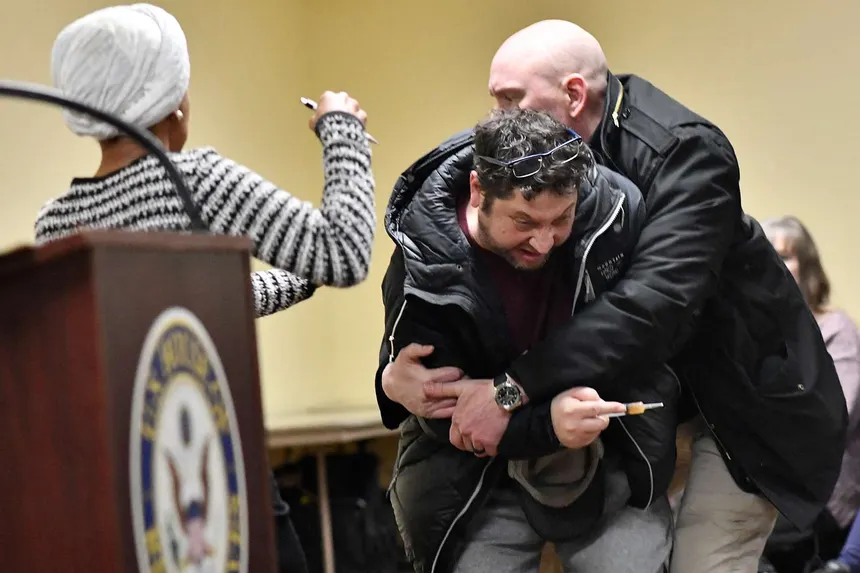
The incident occurred Tuesday evening as Omar addressed questions about federal immigration enforcement and criticized the actions of U.S. Immigration and Customs Enforcement (ICE). According to video footage from the event, a man rushed toward the stage before spraying a liquid across Omar’s chest using what appeared to be a large syringe. The attack occurred within seconds, demonstrating the audacity of the assailant and the urgency of the security response.
Security and police officers quickly intervened, subduing the man and removing him from the venue. He was later taken into custody and booked on suspicion of third-degree assault. Witnesses at the town hall described a strong, vinegar-like smell immediately following the spray, raising initial concerns about potential chemical or physical harm. In response, a hazmat crew was called to assess the scene and examine the liquid. Authorities later confirmed that there was no ongoing threat to public safety and that the substance did not pose a risk to attendees or staff.
Despite the shock of the incident, Omar declined medical treatment and returned to the stage shortly afterward. Addressing the audience, she emphasized that she was unharmed and refused to allow intimidation to silence her or disrupt her work. Her remarks were met with applause, as constituents expressed support and admiration for her composure. The congresswoman’s quick return to the stage underscored her commitment to civic engagement, even in the face of direct threats.
The town hall took place amid heightened political tensions in Minnesota, where recent federal immigration enforcement operations have sparked protests and widespread debate. Omar, a vocal critic of ICE, had been fielding questions about the federal agency’s approach to immigration enforcement, as well as the impact of such operations on local communities. Her discussion also touched on broader questions of accountability and civil rights, topics that have been increasingly contentious in Minnesota over the past several months.
Political leaders across the state condemned the attack, describing it as unacceptable and praising the rapid response by security personnel and law enforcement. Several lawmakers stressed that political disagreements should never escalate into physical confrontations. In public statements, officials emphasized the importance of protecting elected representatives while maintaining open access to public events, noting that threats and intimidation tactics undermine democratic discourse.
Authorities have confirmed that the alleged attacker remains in custody while investigations continue. Police are reviewing his motivations and whether additional charges will be warranted. While the use of apple cider vinegar has eased concerns about serious physical harm, investigators remain focused on understanding whether this was an isolated act or part of a broader pattern of threats directed at elected officials.
The incident has reignited discussions about the safety of public officials and the increasingly tense atmosphere surrounding political events in the United States. In recent years, threats and confrontations involving elected officials have risen sharply, with numerous high-profile cases of harassment, intimidation, and violence. This trend has prompted calls for stronger security measures at public meetings, balanced against the need to maintain access for constituents.
Experts on political violence note that attacks involving non-lethal substances, like the vinegar sprayed at Omar, can still have significant psychological and political consequences. Such incidents can intimidate other lawmakers, staff, and members of the public who attend town halls or civic gatherings, discouraging participation in local government and open dialogue. In addition, these events can exacerbate partisan tensions, especially when they occur in highly polarized contexts such as immigration debates or debates on social justice.
Omar’s experience in Minneapolis is part of a broader national pattern. Across the United States, lawmakers and public officials have faced threats ranging from verbal harassment to physical assaults during public appearances. These incidents have fueled ongoing discussions about the responsibilities of law enforcement, security protocols at public events, and the role of elected officials in maintaining civility and safety while engaging with their constituents.
The Minneapolis incident also highlights the challenge of balancing public accessibility with personal security. Town halls and other civic events are designed to encourage direct engagement between elected officials and constituents. However, as tensions escalate around controversial policy issues such as immigration enforcement, public health, and civil rights, the risk of confrontations—and potential violence—has increased. Experts stress that effective security planning, rapid response teams, and coordination with local law enforcement are critical to mitigating these risks while ensuring that constituents can exercise their democratic rights.
In addition to law enforcement considerations, the incident has drawn attention to the social and political climate surrounding debates over immigration enforcement in Minnesota. Recent operations conducted by ICE and other federal agencies have sparked protests, drawing both local and national attention. Omar has been a consistent voice in these debates, advocating for accountability and oversight of federal immigration actions while emphasizing the human impact on communities, families, and individuals affected by these operations.
The attack on Omar also underscores the potential for politically motivated actions to escalate rapidly in public spaces. While the assailant’s choice of apple cider vinegar may have limited the physical threat, the symbolic nature of the act can have lasting effects on public discourse, generating fear and concern among officials, staff, and constituents alike. Authorities are investigating whether the attack was premeditated and examining the individual’s background to better understand the motivations behind the act.
Community leaders, advocacy groups, and political commentators have weighed in on the incident, expressing both alarm and concern for the safety of public servants. Many emphasized that open dialogue and civic engagement should never be met with intimidation or violence, and that such actions threaten the democratic principles that allow citizens to interact directly with their representatives.
In recent months, local and national officials have increasingly called for enhanced security protocols at public events, including town halls, community forums, and other gatherings where political issues are discussed. Measures such as metal detectors, increased security personnel, and controlled entry points have been proposed, though experts note that maintaining a welcoming and accessible environment remains a key challenge.
The Minneapolis incident involving Rep. Omar illustrates the delicate balance that must be maintained between ensuring safety and preserving the open, participatory nature of American democracy. While officials and staff work to implement appropriate protective measures, elected representatives continue to face the challenge of remaining accessible to their constituents, even amid an increasingly tense and polarized political climate.
As investigations into the incident continue, law enforcement officials are expected to release additional details about the suspect, the sequence of events, and any potential charges beyond third-degree assault. Meanwhile, the incident has sparked broader conversations about political civility, the rise of confrontational behavior in public spaces, and the responsibilities of citizens, media, and public figures in fostering safe and respectful political discourse.
Ultimately, the apple cider vinegar attack on Rep. Ilhan Omar serves as a reminder of the physical and psychological risks associated with public service. It underscores the need for vigilant security protocols, responsive law enforcement, and continued public dialogue about maintaining civility, accountability, and safety in the democratic process. While Omar herself demonstrated resilience and composure in returning to the stage, the incident has raised important questions about how elected officials and communities can navigate contentious political issues without compromising personal safety or the principles of open civic engagement.

Emily Johnson is a critically acclaimed essayist and novelist known for her thought-provoking works centered on feminism, women’s rights, and modern relationships. Born and raised in Portland, Oregon, Emily grew up with a deep love of books, often spending her afternoons at her local library. She went on to study literature and gender studies at UCLA, where she became deeply involved in activism and began publishing essays in campus journals. Her debut essay collection, Voices Unbound, struck a chord with readers nationwide for its fearless exploration of gender dynamics, identity, and the challenges faced by women in contemporary society. Emily later transitioned into fiction, writing novels that balance compelling storytelling with social commentary. Her protagonists are often strong, multidimensional women navigating love, ambition, and the struggles of everyday life, making her a favorite among readers who crave authentic, relatable narratives. Critics praise her ability to merge personal intimacy with universal themes. Off the page, Emily is an advocate for women in publishing, leading workshops that encourage young female writers to embrace their voices. She lives in Seattle with her partner and two rescue cats, where she continues to write, teach, and inspire a new generation of storytellers.