NOTE: VIDEO INSIDE THE ARTICLE
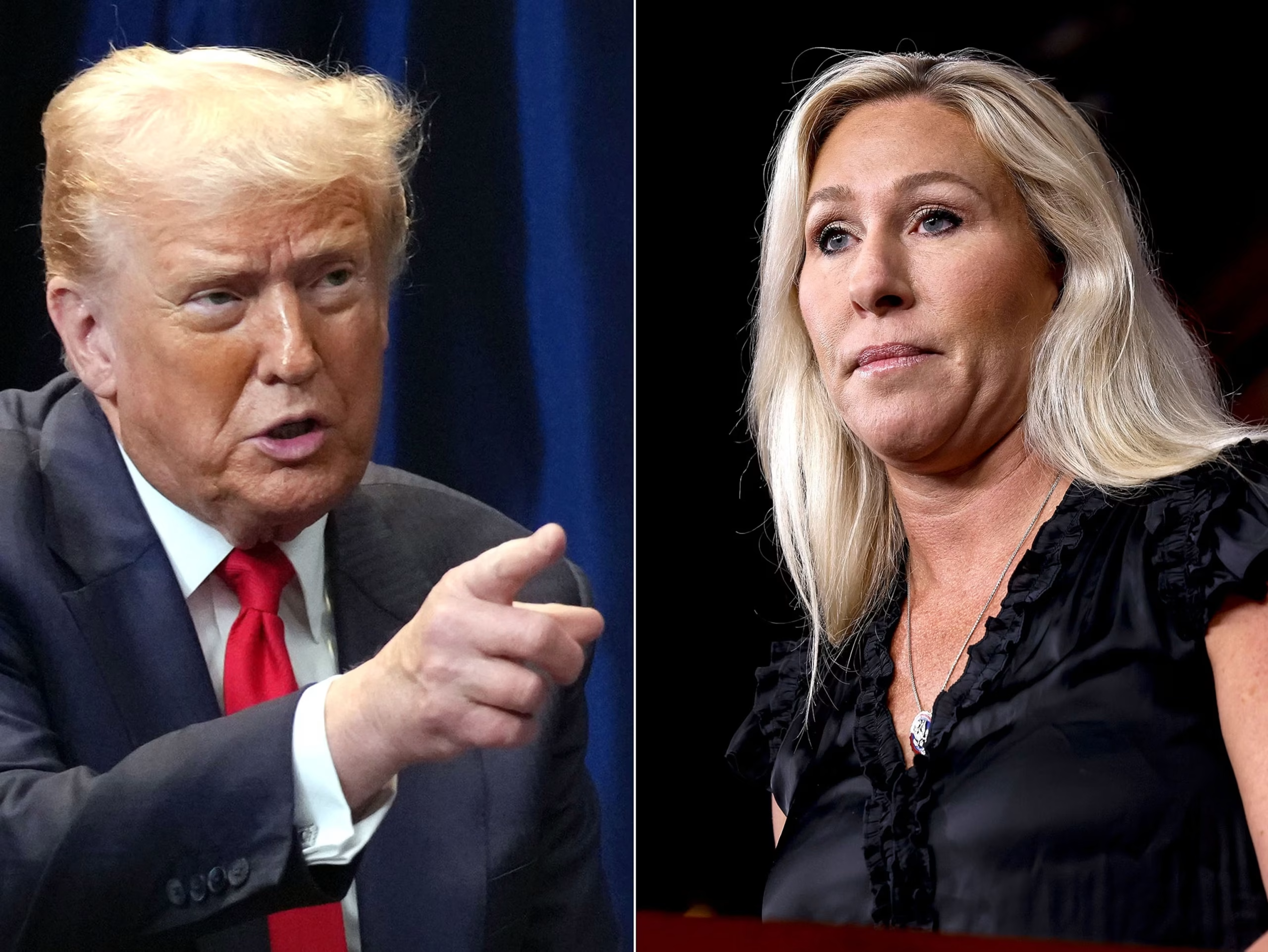
Former Republican congresswoman Marjorie Taylor Greene has launched one of her most explosive attacks yet against President Donald Trump, publicly declaring that the Make America Great Again movement was “all a lie” and accusing the president of abandoning his supporters in favor of wealthy donors, foreign interests, and geopolitical priorities overseas.
In a wide-ranging interview with political commentator Kim Iversen, Greene delivered a blistering critique of the political movement that once defined her career. Speaking with striking bluntness, she claimed that many voters are only now realizing that MAGA never delivered what it promised to ordinary Americans.
“MAGA is — I think people are realizing it was all a lie,” Greene said. “It was a big lie for the people.”
Greene’s comments mark a dramatic rupture with the president she once fiercely defended. For years, she was among Trump’s most vocal allies in Congress, embracing his rhetoric, echoing his grievances, and positioning herself as a loyal enforcer of the MAGA agenda. Her remarks now suggest a complete ideological break — not just with Trump personally, but with the movement itself.
According to Greene, Trump has “turned on his base” and no longer governs with the interests of everyday Americans in mind. Instead, she argued, his focus has shifted to wealthy donors, political insiders, and powerful corporations that benefit from access to his influence.
She alleged that those who financially support Trump’s political operation receive preferential treatment, including government contracts and legal leniency. In her telling, the movement that promised to fight corruption has become indistinguishable from the system it once claimed to oppose.
“Those are the people that get the special favors,” Greene said, referring to major donors and political benefactors. “They get the government contracts. They get the pardons.”
Greene went further, asserting that foreign governments and multinational corporations now wield outsized influence over American policy. She argued that MAGA’s nationalist branding has masked what she described as a globalist reality, in which decisions are driven by what benefits international power structures rather than U.S. citizens.
“It’s the foreign countries that are running the show here,” she said. “It’s the major big corporations and what is best for the world. That’s really what MAGA is.”
One of Greene’s sharpest criticisms focused on what she described as Trump’s misplaced priorities. She accused the president of being more concerned with foreign conflicts than with domestic unrest, specifically pointing to tensions in Minnesota, which she characterized as nearing a breaking point.
“I’m sorry, we’ve got civil war practically breaking out in Minnesota,” Greene said. “Can we not care about that?”
Her remarks echoed a broader populist critique that Trump has increasingly prioritized international strategy over internal stability, a charge that has surfaced among some factions of his former base. Greene framed this shift as a betrayal of the movement’s original promise to put Americans first.
The most controversial portion of Greene’s comments centered on U.S. policy toward Israel and the ongoing conflict in Gaza. In unusually harsh language, she accused Trump of being fixated on Israel while ignoring what she described as mass civilian suffering in Gaza.
“We’re seeing war on behalf of Israel,” Greene said. She claimed that innocent civilians in Gaza were being killed while powerful interests stood to profit from future development in the region.
Greene alleged that Trump and allied business interests were more focused on potential real estate opportunities than on humanitarian consequences, suggesting that reconstruction plans were motivated by profit rather than peace. She accused political leaders of overlooking civilian deaths in pursuit of economic gain.
“Hundreds of thousands of innocent people completely murdered,” she said, alleging that the devastation was being tolerated so that “money can pour in and everyone can get rich.”
Her comments represent a significant departure from mainstream Republican rhetoric on Israel and U.S. foreign policy. They also place Greene in a politically isolated position, as both major parties have largely avoided framing the conflict in such stark, accusatory terms.
Greene’s criticisms did not emerge in a vacuum. Her relationship with Trump deteriorated over the past year, culminating in her resignation from Congress. She announced her departure from public office amid escalating tensions with the president, particularly over his handling of the long-promised release of documents related to convicted sex offender Jeffrey Epstein.
According to Greene, Trump failed to act decisively on transparency issues that mattered deeply to his base, further fueling her sense of betrayal. She has repeatedly accused him of protecting powerful figures rather than exposing wrongdoing, framing the delay as evidence that MAGA no longer serves the people who believed in it.
Her resignation marked the end of a turbulent congressional career defined by controversy, loyalty tests, and constant media attention. Yet her latest remarks suggest she has no intention of fading quietly from the political conversation.
Instead, Greene appears to be repositioning herself as a critic of Trump from the right — a rare and politically risky move. While many Republicans have distanced themselves from Trump cautiously or quietly, Greene’s approach is confrontational and unapologetic, accusing him of moral failure, political dishonesty, and ideological fraud.
PLAY:
The reaction to her statements has been polarized. Some former MAGA supporters view her comments as a long-overdue reckoning with broken promises. Others have dismissed her as bitter, opportunistic, or politically adrift after leaving office. Trump himself has not publicly responded to her remarks, though allies have privately downplayed her influence.
Regardless of how they are received, Greene’s words underscore a growing fracture within the MAGA movement. As Trump continues to dominate the Republican Party, dissent from former loyalists highlights the internal strain between populist rhetoric and the realities of governance, power, and influence.
Whether Greene’s critique resonates beyond her immediate audience remains to be seen. What is clear is that one of Trump’s most outspoken former allies has now declared the movement she once championed a deception — and she is doing so in language designed to leave no room for ambiguity.

Emily Johnson is a critically acclaimed essayist and novelist known for her thought-provoking works centered on feminism, women’s rights, and modern relationships. Born and raised in Portland, Oregon, Emily grew up with a deep love of books, often spending her afternoons at her local library. She went on to study literature and gender studies at UCLA, where she became deeply involved in activism and began publishing essays in campus journals. Her debut essay collection, Voices Unbound, struck a chord with readers nationwide for its fearless exploration of gender dynamics, identity, and the challenges faced by women in contemporary society. Emily later transitioned into fiction, writing novels that balance compelling storytelling with social commentary. Her protagonists are often strong, multidimensional women navigating love, ambition, and the struggles of everyday life, making her a favorite among readers who crave authentic, relatable narratives. Critics praise her ability to merge personal intimacy with universal themes. Off the page, Emily is an advocate for women in publishing, leading workshops that encourage young female writers to embrace their voices. She lives in Seattle with her partner and two rescue cats, where she continues to write, teach, and inspire a new generation of storytellers.