A Cracking Point in the Democratic Messaging Machine
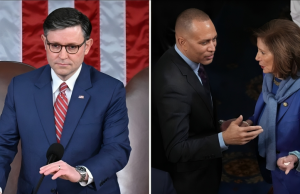
Democrats spent the past year insisting that House Minority Leader Hakeem Jeffries was the “steady hand” guiding their party through the Trump era.
But this week, the narrative broke.
It didn’t shatter because of Republicans.
It didn’t collapse under Trump’s pressure.
It crumbled because MSNBC — the Democrats’ own media safe zone — finally turned the knives inward.
In a highly watched interview on Way Too Early, host Ali Vitali did something MSNBC almost never does: she challenged Jeffries on his record. And not just any part of his record — the one decision Democrats have been terrified to revisit:
Why did Jeffries save Speaker Mike Johnson?
And does he regret it now that the shutdown has humiliated his party?
Jeffries tried to dodge.
He tried to spin.
He tried to paint Republicans as a “subsidiary of the Trump cartel.”
But Vitali didn’t let it go.
And for the first time, Jeffries looked like a man cornered by his own allies.
https://www.youtube.com/watch?v=qCZW_kuxrXU
Jeffries’ Attack on Johnson Backfires — Instantly
Jeffries opened the segment with fire, blasting Speaker Mike Johnson for:
-
Recessing the House during the shutdown
-
Leaving Congress idle for seven weeks
-
Failing to move Democratic priorities
-
And acting, as Jeffries put it, like a servant of “the Trump cartel”
He clearly expected applause from MSNBC.
He got a hammer instead.
The host stopped him and cut straight to the one question he didn’t want:
If Johnson is so irresponsible, why did Democrats save his job last year?
Jeffries froze for a moment — long enough that social media clipped it before breakfast.
Then came his answer:
“No.”
That single word said everything.
But he kept going.
Jeffries insisted that Democrats made the “best possible decision at the time,” claiming they needed Johnson to stay in place to fund Ukraine.
There’s just one big problem.
Ukraine wasn’t an ally.
Congress never declared it one.
And much of the country — especially voters over 60 — sees Ukraine aid as an endless pit of corruption, not a noble mission.
Jeffries didn’t help himself by doubling down, claiming Democrats had to “protect democracy,” even as their own caucus was falling apart.
It was the wrong answer at the wrong moment.
And MSNBC smelled blood.
The Shutdown Fight That Exposed Democratic Weakness
While Jeffries tried to paint Republicans as the problem, everyone watching knew the truth:
Democrats triggered the shutdown.
Democrats dragged it out.
Democrats refused to pass a deal identical to the one they eventually accepted.
For 43 straight days, Democrats stalled over Obamacare subsidies that Republicans had already ruled out as a nonstarter.
They held up:
-
government paychecks
-
airport staffing
-
food stamp guidance
-
federal assistance programs
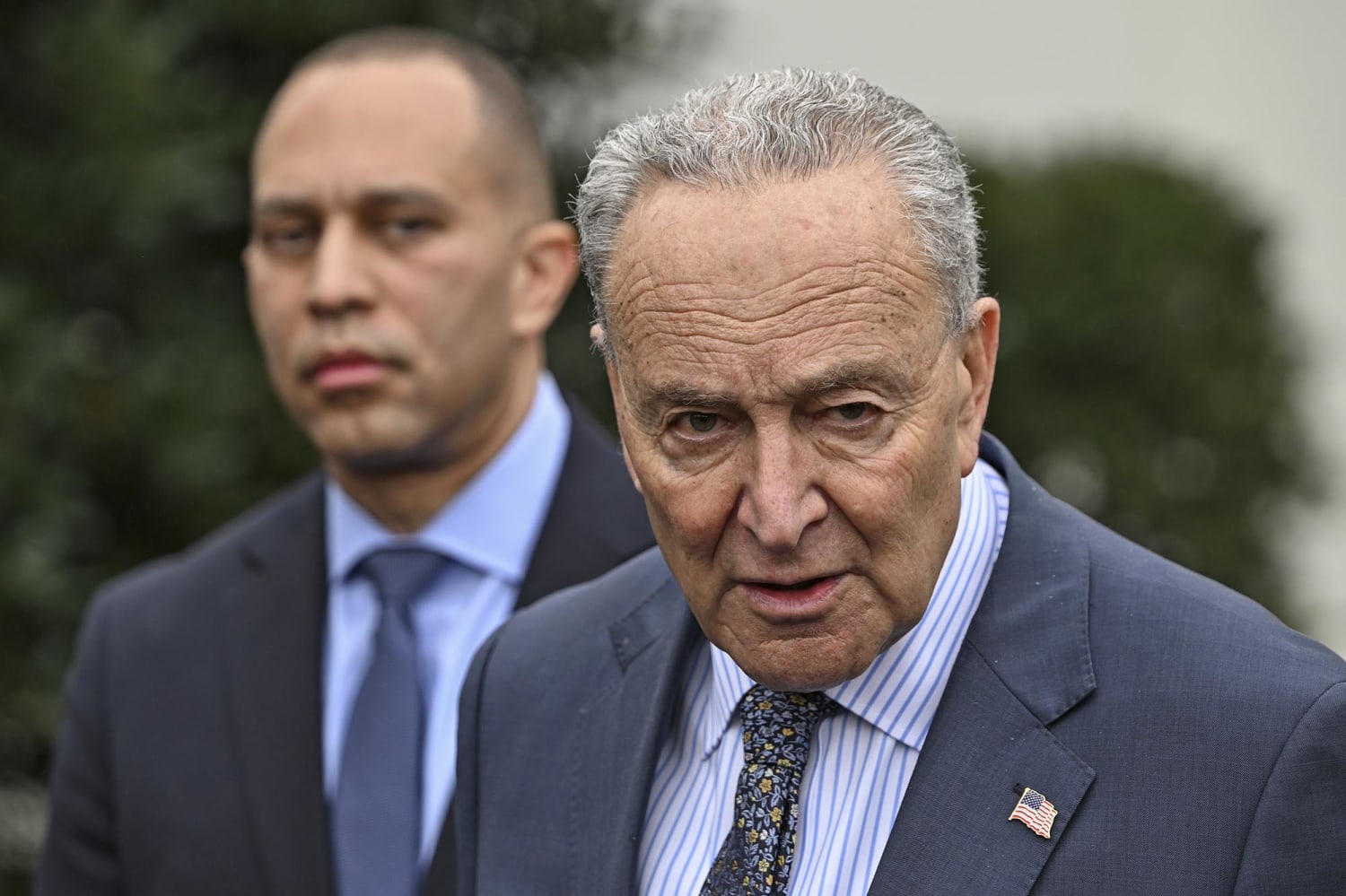
Not because Republicans forced their hand — but because Chuck Schumer and Hakeem Jeffries believed they could break the GOP’s unity.
They bet big.
They lost bigger.
And when the smoke cleared, Johnson stayed Speaker.
Trump stood firm.
Republicans passed the deal almost unchanged.
So when MSNBC confronted Jeffries about why he protected Johnson, the subtext was obvious:
You saved him… for this?
Six Democrats Break Ranks — and Jeffries Looks Weak
While Jeffries spent weeks railing against the bill, six Democrats quietly walked away from him Wednesday night:
-
Jared Golden
-
Adam Gray
-
Henry Cuellar
-
Marie Gluesenkamp Perez
-
Don Davis
-
Tom Suozzi
These members didn’t just drift off.
They made Jeffries look powerless.
They revealed the split inside the Democratic caucus that party leaders have tried to hide for months.
Jeffries couldn’t whip his own team.
Schumer couldn’t hold the line.
The moderates abandoned them both.
That’s why MSNBC finally turned.
The media can sense when a politician loses leverage.
And right now, Jeffries is bleeding influence faster than the party can spin.
Why the Johnson Question Hurts Jeffries the Most
Democrats didn’t just keep Mike Johnson in power — they did it loudly.
Proudly.
Publicly.
Jeffries positioned himself as the adult in the room.
The “protector of democracy.”
The man who could “stabilize” Congress.
Now, a year later, he’s accusing Johnson of being reckless, irresponsible, and subservient to Trump.
That’s why MSNBC finally pushed back:
If Johnson is all those things… why did Jeffries save him?
Why did Democrats bail him out?
And why does Jeffries still defend that decision today?
His answer felt weak.
And viewers could feel it.
Jeffries didn’t save Johnson.
He trapped himself.
Schumer Is Collapsing — and Jeffries Is Next in Line
Behind the scenes, Democrats are furious.
Not at Republicans.
Not at Trump.
At their own leadership.
Schumer is under fire after losing control of the Senate.
Jeffries is now under fire after losing control of the House caucus.
Both men pushed a shutdown strategy that failed.
Both blamed Republicans.
And both are now being confronted by their own side.
Jeffries’ MSNBC moment wasn’t a one-off.
It was a warning shot.
The media that once protected him is signaling that his time may be running out — especially with more Democrats openly calling for internal changes.
And the more Jeffries defends the shutdown disaster, the more he looks like a man covering for his own missteps.
The Ukraine Excuse Made Everything Worse
Jeffries’ defense didn’t just fall flat.
It triggered the exact reaction he didn’t want.
He tried to justify saving Johnson as necessary to:
-
“fund our ally, Ukraine”
-
“defend democracy abroad”
-
“fight authoritarianism”
But MSNBC viewers — even liberal ones — know Ukraine aid is controversial, heavily scrutinized, and riddled with corruption reports.
Older Americans, especially conservative-leaning ones, overwhelmingly oppose endless funding.
Jeffries didn’t sound principled.
He sounded disconnected.
And when he described Ukraine as a “formal ally,” viewers instantly knew he was spinning.
It wasn’t a defense.
It was an admission:
Democrats protected Johnson for political reasons, not national ones.
Democrats Wanted a Shutdown Fight They Couldn’t Win
The shutdown proved something Democrats hoped no one would notice:
They thought Trump would cave.
They thought Republicans would splinter.
They thought public pressure would force Johnson to yield.
Instead:
-
Trump held firm
-
Johnson kept his caucus together
-
Republicans didn’t split
-
Democrats broke first
And now, Jeffries is trying to rewrite the story on MSNBC… only to be corrected by the very network that usually shields his party.
This wasn’t a Republican victory by accident.
It was a Democratic collapse by strategy.
MSNBC’s Shift Means One Thing: Jeffries Has Lost the Narrative
When left-leaning media outlets turn on a Democratic leader, it’s never random.
It’s coordinated.
It’s purposeful.
And it signals something real:
Jeffries is no longer seen as an asset.
He’s seen as a liability.
A leader who couldn’t hold his caucus.
A strategist who misread the shutdown.
A politician who saved the Speaker he now attacks.
A man whose explanations don’t line up anymore.
And MSNBC just said the quiet part out loud.

James Jenkins is a celebrated Pulitzer Prize-winning author whose work has reshaped the way readers think about social justice and human rights in America. Raised in Atlanta, Georgia, James grew up in a community that instilled in him both resilience and a strong sense of responsibility toward others. After studying political science and creative writing at Howard University, he worked as a journalist covering civil rights issues before dedicating himself fully to fiction. His novels are known for their sharp, empathetic portraits of marginalized communities and for weaving personal stories with broader political realities. Jenkins’s breakout novel, Shadows of Freedom, won national acclaim for its unflinching look at systemic inequality, while his more recent works explore themes of identity, resilience, and the fight for dignity in the face of oppression. Beyond his novels, James is an active public speaker, lecturing at universities and participating in nonprofit initiatives that support literacy and community empowerment. He believes that storytelling is a way to preserve history and inspire change. When not writing, James enjoys jazz music, mentoring young writers, and traveling with his family to explore cultures and stories around the world.