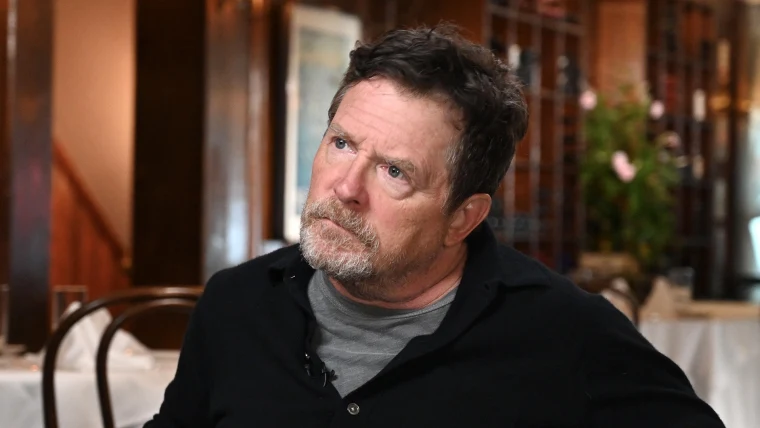
Michael J. Fox was only 29 years old when his life changed forever. In 1991, at the height of his Hollywood ascent, doctors delivered a diagnosis that would quietly follow him for the rest of his days: Parkinson’s disease. At an age when most actors are still chasing momentum, Fox had already become a generational icon. He was the time‑traveling hero of Back to the Future, the charismatic lead in Teen Wolf, and a rising dramatic presence in films like Bright Lights, Big City. His career appeared limitless. Instead, he was handed a future defined by uncertainty.
More than three decades later, now 65, Fox speaks about that moment with a clarity forged by time. In recent interviews promoting his forthcoming memoir Future Boy, the actor reflected not only on his long battle with the incurable neurodegenerative condition, but also on the way he hopes his story will ultimately end. His words are neither morbid nor melodramatic. They are calm, honest, and deeply human.
“I’d like to just not wake up one day,” he said. “That’d be really cool.”
It is not a declaration born of despair. It is the voice of someone who has spent more than half his life adapting to a body that no longer obeys him, someone who understands the fragility of control and the dignity of quietness. Fox does not envision a dramatic exit. He does not want his final moments shaped by a fall, a sudden injury, or a chaotic accident caused by unsteady movement. He wants peace. He wants simplicity.
When Fox first learned of his diagnosis, Parkinson’s was little more than an ominous word to him. In his 2002 memoir Lucky Man, he admitted how terrified he felt. “I was so scared. I was so unfamiliar with Parkinson’s. I only knew it as this thing that would end my working life and everything I loved doing.” The disease carried an image of inevitability, of slow erosion, of identity slipping away.
Parkinson’s is a progressive disorder that affects the brain and nervous system. Over time, it impairs movement, balance, and coordination. Tremors, stiffness, and difficulty walking are common. Cognitive changes can follow. Unlike many illnesses, it does not unfold along a predictable path. There is no neat sequence of stages, no reliable timeline. Each person’s experience is different.
Fox has come to understand this unpredictability as one of the disease’s defining traits. “There’s no timeline,” he explained. “There’s no series of stages that you go through—not in the same way that you would, say, with prostate cancer. It’s much more mysterious and enigmatic.”
That mystery shaped the early years of his diagnosis. For a time, Fox retreated from public view, trying to preserve both his privacy and his career. He continued working in secret, hiding tremors, scheduling shoots around medication cycles, and relying on sheer willpower to maintain the illusion of normality. Eventually, in 1998, he went public. The relief was profound.
What followed was not a withdrawal from life, but a reinvention of it. Fox became one of the most visible advocates for Parkinson’s research, founding the Michael J. Fox Foundation in 2000. The organization has since raised billions for scientific studies and treatment development, transforming the landscape of Parkinson’s research. In many ways, Fox traded the role of movie star for something more enduring: that of catalyst.
Yet even with purpose, the disease has continued to advance. Fox no longer works in the way he once did. He still appears occasionally on screen, but his body imposes limits he cannot negotiate with. “I can walk,” he says, “but it’s not pretty and it’s a bit dangerous.” Falls have become more common. Injuries linger. Every movement carries risk.
Rather than deny this reality, Fox folds it into his life with humor and grace. He acknowledges what he has lost without surrendering what remains. That balance—between acceptance and defiance—has become his defining trait.
He is also deeply rooted in family. Fox and his wife, actress Tracy Pollan, have been married for over three decades. They share four children: one son and three daughters. Their relationship, born on the set of Family Ties, has endured the pressures of fame and illness alike. Fox often speaks of Pollan as his anchor, the person who steadied him when fear threatened to take over.
Parenthood, too, reshaped his understanding of time. A diagnosis in your twenties feels like theft. A diagnosis in middle age becomes a negotiation. A diagnosis in later life becomes a meditation on legacy. Fox has lived through all three phases.
His comments about death are not about giving up. They are about agency. About hoping that when the moment arrives, it does so gently. “I don’t want it to be dramatic,” he said. “I don’t want to trip over furniture, smash my head.”
It is a practical concern, voiced without self‑pity. For someone whose career was built on physical expressiveness—on kinetic charm, comic timing, and motion—the slow betrayal of the body is especially cruel. Yet Fox has refused to let that betrayal define him. He has redefined what strength looks like.
Where once he raced through scenes and quipped his way into pop‑culture immortality, he now measures triumph in quieter units: another day without a fall, another conversation, another chapter written. His new memoir revisits the boy who became a star and the man who learned how to live without guarantees.
There is a temptation to frame Fox’s story as tragic. He resists that framing. He acknowledges suffering, but he also insists on meaning. Parkinson’s took something from him, but it gave him a mission. It forced him to confront impermanence earlier than most. In doing so, it sharpened his gratitude.
When he says he hopes to “just not wake up one day,” he is not rejecting life. He is honoring it. He is expressing a wish that the end, when it comes, mirrors the quiet courage with which he has lived the middle.
For more than thirty years, Michael J. Fox has stood in public view as his body changed. He has allowed the world to witness vulnerability without spectacle. He has turned a private struggle into collective progress. And in speaking openly about how he hopes his story ends, he offers something rare in celebrity culture: an unvarnished truth about mortality.
It is not a headline designed to shock. It is a reminder. Even icons age. Even heroes fall. What endures is not the absence of fear, but the way one chooses to live in its presence.
Fox chose honesty. He chose humor. He chose to keep moving—sometimes unsteadily, sometimes painfully, always forward.
And in doing so, he became more than a star. He became a testament to resilience in a world that guarantees none.

Emily Johnson is a critically acclaimed essayist and novelist known for her thought-provoking works centered on feminism, women’s rights, and modern relationships. Born and raised in Portland, Oregon, Emily grew up with a deep love of books, often spending her afternoons at her local library. She went on to study literature and gender studies at UCLA, where she became deeply involved in activism and began publishing essays in campus journals. Her debut essay collection, Voices Unbound, struck a chord with readers nationwide for its fearless exploration of gender dynamics, identity, and the challenges faced by women in contemporary society. Emily later transitioned into fiction, writing novels that balance compelling storytelling with social commentary. Her protagonists are often strong, multidimensional women navigating love, ambition, and the struggles of everyday life, making her a favorite among readers who crave authentic, relatable narratives. Critics praise her ability to merge personal intimacy with universal themes. Off the page, Emily is an advocate for women in publishing, leading workshops that encourage young female writers to embrace their voices. She lives in Seattle with her partner and two rescue cats, where she continues to write, teach, and inspire a new generation of storytellers.