White House Press Secretary Karoline Leavitt has recently found herself at the center of a viral media moment. After a close-up portrait of her appeared in Vanity Fair, the photograph quickly drew attention online for highlighting what appeared to be lip filler injection sites. In response, Leavitt shared a series of behind-the-scenes photographs on Instagram on Wednesday, December 17, offering a glimpse into her preparation for live interviews and aiming to shift the narrative back to her professional role as the White House spokesperson.
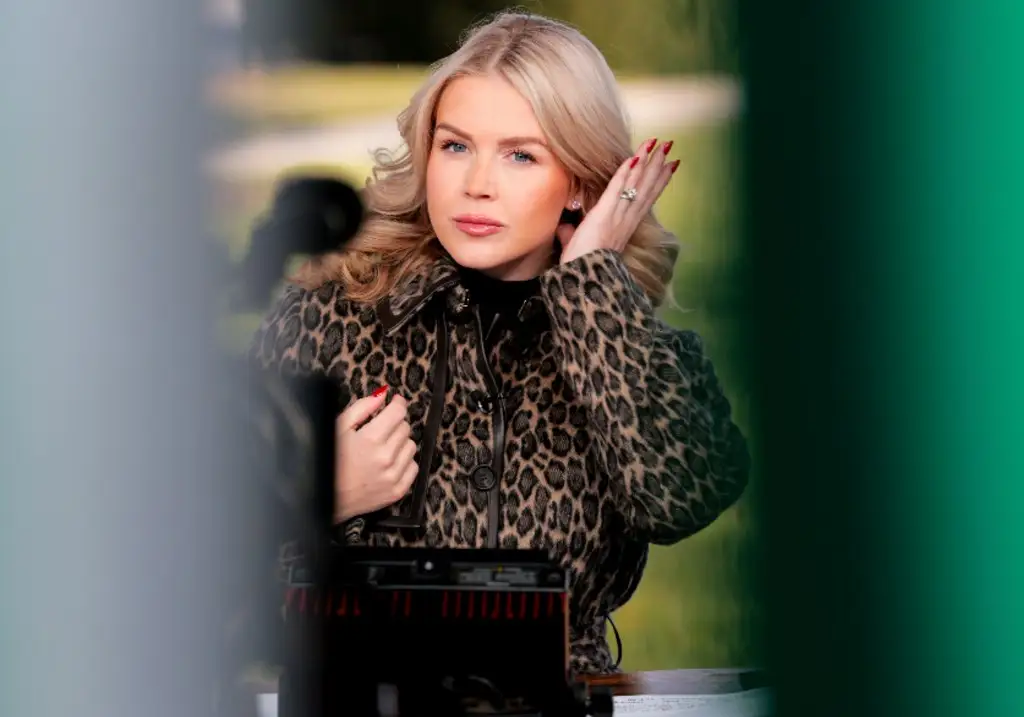
The Instagram post, which captured Leavitt adjusting her hair while standing on the North Lawn of the White House, shows her wearing a leopard-print jacket paired with a black turtleneck and bright red nail polish. The photos appear deliberately casual, providing a stark contrast to the highly stylized, up-close Vanity Fair portrait that went viral the day prior. Leavitt wrote in the caption, “Behind the scenes before a live interview on the North Lawn of the White House, captured by @anna.money 📸.”
The Vanity Fair photoshoot, taken by renowned photographer Christopher Anderson, formed part of a magazine series of interviews with key figures in President Donald Trump’s administration, including White House Chief of Staff Susie Wiles. Anderson is known for extreme close-up portraits, often capturing details that other photographers might overlook. While his portraits are recognized for their intimacy and intensity, the image of Leavitt immediately drew widespread attention online. Commenters on Vanity Fair’s Instagram described the close-up as startling, with some labeling it a “jumpscare” and others remarking that it lacked any kind of “trigger warning.”
In the viral photograph, what appeared to be lip filler injection sites were clearly visible, prompting intense discussion across social media platforms. While the image captured the public’s attention, it also sparked debate about the ethics of extreme close-up portraiture and whether such imagery crosses the line into personal scrutiny. The controversy has raised broader questions about the pressures faced by women in politics and the scrutiny applied to their appearance, especially in high-profile roles such as White House Press Secretary.
Anderson, speaking to The Independent, defended the style of photography, explaining that the approach was consistent with his long-standing work. “Very close-up portraiture has been a fixture in a lot of my work over the years, particularly political portraits that I’ve done over the years,” Anderson said. “I like the idea of penetrating the theater of politics.” He added that the portraits were not intended to demean or embarrass his subjects, emphasizing that he has employed the same style with people across all political stripes, from left to right. Anderson’s portfolio includes close-up portraits of public figures for prestigious outlets such as The New York Times, Esquire, and The Wall Street Journal, highlighting his reputation as a skilled and deliberate portraitist.
Despite Anderson’s explanation, the response to Leavitt’s portrait quickly became a viral sensation. On social media, the image circulated widely, accompanied by both humorous and critical commentary. Many observers focused narrowly on the perceived cosmetic enhancements, while others criticized Vanity Fair for presenting the image without context or sensitivity. The discussion underscored the intense scrutiny female political figures face, where even minor aspects of appearance can dominate public conversation, often overshadowing professional accomplishments or policy expertise.
In response to the viral coverage, the White House issued a strong defense of Leavitt. Spokeswoman Taylor Rogers told PEOPLE, “It is clear that Vanity Fair intentionally photographed Karoline and the White House staff in bizarre ways, and deliberately edited the photos, to try to demean and embarrass them.” Rogers went on to praise Leavitt, describing her as “a beautiful person and truly one of the most incredible people you will meet in politics” and highlighting her effectiveness as the White House Press Secretary. The statement suggested that the administration viewed the coverage not simply as photography, but as an attempt to undermine Leavitt’s professional credibility.
Leavitt, for her part, has not directly commented on the Vanity Fair image or the ensuing online reactions. However, her Instagram post serves as a subtle response, offering a more grounded, behind-the-scenes view of her work. By sharing candid moments of preparation, Leavitt may be seeking to remind the public that her role extends far beyond appearances. The post presents her in action—preparing for interviews, adjusting her hair, and maintaining composure under the constant demands of political life—showcasing the human element often lost in viral moments.
The controversy also highlights broader trends in media coverage of political figures. Female officials, in particular, often face heightened scrutiny regarding appearance, fashion, and cosmetic choices, even as male counterparts are seldom subjected to similar examination. While extreme close-up portraiture can offer intimacy and insight, it can also inadvertently draw attention to personal aesthetic choices, generating disproportionate commentary relative to professional achievements. In Leavitt’s case, the viral attention focused on her lips rather than her responsibilities as the President’s spokesperson or her role in shaping communications strategy for the administration.
Leavitt’s career trajectory provides important context for understanding the stakes of such public scrutiny. At 28, she is one of the youngest individuals to serve as White House Press Secretary in modern history. Known for her poise and quick responses during press briefings, Leavitt has established herself as a highly capable communicator, often acting as the public face of the administration’s messaging on critical issues. Her ability to handle high-pressure media situations, manage messaging for the President, and respond to breaking news is widely acknowledged by colleagues and political observers. Yet, even these professional accomplishments can be overshadowed in moments when viral media coverage emphasizes appearance over performance.
The controversy also raises questions about the role of celebrity-style journalism in modern political reporting. Vanity Fair, a magazine historically focused on culture, fashion, and celebrity, often approaches political figures from a human-interest and aesthetic perspective rather than a strictly policy-driven lens. While this approach can provide unique insights, it also carries risks. As seen with Leavitt’s portrait, the editorial choice to focus on extreme close-up imagery of facial features can spark sensationalist commentary that diverts attention from substantive professional contributions.
Experts in media ethics and political communications note that such coverage can have real consequences for public perception. Dr. Amanda Holbrook, a professor of political communications at Georgetown University, observed, “Visual framing matters tremendously in politics. Images, especially extreme close-ups, carry powerful implicit messages. Even when a photograph is neutral or intended to be artistic, the public often interprets it through cultural expectations, gender norms, and existing biases. This can shape perceptions of competence and credibility unfairly.”
The Leavitt incident is also part of a larger pattern in which social media accelerates and amplifies attention to sensational aspects of public figures’ appearances. While traditional news outlets might report a story in measured tones, viral platforms can rapidly circulate images with minimal context, prompting commentary that ranges from supportive to mocking. In this digital environment, even a single photograph can dominate public discourse and shape broader narratives, often independent of the individual’s actual work or policy positions.
Interestingly, Leavitt’s behind-the-scenes Instagram post contrasts sharply with the stylized Vanity Fair photograph. The informal, candid nature of the images emphasizes authenticity, effort, and professionalism rather than aesthetic perfection. By sharing these moments, Leavitt subtly reasserts control over her public image, reminding followers and critics alike that her identity is not defined solely by appearances or cosmetic choices. Instead, her work as a Press Secretary involves complex responsibilities that require intelligence, strategic thinking, and composure under pressure.
The episode also sheds light on the challenges faced by photographers like Anderson, whose artistic choices can unintentionally provoke controversy. While his intent may be to capture raw, intimate portraits, the public’s interpretation is often unpredictable, particularly in politically charged contexts. The intersection of art, journalism, and politics is fraught with tension: photographers seek to tell compelling visual stories, publications seek to engage readers, and subjects must navigate the consequences of public exposure. In Leavitt’s case, this tension manifested in a viral moment that drew attention to personal features rather than professional accomplishments.
Looking forward, the incident may have several implications. For Leavitt, it underscores the necessity of managing media narratives in an era of viral scrutiny. For the White House, it serves as a reminder of the potential pitfalls when cultural and celebrity-focused publications intersect with political communications. And for the public, it highlights the need for critical engagement with media coverage, recognizing when sensationalism overshadows substance.
While the immediate viral reaction focused on cosmetic speculation, the broader story ultimately concerns professionalism, media literacy, and the responsibilities of both journalists and public figures in a high-stakes political environment. Leavitt’s Instagram post represents a strategic attempt to reclaim the narrative, offering a reminder that behind the viral headlines and sensational commentary lies a dedicated young professional managing the complex communications apparatus of the White House.
As political communication continues to evolve in the digital age, incidents like the Leavitt portrait reveal the delicate balance between public interest, journalistic expression, and personal privacy. Extreme close-up portraiture may offer artistic insight, but it can also magnify scrutiny in ways that disproportionately affect female officials. Leavitt’s response, emphasizing her day-to-day work and humanizing moments behind the scenes, provides an instructive case study in how public figures can navigate and respond to viral media attention while maintaining focus on their professional responsibilities.
In sum, Karoline Leavitt’s viral Vanity Fair moment serves as a microcosm of contemporary political media dynamics. It demonstrates the power of visual media to shape narratives, the pressures faced by young female leaders, and the strategies individuals can use to reclaim control over their image. By sharing candid behind-the-scenes photographs, Leavitt provides context, emphasizes her professionalism, and offers a model for responding thoughtfully to sensationalized media coverage. While the conversation about lip filler and aesthetics may persist online, her work as Press Secretary remains central to her public identity—a reminder that professionalism and dedication can, and should, define a public figure more than viral images ever could.

Emily Johnson is a critically acclaimed essayist and novelist known for her thought-provoking works centered on feminism, women’s rights, and modern relationships. Born and raised in Portland, Oregon, Emily grew up with a deep love of books, often spending her afternoons at her local library. She went on to study literature and gender studies at UCLA, where she became deeply involved in activism and began publishing essays in campus journals. Her debut essay collection, Voices Unbound, struck a chord with readers nationwide for its fearless exploration of gender dynamics, identity, and the challenges faced by women in contemporary society. Emily later transitioned into fiction, writing novels that balance compelling storytelling with social commentary. Her protagonists are often strong, multidimensional women navigating love, ambition, and the struggles of everyday life, making her a favorite among readers who crave authentic, relatable narratives. Critics praise her ability to merge personal intimacy with universal themes. Off the page, Emily is an advocate for women in publishing, leading workshops that encourage young female writers to embrace their voices. She lives in Seattle with her partner and two rescue cats, where she continues to write, teach, and inspire a new generation of storytellers.