
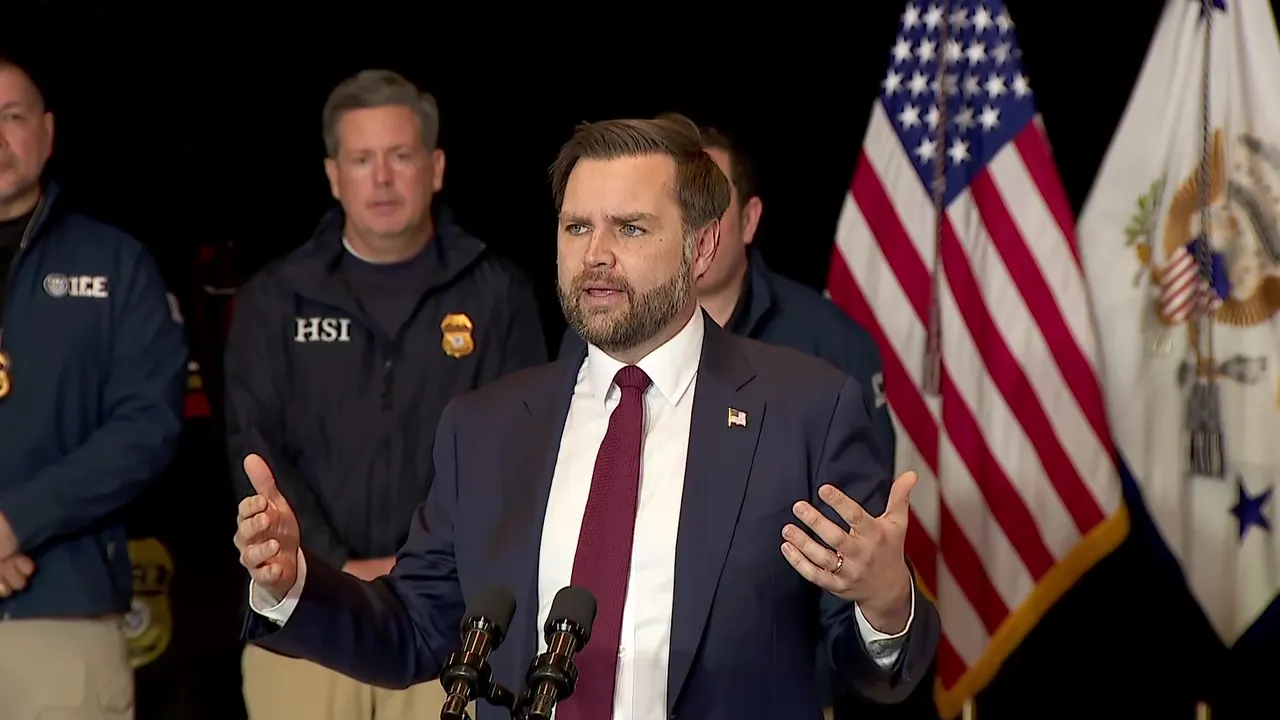
Vice President JD Vance has placed responsibility for escalating unrest in Minneapolis squarely on local leadership, arguing that a lack of cooperation between city officials and federal authorities has turned immigration enforcement efforts into what he described as a uniquely chaotic situation. His remarks came amid mounting outrage over Immigration and Customs Enforcement (ICE) operations in the city that have resulted in the detention of several children and intensified public protests.
Minneapolis has been at the center of national attention following weeks of aggressive ICE activity, including workplace raids, neighborhood patrols, and the detention of families with young children. Reports of ICE agents detaining individuals near schools and residential areas have drawn sharp criticism from educators, parents, and local officials, who say the operations have created widespread fear and instability across communities.
One of the most troubling cases involved a five-year-old preschool student, Liam Ramos, who was detained alongside his father while returning home from school. According to Zena Stenvik, superintendent of the Columbia Heights school district, the incident occurred shortly after dismissal, sending shockwaves through the district. Liam is one of at least four children from the district reportedly taken into ICE custody during recent enforcement actions.
School officials have warned that the emotional toll on students has been severe. Stenvik accused federal agents of operating in ways that place children directly in harm’s way, saying ICE officers had been seen circling schools, following school buses, and entering school parking areas. “Our children are traumatized,” she said. “The community is shaken.”
The ICE activity comes against the backdrop of heightened tension following the fatal shooting of Renee Nicole Good, a Minneapolis resident who was killed by an ICE agent shortly after dropping her six-year-old child off at school earlier this month. The incident intensified public anger and prompted large-scale protests across the city, further straining relations between residents and law enforcement.
During a visit to Minneapolis, Vice President Vance addressed the situation directly, defending federal enforcement actions while criticizing city and state leadership for what he described as deliberate noncooperation. Speaking at a closed meeting that reportedly did not include the city’s mayor or police chief, Vance suggested that local authorities were being instructed to withhold assistance from federal agents.
He questioned how such a breakdown in coordination could be justified, arguing that public safety should transcend political disagreements. Vance framed the issue not as a disagreement over immigration policy, but as a failure of governance. In his view, the refusal of local officials to assist federal law enforcement had created conditions that allowed disorder and violence to escalate.
“What kind of leadership tells local police not to intervene when people are being assaulted or when chaos breaks out?” Vance asked. “That’s not leadership. That’s abdication.”
The vice president made clear that he was not seeking public endorsements from Democratic leaders such as Minnesota Governor Tim Walz or Minneapolis Mayor Jacob Frey. Instead, he said, what the federal government needs is operational cooperation—clear communication, shared intelligence, and coordinated enforcement—to reduce the disruption caused by ICE operations.
Vance argued that Minneapolis stands apart from other major cities where ICE has conducted similar actions. While acknowledging that there have been challenges in cities like Los Angeles and Chicago, he said none have experienced the same level of unrest. According to Vance, the difference lies in how local authorities have responded.
“We don’t see this level of chaos everywhere,” he said. “We don’t see this level of violence everywhere. The common denominator here is the lack of cooperation.”
The administration, Vance said, believes the breakdown in Minneapolis is not accidental but the result of policy choices made at the local level. He pointed to what he described as an adversarial posture toward federal authorities, arguing that it has left enforcement efforts more visible, more disruptive, and more dangerous for everyone involved.
City officials have strongly rejected that characterization.
Shortly after Vance’s remarks, Mayor Jacob Frey held his own press conference, pushing back against the suggestion that Minneapolis bears responsibility for the unrest. Frey accused the federal government of attempting to deflect criticism by shifting blame onto local leaders.
“There’s a messaging problem here,” Frey said. “And it exists because people can see with their own eyes what’s happening.”
Frey disputed claims that ICE operations in the city were targeted or narrowly focused. He argued that detaining parents with young children, or apprehending individuals near schools, contradicts any assertion that enforcement actions are limited to serious criminal threats.
“You cannot say with a straight face that pulling people off the street or entering school areas is targeted enforcement,” Frey said. “It’s not.”
The mayor emphasized that Minneapolis officials have not obstructed federal law enforcement but have sought to protect residents from what they view as excessive and indiscriminate tactics. He stressed that the city’s priority is public safety, particularly for children and families, and warned that aggressive federal actions undermine trust between communities and authorities.
The dispute reflects a broader national divide over immigration enforcement and the role of local governments. While the Trump administration has taken an increasingly assertive approach to immigration, many Democratic-led cities have resisted cooperating fully with federal agencies, citing humanitarian concerns and the potential erosion of civil liberties.
Legal experts note that while federal authorities have the power to enforce immigration law, cooperation from local governments can significantly affect how those laws are implemented on the ground. Without coordination, enforcement actions can become more visible and disruptive, increasing the likelihood of public backlash.
Educators and child advocates have expressed particular concern about the impact on children. Mental health professionals warn that witnessing arrests or experiencing detention can have long-lasting psychological effects, especially for young children who may not understand what is happening.
For families in Minneapolis, the debate has become deeply personal. Parents have reported keeping children home from school out of fear. Teachers say students are distracted, anxious, and struggling to focus. Community leaders warn that trust in public institutions is eroding rapidly.
Despite the mounting criticism, the administration has signaled it does not plan to scale back enforcement efforts. Instead, officials continue to call on local leaders to cooperate, arguing that coordination would reduce chaos and protect both officers and civilians.
As protests continue and investigations into recent incidents move forward, Minneapolis remains a focal point in the national conversation over immigration, federal authority, and local autonomy. Whether cooperation can be restored—or whether the divide will deepen—remains an open question.
What is clear is that the city is grappling with a moment of profound tension, one that has placed children, families, and public institutions at the center of a bitter political and moral debate.

Emily Johnson is a critically acclaimed essayist and novelist known for her thought-provoking works centered on feminism, women’s rights, and modern relationships. Born and raised in Portland, Oregon, Emily grew up with a deep love of books, often spending her afternoons at her local library. She went on to study literature and gender studies at UCLA, where she became deeply involved in activism and began publishing essays in campus journals. Her debut essay collection, Voices Unbound, struck a chord with readers nationwide for its fearless exploration of gender dynamics, identity, and the challenges faced by women in contemporary society. Emily later transitioned into fiction, writing novels that balance compelling storytelling with social commentary. Her protagonists are often strong, multidimensional women navigating love, ambition, and the struggles of everyday life, making her a favorite among readers who crave authentic, relatable narratives. Critics praise her ability to merge personal intimacy with universal themes. Off the page, Emily is an advocate for women in publishing, leading workshops that encourage young female writers to embrace their voices. She lives in Seattle with her partner and two rescue cats, where she continues to write, teach, and inspire a new generation of storytellers.