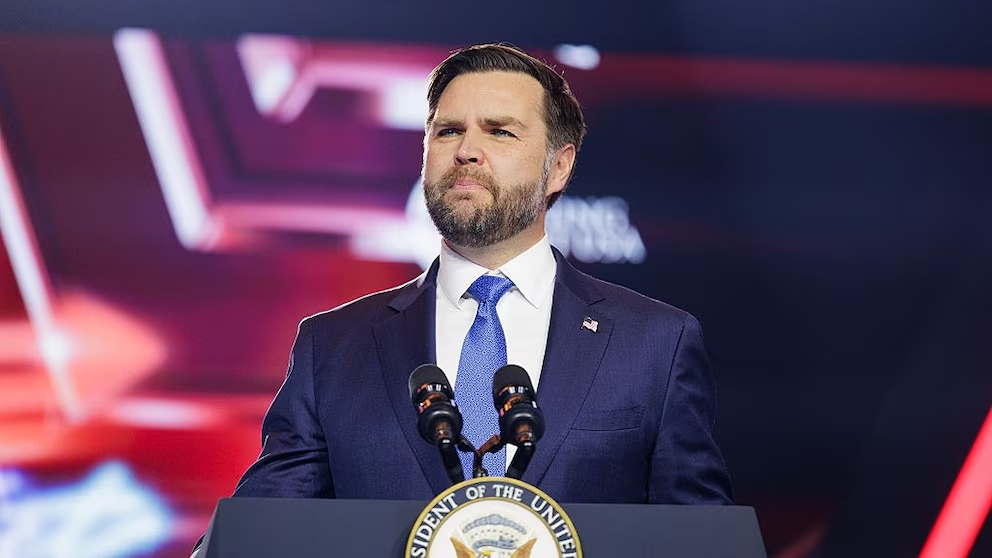
Vice President JD Vance closed out Turning Point USA’s AmericaFest 2025 with a pointed message to a divided conservative movement: stop trying to cancel one another and focus on the larger political and cultural battles ahead.
Speaking on December 21 at the Phoenix Convention Center, Vance addressed the growing tensions that surfaced repeatedly throughout the multi-day event, urging conservatives to resist the impulse to exile ideological rivals from the movement.
“I didn’t come here with a list of conservatives to denounce or deplatform,” Vance told the crowd during the final moments of his address. “We have far more important work to do than canceling each other.”
His remarks capped off a turbulent AmericaFest that featured public clashes among some of the most prominent figures on the political right, including Ben Shapiro, Tucker Carlson, Megyn Kelly, and Steve Bannon. The disputes exposed deep ideological and personal fractures within a movement that has otherwise been riding high following President Donald Trump’s return to the White House.
The gathering was also the first AmericaFest held since the assassination of Turning Point USA co-founder Charlie Kirk in September, an event that loomed heavily over the conference and infused it with both grief and intensity.
Vance explicitly tied his call for unity to Kirk’s legacy.
“The best way to honor Charlie is not to do in death what he refused to do in life,” the vice president said. “He invited debate. He invited disagreement. He invited all of us.”
The plea appeared aimed squarely at the increasingly personal attacks that erupted on the event’s opening day.
Ben Shapiro, speaking shortly after Kirk’s widow and current TPUSA CEO Erika Kirk, delivered a blistering critique of Candace Owens, accusing her of spreading conspiracy theories about Kirk’s murder. Shapiro alleged that Owens had implicated figures ranging from French intelligence agencies to Israeli intelligence services, as well as TPUSA itself, without evidence.
Shapiro extended his criticism to others on the right, faulting Tucker Carlson for what he described as silence on Owens’ accusations and accusing Megyn Kelly of avoiding public condemnation. He also accused Steve Bannon of smearing political opponents by questioning their loyalty to the United States.
“As people with a microphone, we have a moral obligation to call this out by name,” Shapiro said.
The remarks set off a chain reaction.
Carlson responded forcefully in his own speech, accusing Shapiro of attempting to deplatform him and framing the comments as part of a broader effort to sideline Vice President Vance ahead of a potential 2028 presidential race.
“There are people who are mad at JD Vance,” Carlson told the audience. “And they’re stirring this up to make sure he doesn’t get the nomination.”
The timing fueled speculation. Just minutes before Shapiro took the stage, Erika Kirk publicly stated that Turning Point USA would support a Vance presidential bid in 2028. While Vance has not declared his candidacy, his growing influence within conservative circles was unmistakable throughout the event.
Megyn Kelly also pushed back against Shapiro, airing her grievances days earlier during a podcast appearance with activist Jack Posobiec. Kelly said she resented the implication that she was obligated to publicly denounce fellow conservatives on demand.
“I don’t think he gets to decide who must say what to whom and when,” Kelly said. “So I don’t think we’re friends anymore.”
Steve Bannon, speaking at AmericaFest on December 19, fired his own salvo, labeling Shapiro a “hardcore never-Trumper” and accusing him of prioritizing foreign interests over American ones — a charge Shapiro has repeatedly rejected.
Against that backdrop, Vance’s appearance on the final day took on added significance.
Acknowledging the discord without naming names, the vice president argued that disagreement is not a weakness but a defining feature of conservatism.
“This is a movement of freethinkers,” Vance said. “If we all agreed on everything, something would be wrong.”
He urged conservatives to channel internal debate into political action rather than mutual destruction, warning that endless infighting only benefits their opponents.
The speech also underscored Vance’s emphasis on Christianity as a foundational element of American identity — a theme echoed throughout the conference.
As he took the stage, Vance was introduced by Erika Kirk, who assumed leadership of Turning Point USA following her husband’s death. She previously endorsed Vance for president, further fueling speculation about his political future.
Although the 22nd Amendment limits presidents to two terms, some have speculated that President Trump could attempt a third. Trump has publicly dismissed that idea, while floating Vance and Secretary of State Marco Rubio as possible successors. Rubio has said he would not run if Vance enters the race.
While avoiding direct discussion of Republican succession, Vance did comment on the Democratic field, predicting that Democrats would ultimately choose between California Governor Gavin Newsom and former Vice President Kamala Harris.
The vice president’s remarks came after appearances by a long list of prominent Republicans and Trump allies, including Republican National Committee Chairman Michael Whatley, Florida Congressman Byron Donalds, House Speaker Mike Johnson, Arizona gubernatorial candidate Andy Biggs, and Donald Trump Jr.
One of the more unexpected moments of the conference came when rapper Nicki Minaj appeared on stage alongside Erika Kirk. Minaj spoke about her advocacy for persecuted Christians in Nigeria, drawing enthusiastic applause.
“We will speak up for Christians wherever they are in the world,” Minaj said.
The Christian tone of the event was unmistakable. The day began with a worship service, and several speakers referenced faith throughout their remarks.
Pastor Greg Laurie spoke about Vance’s religious journey, noting that the vice president converted to Catholicism in 2019. Vance has spoken openly about raising his children as Christians, while also emphasizing respect for religious freedom. His wife, Usha, is Hindu.
“The only thing that has truly anchored the United States of America,” Vance said, “is that we have been, and by the grace of God always will be, a Christian nation.”
He quickly added that Americans need not be Christian to be patriotic or fully American.
As he concluded, Vance returned to Charlie Kirk, praising him as a model of conviction without exclusion.
“The fruits of true Christianity are men like Charlie Kirk,” he said, prompting chants of “Charlie!” from the crowd.
In a weekend marked by sharp words and public feuds, Vance’s speech offered a closing appeal for restraint — and a reminder that the conservative movement’s internal battles may prove as consequential as the fights it wages beyond the convention hall.

Emily Johnson is a critically acclaimed essayist and novelist known for her thought-provoking works centered on feminism, women’s rights, and modern relationships. Born and raised in Portland, Oregon, Emily grew up with a deep love of books, often spending her afternoons at her local library. She went on to study literature and gender studies at UCLA, where she became deeply involved in activism and began publishing essays in campus journals. Her debut essay collection, Voices Unbound, struck a chord with readers nationwide for its fearless exploration of gender dynamics, identity, and the challenges faced by women in contemporary society. Emily later transitioned into fiction, writing novels that balance compelling storytelling with social commentary. Her protagonists are often strong, multidimensional women navigating love, ambition, and the struggles of everyday life, making her a favorite among readers who crave authentic, relatable narratives. Critics praise her ability to merge personal intimacy with universal themes. Off the page, Emily is an advocate for women in publishing, leading workshops that encourage young female writers to embrace their voices. She lives in Seattle with her partner and two rescue cats, where she continues to write, teach, and inspire a new generation of storytellers.