
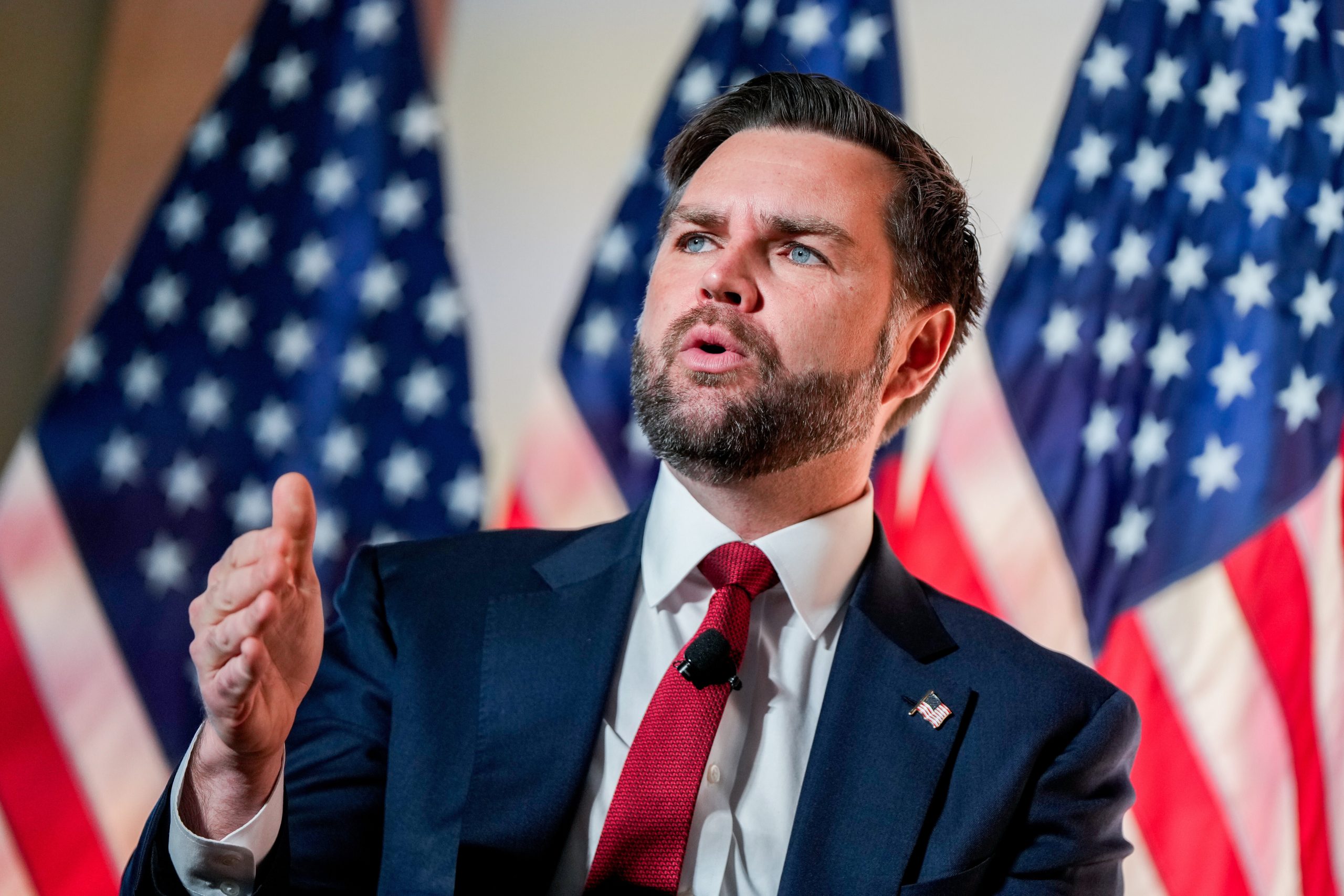
Vice President JD Vance offered a measured response this week when asked whether he plans to run for president in 2028, choosing to downplay the speculation and instead emphasize his commitment to his current responsibilities in office.
Appearing on The Story with Martha MacCallum on Fox News, Vance was pressed on whether he sees himself mounting a bid for the White House at the end of President Donald Trump’s current term. The question has increasingly surfaced in political circles, as Republicans quietly begin positioning themselves for the party’s next chapter.
Vance initially laughed at the suggestion before responding directly.
“One of the things that I don’t like about this question, and this entire perspective, is that I’ve been in this job for a year,” he said. “About a year and six months ago, I asked the American people to give me this job that I have right now. Why don’t I do as good of a job as I can in this job? We’ll worry about the next job sometime in the future.”
His remarks signal an attempt to temper mounting speculation about the 2028 Republican primary while reinforcing loyalty to the current administration. Though he did not explicitly rule out a future run, he avoided engaging in forward-looking political maneuvering.
Rising 2028 Speculation
At 41, Vance is widely viewed as one of the leading figures in the next generation of Republican leadership. Since assuming the vice presidency, he has taken on a visible role in economic messaging, foreign policy discussions and domestic policy outreach.
Alongside Secretary of State Marco Rubio, Vance is frequently mentioned as a potential top-tier contender for the Republican nomination in 2028. Both men are seen as influential voices within the party, though they represent somewhat different stylistic and strategic approaches to Republican politics.
Despite media narratives framing the two as possible rivals, Vance dismissed the notion of internal conflict.
“I think it’s so interesting the media wants to create this conflict where there just isn’t any conflict,” he said during the Fox News interview. “Marco’s doing a great job. I’m trying to do as good a job as I can. The president’s doing a great job. We’re going to keep on working together.”
His comments reflect a broader effort by administration officials to present unity within the Republican leadership team, particularly as Democrats and political analysts speculate about potential fractures ahead of the next presidential cycle.
Trump’s Position on Succession
President Trump himself has added to the intrigue surrounding 2028, though he has stopped short of endorsing any successor.
Speaking to reporters aboard Air Force One earlier this week, Trump declined to weigh in definitively on who might carry the Republican banner after his term concludes.
“It’s something I don’t have to worry about now. I’ve got three years to go,” he said, according to reporting from Bloomberg.
He praised both Vance and Rubio, calling them “fantastic” and commending Rubio’s recent performance at an international security conference in Munich.
By complimenting both figures without signaling preference, Trump appears to be keeping his options open — a strategy consistent with his past approach to party dynamics. His endorsement will likely carry significant weight in determining the eventual Republican nominee.
Constitutional Questions and Third-Term Talk
The discussion of 2028 is further complicated by ongoing conversation among some Trump allies about the possibility of extending his time in office beyond two terms — an idea that faces clear constitutional barriers.
The Twenty-second Amendment to the United States Constitution limits presidents to two elected terms. Additionally, the Twelfth Amendment to the United States Constitution bars individuals who are constitutionally ineligible to serve as president from serving as vice president.
Despite these restrictions, speculation has occasionally surfaced among Trump supporters about potential legal or procedural avenues to allow him to remain in power beyond 2028. Legal scholars, however, widely agree that altering the two-term limit would require a constitutional amendment — a process that demands approval from two-thirds of Congress and ratification by three-quarters of the states.
Former White House strategist Steve Bannon fueled discussion last year when he suggested there were “many different alternatives” to enable Trump to serve again. His comments, made in an interview with The Economist, drew criticism from constitutional experts and lawmakers across the political spectrum.
For his part, Trump has alternated between playful ambiguity and serious rhetoric when addressing the topic. While he has occasionally hinted at the idea of a third term, he has not formally proposed a constitutional amendment or outlined a specific legal pathway.
Vance’s Political Positioning
Against that backdrop, Vance’s comments take on added significance. By declining to engage in 2028 speculation, he signals alignment with the administration’s present priorities rather than positioning himself as a successor-in-waiting.
Political analysts note that vice presidents often walk a delicate line. Openly campaigning for a future presidential bid too early can appear disloyal or distract from governance. At the same time, remaining visible and building a national profile is essential for future viability.
Vance’s remarks suggest a strategy focused on performance rather than projection. By emphasizing competence in his current role, he may be attempting to strengthen his credentials without triggering perceptions of premature ambition.
The vice presidency has historically served as a launching pad for future presidents, though not always successfully. Recent decades have shown that vice presidents can either consolidate party support or struggle to escape the shadow of the administration they serve.
For now, Vance appears content to avoid overt campaign signals.
Party Dynamics Heading Into 2028
Within Republican circles, early maneuvering is already underway, even if formal campaigns are years away. Governors, senators and cabinet officials are quietly cultivating donor networks and policy credentials.
Rubio, a former senator from Florida before becoming secretary of state, has long harbored national ambitions and previously ran for president in 2016. His foreign policy portfolio positions him as a global statesman within the administration.
Vance, meanwhile, represents a newer generation of Republican leadership, with strong ties to the party’s populist wing. His rise from author and venture capitalist to senator and then vice president has been rapid.
The degree to which Trump chooses to influence the next primary contest will shape the field dramatically. His backing could consolidate support behind a single candidate, while his neutrality might open the door to a competitive and potentially divisive primary season.
Looking Ahead
For now, the focus remains on governance rather than campaigning. With three years left in the current presidential term, both Vance and Rubio continue to carry out their respective duties amid domestic policy debates and international challenges.
Vance’s decision to deflect the 2028 question may reflect political prudence. By grounding his response in present responsibilities, he avoids alienating voters who expect elected officials to prioritize current obligations over future ambitions.
Whether that posture holds as 2028 draws closer remains to be seen. Presidential speculation often begins years before formal announcements, and political landscapes can shift rapidly.
But at least for now, the vice president’s message is clear: his attention, he says, is on the job he already has — not the one he might someday seek.

Emily Johnson is a critically acclaimed essayist and novelist known for her thought-provoking works centered on feminism, women’s rights, and modern relationships. Born and raised in Portland, Oregon, Emily grew up with a deep love of books, often spending her afternoons at her local library. She went on to study literature and gender studies at UCLA, where she became deeply involved in activism and began publishing essays in campus journals. Her debut essay collection, Voices Unbound, struck a chord with readers nationwide for its fearless exploration of gender dynamics, identity, and the challenges faced by women in contemporary society. Emily later transitioned into fiction, writing novels that balance compelling storytelling with social commentary. Her protagonists are often strong, multidimensional women navigating love, ambition, and the struggles of everyday life, making her a favorite among readers who crave authentic, relatable narratives. Critics praise her ability to merge personal intimacy with universal themes. Off the page, Emily is an advocate for women in publishing, leading workshops that encourage young female writers to embrace their voices. She lives in Seattle with her partner and two rescue cats, where she continues to write, teach, and inspire a new generation of storytellers.