Five years of welding in Japan—every burn scar on my forearms, every grueling double shift that left me barely standing, every lonely night in a cramped apartment thousands of miles from home—all of it had been worth it because Mom finally had her own home in California. A real place with a yard and sunshine, where she would never have to worry about rent checks or landlords again. A place where she could rest after decades of backbreaking work, tend to the garden she’d always dreamed of having, and live the quiet, peaceful life she had earned through years of sacrifice.
But the day I returned home, nothing looked right from the moment I turned onto her street.
Security cameras watched me from multiple corners of the roof, their black lenses following my approach like mechanical eyes. A sleek keypad gate with a digital screen beeped coldly as I stood there, confused about why such a thing existed at all. The front yard was decorated with expensive outdoor furniture that looked like it belonged in a luxury hotel catalog—the kind of stuff Mom would never in a million years choose or buy for herself. The warm, welcoming home I remembered had been transformed into something cold and sterile.
And when my brother Colin finally opened the front door after I rang the bell twice, his smile was painted on like a theatrical mask, too bright and entirely unconvincing.
“Paul!” he said with exaggerated enthusiasm. “You’re early. We weren’t expecting you until next week.”
His wife Carla appeared behind him in the doorway, floating into view like she owned not just the house but the very air itself. She wore designer athleisure clothing and had her hair done in that expensive way that required salon appointments. “Oh… it’s you,” she said with obvious disappointment, already bored with my presence.
I stepped inside, and my stomach dropped. Mom’s cozy wooden furniture was completely gone. Her beloved reading chair that had been reupholstered three times because she couldn’t bear to part with it, her floral cushions she’d collected over the years, the knitted blankets she’d made during cold California winters while watching her favorite shows—everything that made this place feel like her home had been erased. Replaced with glass tables, chrome accents, and decorative clutter that served no purpose. The house didn’t look like a home anymore. It looked like a showroom, like a place that belonged to someone else entirely.
“Where’s Mom?” I asked, my voice tighter than I intended.
“In the kitchen,” Colin answered too quickly, too casually.
And that simple statement was enough to make my stomach twist with immediate dread.
I walked through the house that should have been familiar but felt alien, past rooms that had been completely redesigned without any consideration for the woman who actually lived here. When I reached the kitchen, I found her standing at the sink in an old, faded apron—her favorite one, yes, but one that was stained with years of use and memories. She was washing a massive pile of dishes with hands that trembled slightly. She looked thin, noticeably thinner than when I’d left five years ago. Smaller somehow. Tired in a way I had never seen before, with dark circles under her eyes and a posture that spoke of exhaustion that went deeper than physical fatigue.
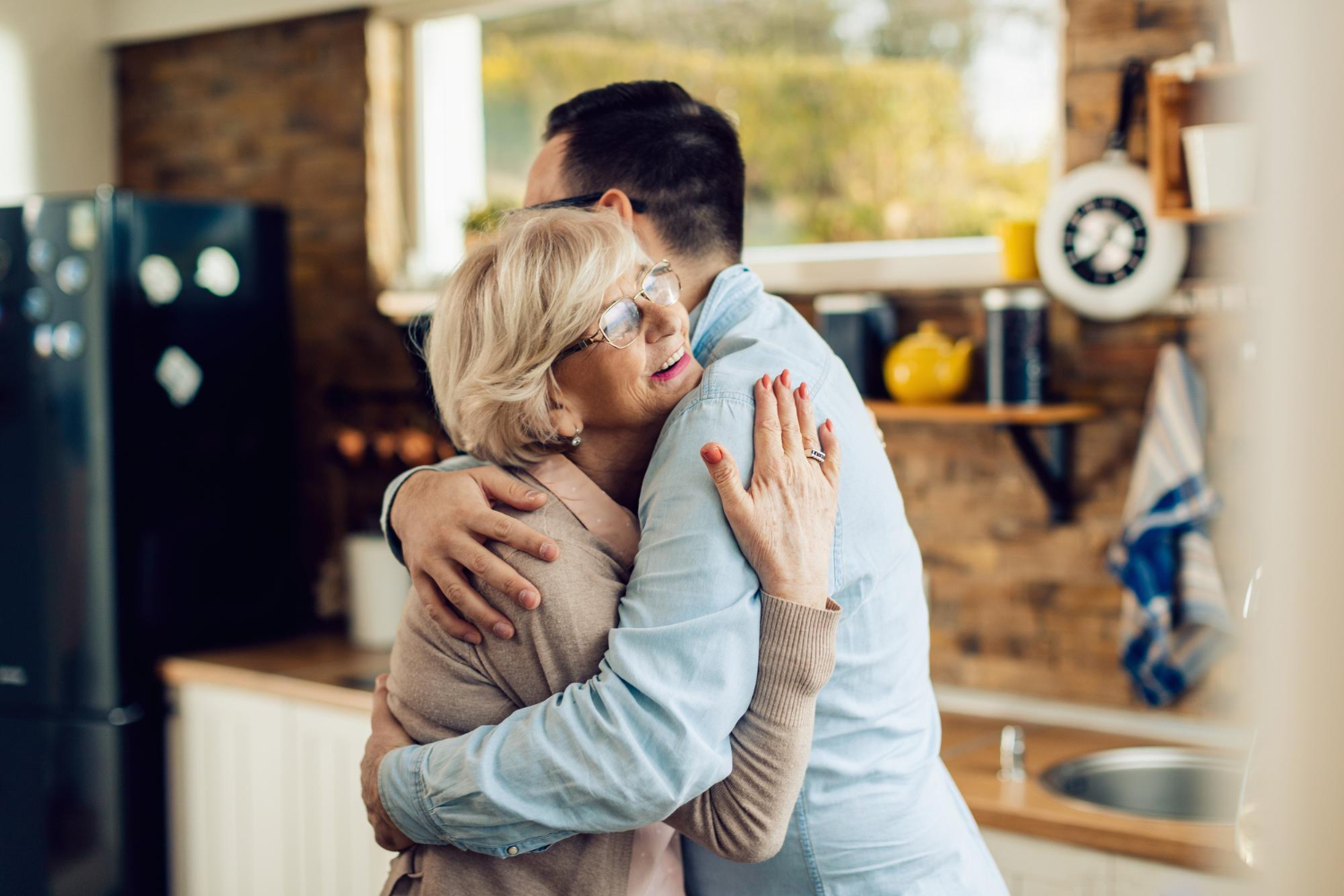
She turned when she heard my footsteps on the tile floor. Her eyes widened in shock, immediately filling with tears she desperately tried to blink away before they could fall.
“Paul? My boy… you actually came home.”
The way she said it broke something inside me. Like she’d stopped believing I would return. Like she’d resigned herself to this new reality.
When I stepped forward to embrace her, Colin suddenly inserted himself between us with surprising speed.
“She likes keeping busy,” he said sharply, his tone defensive. “Helps her feel useful.”
Carla chimed in from the doorway where she’d been watching, “Yeah, we tell her all the time to relax and take it easy, but she absolutely insists on doing everything herself. We can’t stop her.”
The look in Mom’s eyes told me everything they were desperately trying to hide with their casual lies and rehearsed explanations.
She wasn’t “helping out around the house.” She wasn’t “keeping busy because she enjoyed it.” She was serving them. And she was afraid—genuinely afraid—to say otherwise.
That night, I pretended to check into a hotel downtown. I made a show of getting my luggage, saying I’d give them space and come back tomorrow to visit properly. But I didn’t go far at all. Instead, I parked my rental car across the street under the shadow of a large oak tree and watched the house wake up the next morning as dawn broke over the neighborhood.
Mom swept the porch at six-fifteen in the morning. Mom made breakfast at seven, the smell of bacon and eggs drifting through open windows. Mom carried heavy baskets of laundry up the stairs at eight-thirty, struggling with the weight. Mom took out multiple trash bags to the curb at nine, while Colin scrolled mindlessly through his phone on the living room couch and Carla drank iced coffee on the patio like a queen on permanent vacation.
The second day, the pattern repeated with horrifying consistency. Mom was up before anyone else, cooking, cleaning, organizing. Colin and Carla emerged from the master bedroom—my mother’s bedroom, the one with the garden view she’d specifically wanted—around nine-thirty, expecting breakfast to be waiting. They treated her requests for help with annoyed sighs and dismissive waves.
By the third day of surveillance, I knew with absolute certainty that I couldn’t leave her in this situation for another single minute.
The rain came that evening, tapping gently but persistently against the windows of the house. Through the glass, I watched Mom struggling to carry a heavy tray loaded with dinner dishes from the dining room to the kitchen. Her arms shook with the effort, and suddenly the tray tilted dangerously. The clatter of dishes sliding brought Colin running from the living room—but instead of concern for his mother, instead of asking if she was hurt, he barked at her with genuine anger:
“Mom! Be careful! Those plates are expensive! Do you have any idea how much they cost?”
Expensive. Not “Are you okay?” Not “Let me help you with that.” Not “Please sit down, I’ll handle the dishes.”
Just concern about the monetary value of objects.
That single moment was all I needed to see. That was the final piece of evidence that confirmed everything I’d been watching for three days.
I crossed the wet yard in long strides, opened the front door without bothering to knock, and stepped inside my own property.
They froze like statues caught in motion. Carla’s coffee cup stopped halfway to her mouth. Colin’s hand hovered over his phone. Mom stood in the kitchen doorway, holding a dish towel, her eyes wide.
Carla looked offended at the intrusion. Colin looked nervous, like he’d been caught doing something he knew was wrong. Mom looked relieved, like she’d been praying for exactly this intervention.
“I think we should all sit down and have a conversation,” I said softly, but the steel in my voice made it absolutely clear I wasn’t asking or making a suggestion.
Colin laughed awkwardly, trying to regain control of the situation. “Paul, you can’t just walk in here like you own the—”
“I own this house,” I interrupted calmly. “So yes, actually, I can.”
Carla scoffed, setting down her coffee with an aggressive clink. “Well, technically, it was a gift to your mother. And we live here now legally, so you can’t just—”
I ignored her completely. Instead, I placed my weatherproof backpack on the glass coffee table they had purchased with money that should have been Mom’s and pulled out a thick stack of official papers I’d been carrying since my arrival.
“Here’s the deed,” I said, spreading the first document across their expensive table. “Still in my name. I never transferred ownership. Here are the property tax records—paid by me every year from Japan. Here are the utility bills—also paid from my account. And here…”
I slid the final folder directly toward Colin with deliberate slowness.
“…is the signed agreement you wrote and signed before I left for Japan five years ago. The one that explicitly says you and Carla may live here ONLY as long as Mom wants you to, and ONLY if you contribute to household expenses and treat her with respect.”
Carla’s face went pale, all the color draining from her cheeks. “That’s not— that can’t be legally binding—”
“It’s completely legal,” I said evenly. “Digital signatures backed by email confirmation count as legal agreements in California. I had a lawyer verify it before I came here.”
Mom’s voice trembled from where she stood. “Paul… I didn’t want to bother you overseas. You were working so hard…”
“You’re not a bother,” I told her gently, turning to meet her eyes. “You’re my mother. And this is your home.”
Heavy silence swallowed the room. The rain drummed against the windows. Somewhere in the house, a clock ticked.
Then I turned back to her with the most important question.
“Mom… what do YOU want? Not what they want. Not what’s easiest. What do you want for your life and your home?”
She swallowed hard, tears pooling at the corners of her eyes that she’d held back for probably months or even years. She looked around at the home she had slowly been pushed out of piece by piece—the kitchen where she no longer felt welcome to cook her own recipes, the bedroom she’d been told to “share” with a smaller guest room, the living room where she wasn’t allowed to put her feet up on her own furniture. I watched her take it all in, perhaps truly seeing it clearly for the first time.
Then she whispered the words that changed everything:
“I want my home back.”
Carla exploded with theatrical outrage. “You’re choosing HIM over US? After everything we’ve done for you? After we moved across the state to live here and keep you company?”
Mom’s voice was soft but carried an unshakable quality I recognized from my childhood—the tone she used when a decision was final. “Everything you did was for yourselves. You took my home and made it yours. You took my bedroom. You sold my furniture. You made me feel like a guest in my own house.”
Colin tried to interrupt. “That’s not fair, we were just trying to modernize—”
“You have seventy-two hours to move out,” I told them, my voice calm but absolutely final. “Take what’s actually yours. Leave everything that belongs to Mom or that I purchased for this house.”
Colin tried to argue, bringing up fairness and family obligations and how they had nowhere else to go, but even he knew the truth had finally caught up with him. Even he could see that his mother’s expression had changed, that she was done being afraid.
Carla tried a different approach, tears suddenly appearing. “Mom, please, you don’t really want this. Paul’s manipulating you. We’re your family.”
But Mom just shook her head slowly. “Family doesn’t make you feel small in your own home.”
They left at dawn three days later, just as the sun was beginning to paint the sky pink and orange. No goodbye. No apology. No acknowledgment of what they’d done. Just a car and a rental truck full of things that never should have been in this house anyway—the chrome furniture, the expensive decorations, the security equipment that had made Mom feel like a prisoner.
As soon as their vehicles disappeared around the corner, Mom and I stood together on the front porch in the cool morning air and began the work of restoring the home she had lost piece by piece.
I had been prepared for this. During my three days of surveillance, I’d made phone calls, rented a storage unit, and tracked down everything I could. I brought her original furniture back from where Colin had sold it to a consignment shop—her floral sofa that she’d picked out twenty years ago, her solid wooden dining table that had hosted countless family dinners, her bookshelf filled with old cookbooks with food-stained pages and photo albums documenting our family history. We removed every piece of ugly glass décor and every pretentious art piece that meant nothing. We replaced the intimidating keypad gate with a simple white wooden fence she’d always wanted, the kind that welcomed neighbors instead of keeping them out.
By afternoon, the house smelled like her cooking again—her famous tomato sauce simmering on the stove, garlic bread warming in the oven, the scents that defined home for me.
Her laughter returned to the hallways, tentative at first, then growing stronger.
Her footsteps sounded like they belonged again, no longer hurried or fearful.
And for the first time in what must have been years, she sat at her kitchen table—not to serve anyone, not to clean up after others, not to obey demands or meet expectations—but simply to rest with a cup of tea and a book she’d been wanting to read.
That evening, as the sun set and painted the walls golden, she brought me a cup of coffee exactly how I liked it and said in a voice thick with emotion, “Paul… thank you for coming home when you did. Another year and I don’t know if…”
She didn’t finish, but she didn’t need to.
I squeezed her hand gently. “I didn’t come to save you,” I said honestly. “I came to give you back what was already yours. This house, this life, this peace—you earned all of it.”
She smiled then, small but genuine—the smile she used to wear all the time before life had become heavy, before she’d been made to feel like a burden in her own home.
Over the following weeks, I stayed in California, working remotely and helping Mom fully reclaim her space and her life. We repainted the walls in the soft colors she preferred. We planted flowers in the garden—roses and lavender and vegetables she could harvest. We hung family photos on the walls, the ones Colin had put in storage because they “didn’t match the aesthetic.”
Neighbors began stopping by again, people who told me they’d tried to visit over the past few years but had been turned away at the gate by Carla, told that Mom was “resting” or “busy.” They brought casseroles and stories and laughter, and I watched my mother come back to life in a way that had nothing to do with age and everything to do with dignity.
One afternoon, we sat together on her reclaimed porch swing, watching birds visit the new feeder we’d installed.
“You know what I missed most?” she asked quietly. “Not the furniture or even my bedroom. It was the feeling that this was mine. That I could make decisions. That I could wake up in the morning and choose how to spend my day instead of waiting for instructions.”
I nodded, understanding completely. Colin and Carla hadn’t just taken physical space—they’d taken her autonomy, her sense of self, her right to exist in her own home on her own terms.
“It won’t happen again,” I promised her. “I’m setting up everything so you have complete control. The deed is being transferred to your name properly this time, with legal protections. You’ll have your own bank account that only you can access. And I’m staying in California, found a welding job here, so I’m close if you ever need anything.”
She turned to look at me with tears in her eyes. “You’d give up Japan for me?”
“Mom, I went to Japan FOR you. To build you this life. There’s no point to any of it if you’re not happy and safe.”
We sat in comfortable silence as the sun set, painting the California sky in shades of orange and purple.
Colin called once, about two weeks after they’d left. I answered, curious what he’d say.
“Paul, we need to talk about Mom,” he started. “Carla and I have been discussing it, and we think we were all too hasty. We’d like to come back and work things out properly.”
“No,” I said simply.
“What do you mean, no? She’s our mother too.”
“Then act like it,” I replied. “You treated her like unpaid help in her own home. You took advantage of her kindness and her reluctance to cause conflict. You made her small.”
“That’s not fair—”
“You have her number,” I interrupted. “If you want a relationship with her, you can call her, apologize sincerely, and work to rebuild trust. But you will never live in her house again. That chapter is closed.”
He hung up without another word. He never called Mom. Neither did Carla.
Six months later, Mom hosted Thanksgiving dinner in her fully restored home. She invited neighbors, old friends, people from her church, and me. The house was full of warmth and laughter and the smells of turkey and pie. She wore a new apron I’d bought her, bright yellow with sunflowers, and she moved through her kitchen with confidence and joy.
As I watched her serve food she’d chosen to make, hosting people she’d chosen to invite, in the home she’d finally reclaimed, I realized something profound:
I hadn’t just reclaimed a house from people who’d taken advantage.
I had reclaimed my mother’s dignity, her freedom, her right to live without fear in the space that was meant to be her sanctuary.
And as she caught my eye from across the room and smiled that genuine, peaceful smile I remembered from childhood, I knew that every burn scar, every lonely night in Japan, every sacrifice I’d made had been worth it.
Not because I’d bought her a house.
But because I’d given her back something far more valuable:
The right to be herself, in her own space, on her own terms.
And no one would ever take that from her again.

Emily Johnson is a critically acclaimed essayist and novelist known for her thought-provoking works centered on feminism, women’s rights, and modern relationships. Born and raised in Portland, Oregon, Emily grew up with a deep love of books, often spending her afternoons at her local library. She went on to study literature and gender studies at UCLA, where she became deeply involved in activism and began publishing essays in campus journals. Her debut essay collection, Voices Unbound, struck a chord with readers nationwide for its fearless exploration of gender dynamics, identity, and the challenges faced by women in contemporary society. Emily later transitioned into fiction, writing novels that balance compelling storytelling with social commentary. Her protagonists are often strong, multidimensional women navigating love, ambition, and the struggles of everyday life, making her a favorite among readers who crave authentic, relatable narratives. Critics praise her ability to merge personal intimacy with universal themes. Off the page, Emily is an advocate for women in publishing, leading workshops that encourage young female writers to embrace their voices. She lives in Seattle with her partner and two rescue cats, where she continues to write, teach, and inspire a new generation of storytellers.