


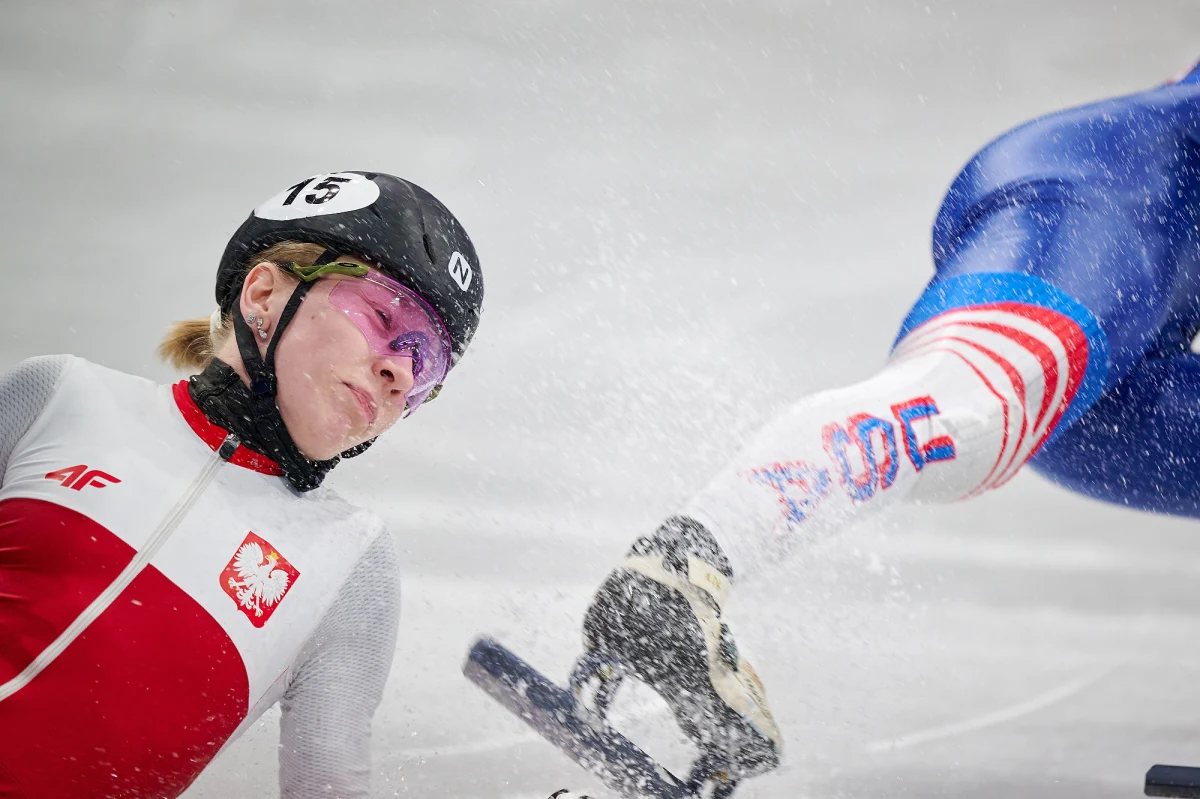
A tense moment at the Milan-Cortina Winter Olympics on Friday left spectators and fellow athletes shocked after Polish speedskater Kamila Sellier was seriously injured during the women’s short-track 1,500 meters quarter-finals. Sellier was slashed near her left eye after a collision with Italy’s Arianna Fontana and American skater Kristen Santos-Griswold, an incident that forced her to be stretchered off the ice and rushed for immediate medical attention.
The dramatic event unfolded when Sellier, 25, was competing for a spot in the semi-finals. Officials later determined that Santos-Griswold committed an illegal lane pass, resulting in a penalty that prevented her from advancing. Fontana, meanwhile, managed to continue racing, ultimately finishing fifth in the final, but Sellier’s run was tragically cut short due to the severity of her injury.
Eyewitnesses reported a trail of blood at the scene, and a large white sheet was held up to shield the skater while medical personnel treated her on-site. Despite the alarming circumstances, Sellier showed a sign of resilience, giving a thumbs-up to the crowd as she was taken off the track.
Immediate Medical Response
Following the incident, Sellier was transported to a nearby hospital where she underwent surgery on Friday evening. Polish Olympic officials released a statement confirming that the procedure was completed successfully and that she was in stable condition. Tests were planned for the following day to assess any potential damage to her eye.
Her teammates were visibly shaken by the accident. Natalia Maliszewska expressed the shock experienced by the Polish team, stating she could “think of nothing else” after witnessing the collision. Gabriela Topolska added that while such incidents are uncommon, Sellier had previously experienced a skate-related injury to the face. Topolska confirmed that the injury required stitches but reassured fans that her teammate’s condition was stable.
On Saturday, Sellier herself provided an update via Instagram, sharing a photo from her hospital bed along with a message of gratitude and strength:
“I know that one day I’ll look at this picture and remember that I’m stronger than I ever believed. Thank you for all your words of support, just wanted to let you know that I’m doing quite okay.”
Her message has since been met with an outpouring of support from fans and fellow athletes around the world, highlighting the admiration for her perseverance and courage in the face of a frightening accident.
Impact on the Competition
The women’s 1,500 meters event continued after the incident, with South Korea’s Kim Gilli claiming gold and teammate Choi Min-jeong taking silver. The United States’ Corinne Stoddard secured bronze, edging out China’s Yang Jingru. Fontana, a decorated Olympian who had already earned two silvers and a gold during the 2026 Games, finished fifth after the collision disrupted her rhythm and concentration.
While the incident did not change the final medal distribution significantly, it underscored the high risks inherent in short-track speedskating, where athletes reach remarkable speeds and collisions can occur with devastating consequences.
Safety and Rules in Short-Track
Short-track speedskating is recognized for its fast-paced and often unpredictable nature. Skaters race on tight, oval ice tracks, navigating sharp turns while maintaining high speeds in close proximity to one another. Because of this, collisions, falls, and accidental blade contact are constant hazards.
The International Skating Union (ISU), which governs short-track competitions, has strict rules regarding lane changes and contact between competitors. Illegal lane passes, such as the one attributed to Santos-Griswold in this race, can result in penalties or disqualifications. Despite these regulations, accidents can still occur, as demonstrated by Sellier’s injury.
Medical staff are always present at competitions, trained to respond to high-risk incidents immediately. The rapid intervention following Sellier’s injury likely prevented more serious outcomes and allowed for prompt surgical care.
Athlete Response and Resilience
Sellier’s calm and reassuring message after the surgery demonstrates the mental fortitude required of elite athletes in the face of sudden trauma. She has already navigated intense international competition and the pressure of representing her country on the Olympic stage, and her response to this incident has further highlighted her strength of character.
Social media users and sports commentators have praised Sellier for maintaining composure, with many highlighting her thumbs-up gesture as a symbol of courage and professionalism. Athletes in high-speed sports often face physical risks, but Sellier’s quick recovery and optimism will likely inspire both fellow competitors and fans alike.
Broader Context
Poland has a proud tradition in short-track speedskating, with athletes frequently achieving top placements in European and world competitions. Sellier’s performances have placed her among the nation’s elite, and she was considered a strong contender in the 1,500 meters event prior to the incident.
Incidents like these, while alarming, are part of the high-intensity environment of Olympic-level sports. They often prompt review of safety protocols and training techniques to minimize future risks. The ISU is expected to conduct an internal review of the collision to determine if any procedural adjustments are warranted for upcoming competitions.
Moving Forward
As Sellier continues her recovery, her participation in remaining events at the Milan-Cortina Games is uncertain. Polish officials have emphasized that the athlete’s health is the top priority and that no decisions will be made regarding competition until she receives further medical evaluations.
For now, the incident has served as a reminder of the physical dangers athletes face in high-speed winter sports. It has also brought attention to the remarkable courage and determination required to compete at the highest level. Sellier’s fortitude in the aftermath of the accident has earned admiration from fans worldwide and has become a testament to the resilience of Olympic competitors.
The 2026 Winter Olympics continue in Milan-Cortina, with athletes across disciplines striving to achieve personal and national milestones. Sellier’s story will remain a key example of the risks and triumphs that define elite sport, highlighting both the skill required to compete and the strength required to recover from unexpected setbacks.

James Jenkins is a celebrated Pulitzer Prize-winning author whose work has reshaped the way readers think about social justice and human rights in America. Raised in Atlanta, Georgia, James grew up in a community that instilled in him both resilience and a strong sense of responsibility toward others. After studying political science and creative writing at Howard University, he worked as a journalist covering civil rights issues before dedicating himself fully to fiction. His novels are known for their sharp, empathetic portraits of marginalized communities and for weaving personal stories with broader political realities. Jenkins’s breakout novel, Shadows of Freedom, won national acclaim for its unflinching look at systemic inequality, while his more recent works explore themes of identity, resilience, and the fight for dignity in the face of oppression. Beyond his novels, James is an active public speaker, lecturing at universities and participating in nonprofit initiatives that support literacy and community empowerment. He believes that storytelling is a way to preserve history and inspire change. When not writing, James enjoys jazz music, mentoring young writers, and traveling with his family to explore cultures and stories around the world.