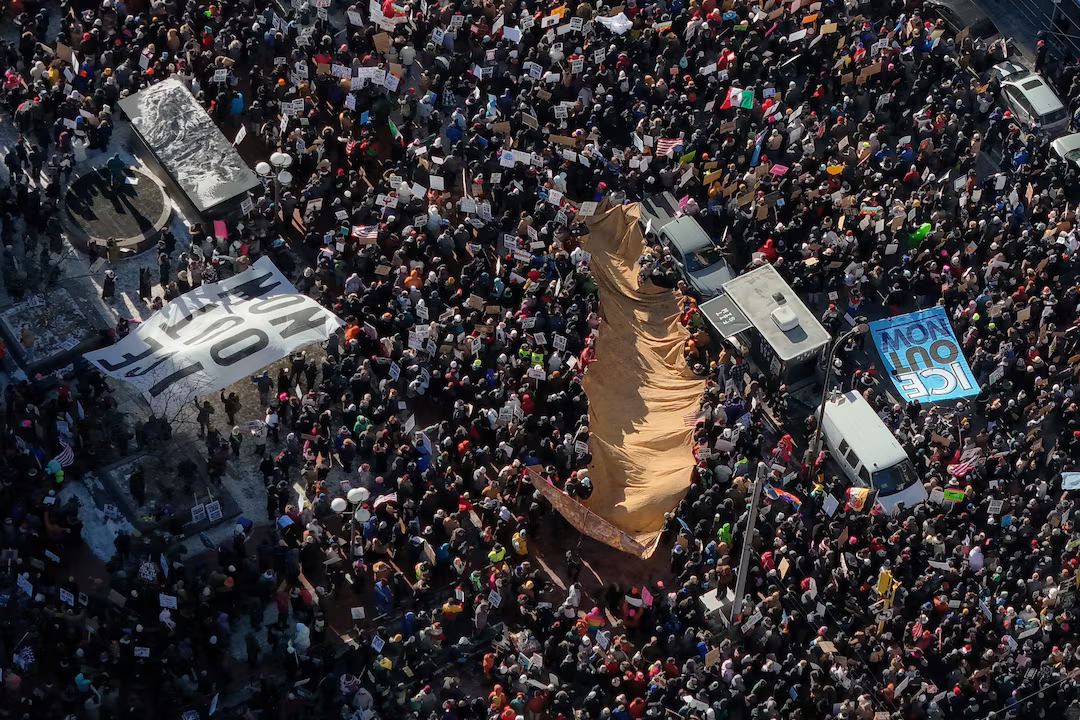
Recent protests in Minneapolis, triggered by federal immigration operations, have become the focus of intense political debate, with some media outlets alleging that organized far-left groups are behind the demonstrations. These protests were sparked by highly controversial federal actions in the city, including the deaths of civilians during immigration enforcement operations, and have drawn attention from across the country. However, while some reports claim that socialist, communist, or Marxist-Leninist organizations are orchestrating the protests, independent reporting suggests that the reality is far more complex and nuanced.
The origins of the protests trace back to the federal immigration operation known as Operation Metro Surge, which was deployed in Minneapolis to address immigration violations. The operation quickly became controversial after multiple incidents in which federal agents shot and killed protesters, including Renee Good and Alex Pretti. These tragic deaths sparked widespread outrage and mobilized hundreds of demonstrators across the Twin Cities and beyond. In response, local and national activist communities organized a series of protests aimed at calling attention to federal overreach, demanding accountability, and advocating for changes to immigration policy.
Some media coverage, particularly from right-leaning outlets, has alleged that the protests were not merely grassroots reactions but were instead coordinated by a network of far-left organizations. These reports claim that groups identifying as socialist, communist, or Marxist-Leninist in ideology utilized encrypted communication channels to organize activists and orchestrate responses to federal enforcement actions. Allegations have also been made that some of these groups received funding from outside sources to support their activities, though these claims have not been independently verified. According to these accounts, the network was able to mobilize demonstrators quickly, amplify messaging on social media, and coordinate the timing of protests to coincide with high-profile incidents, such as federal operations or fatal shootings.
While these claims have drawn attention, independent fact-checking and broader reporting paint a more complex picture. Analysts and journalists emphasize that the Minneapolis protests include a diverse mix of participants, including local activists, community members, unions, civil rights organizations, and concerned residents. Participation is motivated by a variety of factors, such as opposition to aggressive federal immigration enforcement, concern over public safety, and outrage at the deaths caused by federal agents. Observers note that many demonstrators are acting independently rather than under the direction of a centralized or ideologically uniform network. Grassroots mobilization in response to immediate events has been a hallmark of activism in Minneapolis since at least the 2020 George Floyd protests, and much of the recent activity appears to reflect this ongoing pattern.
Further complicating the narrative, some media accounts suggest that certain activist organizations endorsed protests or shared information online about rallies and events. However, endorsement or online communication does not necessarily equate to operational control over all demonstrators. Many participants join events spontaneously or based on local networks and social ties rather than instructions from national or ideological leadership. While encrypted messaging and digital coordination tools are commonly used by modern activist groups to share information or strategize, their presence does not prove illegal activity or indicate that protests are centrally orchestrated.
Independent reporting also underscores that allegations about “paid agitators” or foreign-funded networks are largely unsubstantiated. While some claims suggest external financing may have been involved in certain activities, there is no verified evidence demonstrating that payments were made to individuals to incite or direct protests. Similarly, the suggestion that protests are orchestrated by a unified far-left ideology overstates the degree of coordination observed. Many local residents describe their involvement as a community response to federal enforcement, rooted in solidarity, civic engagement, and advocacy for civil and human rights, rather than participation in a pre-planned ideological campaign.
Law enforcement agencies have noted the use of encrypted communication channels and organized online groups, which some observers view as evidence of coordination. However, authorities have also emphasized that peaceful protest and lawful organization are protected by the First Amendment. Investigations focus primarily on whether any activity crossed into unlawful obstruction or intimidation, rather than the political motivations of participants. The distinction is important, as decentralized organization and online coordination are common in many modern social movements, including environmental, labor, and civil rights campaigns.
Local authorities, community leaders, and activists argue that the Minneapolis protests should be understood in the context of longstanding community activism. Minneapolis has a history of organizing around civil rights, immigrant protections, and police accountability. Grassroots efforts, mutual aid networks, and advocacy for immigrant communities have been integral to local organizing and often inform the way demonstrations are planned and conducted. This perspective emphasizes that while some participants may belong to left-leaning political groups or share ideological sympathies, the protests themselves are not necessarily under the control of any single organization or ideology.
The narrative surrounding far-left involvement has also been shaped by political discourse. Certain outlets and commentators have framed the protests as the product of a coordinated insurgency or extremist network, highlighting the ideological labels of groups that participate in or endorse demonstrations. While these characterizations may attract attention, they often simplify a complex mix of local, national, and individual motivations into a single narrative. In reality, the protests reflect a mixture of local concerns about federal immigration enforcement, broader political activism, and the actions of individuals responding to specific events.
In summary, the Minneapolis protests are a complex phenomenon driven by multiple factors. While media reports have alleged that far-left organizations coordinated or influenced the demonstrations, independent reporting suggests that the protests primarily reflect grassroots activism, community engagement, and responses to federal enforcement actions. Participants include a diverse range of local and national actors, with motivations that extend beyond ideological affiliation. Online communication, group messaging, and organizational endorsements are part of modern activism but do not necessarily indicate central control or illegal activity. Ultimately, the protests highlight tensions between federal enforcement policies and local communities, as well as the broader dynamics of activism in the United States.
The debate over the nature and organization of the protests continues, with differing interpretations depending on political and media perspectives. While some observers emphasize the potential role of organized networks, others focus on the immediate and human response to controversial federal actions. Understanding the protests requires a nuanced view that accounts for both local context and the diversity of participants. It also requires distinguishing between verified evidence of organized coordination and unverified claims or political narratives. Recognizing the range of motivations and structures involved is essential to forming an accurate picture of the protests and the communities engaged in them.
In conclusion, the Minneapolis protests exemplify the interplay between federal enforcement operations, local activism, and media narratives. They have sparked debate over the influence of far-left organizations, the role of decentralized networks, and the nature of modern political mobilization. While some reports allege a coordinated ideological effort behind the protests, broader evidence indicates that they are largely community-driven and responsive to specific events. The situation underscores the importance of distinguishing between verified information and claims, considering the diversity of participants, and understanding the local context that shapes civic engagement and protest activity.

Emily Johnson is a critically acclaimed essayist and novelist known for her thought-provoking works centered on feminism, women’s rights, and modern relationships. Born and raised in Portland, Oregon, Emily grew up with a deep love of books, often spending her afternoons at her local library. She went on to study literature and gender studies at UCLA, where she became deeply involved in activism and began publishing essays in campus journals. Her debut essay collection, Voices Unbound, struck a chord with readers nationwide for its fearless exploration of gender dynamics, identity, and the challenges faced by women in contemporary society. Emily later transitioned into fiction, writing novels that balance compelling storytelling with social commentary. Her protagonists are often strong, multidimensional women navigating love, ambition, and the struggles of everyday life, making her a favorite among readers who crave authentic, relatable narratives. Critics praise her ability to merge personal intimacy with universal themes. Off the page, Emily is an advocate for women in publishing, leading workshops that encourage young female writers to embrace their voices. She lives in Seattle with her partner and two rescue cats, where she continues to write, teach, and inspire a new generation of storytellers.