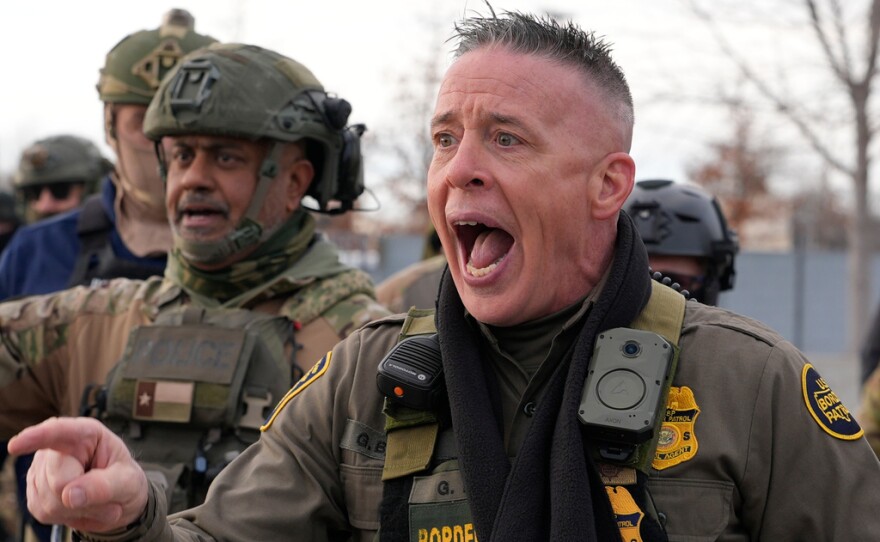
Border Patrol Commander Greg Bovino, who briefly became the public face of the Trump administration’s controversial immigration enforcement surge in Minnesota, has been reassigned and appears to be traveling back toward his home base in California. His departure follows mounting criticism, political pressure, and the fatal shooting of ICU nurse Alex Pretti during a federal operation in Minneapolis.
Bovino, a longtime U.S. Border Patrol official designated as a “commander at large,” arrived in Minnesota earlier this month to help oversee an intensified immigration enforcement effort that brought agents from multiple federal agencies into the Twin Cities. The operation, framed by the administration as a necessary crackdown on illegal immigration and violent crime, quickly drew scrutiny from local officials, civil rights advocates, and residents who accused federal agents of overreach and aggressive tactics.
In recent days, Bovino was spotted traveling west in a convoy of SUVs, with reported sightings in South Dakota and Wyoming before he checked into a hotel in Rapid City. The movements strongly suggest he is returning to California, where he has previously been based and where he is expected to resume duties following his removal from the Minnesota operation.
The reassignment comes after a rapid shift in the White House’s handling of the situation in Minnesota. Bovino had held several high-profile news conferences during his time in Minneapolis and was frequently seen alongside heavily armed agents during public operations. Video footage showing him deploying a smoke canister in a south Minneapolis park became emblematic of the administration’s hardline posture and further inflamed tensions in the city.
Those tensions escalated dramatically after the death of Alex Pretti, a 37-year-old intensive care nurse who was shot and killed during a confrontation with federal agents amid protests. Preliminary findings from a Department of Homeland Security internal review indicated that Pretti did not brandish a weapon prior to being shot, contradicting early claims from senior administration officials that he had posed an immediate lethal threat.
The shooting triggered widespread protests, national media attention, and calls from Democratic lawmakers — and even some Republicans — for accountability and leadership changes within the Department of Homeland Security. As public outrage grew, President Donald Trump signaled a shift in tone, saying he wanted an “honest investigation” into Pretti’s death and emphasizing the need to reduce tensions in Minneapolis.
Shortly afterward, the administration announced that Tom Homan, Trump’s border czar and a central architect of the administration’s aggressive immigration policies, would travel to Minnesota to assume direct oversight of the operation. Homan’s arrival effectively sidelined Bovino, marking a clear change in command and strategy.
Bovino’s reassignment has been interpreted by many observers as an effort by the White House to distance itself from the most visible symbol of the controversial enforcement surge. While the administration has not characterized the move as disciplinary, the timing suggests that political optics and public backlash played a significant role.
During his brief tenure in Minnesota, Bovino strongly defended federal agents, insisting that Border Patrol and ICE personnel were operating lawfully and responsibly. In the immediate aftermath of the Pretti shooting, he described the agents involved as the “victims” of the encounter — comments that drew sharp criticism once body-camera footage and preliminary investigative findings began to emerge.
Local leaders in Minneapolis and across Minnesota repeatedly criticized the federal operation, arguing that agents were conducting warrantless stops, detaining U.S. citizens, and creating fear within immigrant communities. The presence of federal agents near schools, workplaces, and residential neighborhoods intensified anxiety, particularly following the separate fatal shooting of Renee Good, a mother of three who was killed by an ICE agent earlier in the month.
Together, the deaths of Pretti and Good sparked a broader national debate about immigration enforcement under the Trump administration, the use of force by federal agents, and the balance between border security and civil liberties. Civil rights groups have since filed lawsuits challenging the legality of certain enforcement actions in Minnesota, while lawmakers have demanded greater transparency and independent investigations.
Bovino’s return to California marks a sharp contrast to the prominence he briefly held in Minneapolis. Known within Border Patrol circles as a hard-charging commander, he has spent much of his career in leadership roles along the southern border. His designation as a commander at large allowed him to be deployed rapidly to flashpoint situations — a role that placed him squarely in the middle of Minnesota’s political and social unrest.
Despite his removal from the Minnesota operation, federal immigration enforcement in the state is continuing. Under Homan’s leadership, officials have indicated that operations will proceed but with an emphasis on coordination with state authorities and reducing public confrontations. Whether that shift represents a substantive change in policy or merely a change in messaging remains an open question.
For residents of Minneapolis, Bovino’s departure has been met with cautious relief rather than celebration. Many activists argue that removing one commander does little to address systemic issues within immigration enforcement and the broader use of federal power in local communities. Others worry that the reassignment is a temporary measure designed to deflect criticism without altering the underlying strategy.
The White House has not announced Bovino’s next formal assignment, nor has it provided details about how long Homan will remain in Minnesota. Officials have also declined to comment on whether Bovino’s reassignment is permanent or part of a routine rotation of senior personnel.
As Bovino heads west, Minnesota remains a focal point in the national conversation over immigration, policing, and federal authority. The fallout from the deaths of Alex Pretti and Renee Good continues to reverberate, with investigations ongoing and public trust strained.
While Greg Bovino may no longer be the face of the administration’s Minnesota crackdown, the questions raised during his tenure — about accountability, transparency, and the human cost of aggressive enforcement — are unlikely to fade anytime soon.

Emily Johnson is a critically acclaimed essayist and novelist known for her thought-provoking works centered on feminism, women’s rights, and modern relationships. Born and raised in Portland, Oregon, Emily grew up with a deep love of books, often spending her afternoons at her local library. She went on to study literature and gender studies at UCLA, where she became deeply involved in activism and began publishing essays in campus journals. Her debut essay collection, Voices Unbound, struck a chord with readers nationwide for its fearless exploration of gender dynamics, identity, and the challenges faced by women in contemporary society. Emily later transitioned into fiction, writing novels that balance compelling storytelling with social commentary. Her protagonists are often strong, multidimensional women navigating love, ambition, and the struggles of everyday life, making her a favorite among readers who crave authentic, relatable narratives. Critics praise her ability to merge personal intimacy with universal themes. Off the page, Emily is an advocate for women in publishing, leading workshops that encourage young female writers to embrace their voices. She lives in Seattle with her partner and two rescue cats, where she continues to write, teach, and inspire a new generation of storytellers.