I Came Home in a Wheelchair—My Father Slammed the Door: “We Don’t Run a Nursing Home”
“WE DON’T RUN A NURSING HOME.”
My father’s voice cut through the drizzly afternoon like a blade. He stood in the doorway blocking my entrance, his heavy frame wrapped in flannel that smelled like stale beer and cigarettes. His words weren’t angry—they were worse. They were matter-of-fact. Clinical. Like he was explaining why he couldn’t take in a stray dog.
“Go to the VA,” he continued, crossing his arms over his chest. “We don’t have space for cripples here.”
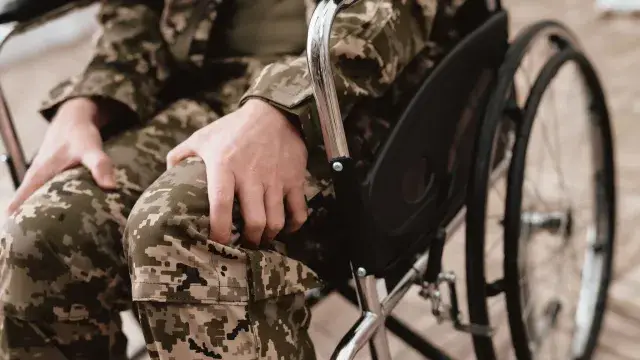
The taxi idled behind me at the curb, exhaust coughing into the grey air. I sat in my wheelchair at the bottom of the driveway—the same driveway I’d shoveled every winter as a kid, back when my legs worked and my biggest worry was whether I’d pass algebra. Now that gentle slope felt like climbing Everest.
I gripped the cold metal rims of my wheels, my calloused palms already aching. I was wearing my dress blues. The uniform was crisp and perfect, every crease sharp enough to cut paper. The medals on my chest caught what little light filtered through the clouds—Bronze Star, Purple Heart, others I’d earned in sand and blood. They gleamed gold and silver.
My father didn’t look at them. Not once.
He looked at the empty space where my legs used to be. His face twisted into something between disgust and inconvenience, like I was a broken appliance he’d have to deal with.
“Dad.” My voice came out smaller than I intended. “It’s me. I’m back. I tried to call but the number—”
“I see that.” Frank—I couldn’t call him Dad anymore, not even in my head—scratched his stomach and took a swig from the beer bottle in his other hand. It was 2:00 PM on a Tuesday. “And I see the chair. We discussed this, Ethan. I told your mother I’m not running a facility here. The VA has beds for people like… you.”
People like me.
“I’m your son,” I said quietly, feeling something crack inside my chest.
“You’re a burden,” he replied, his voice flat and cold as January ice. “And I’m not changing diapers at my age. We finally got the house the way we want it. Turn that chair around and go back where you came from.”
The cruelty wasn’t hot or explosive. It was cold. Practical. Dismissive. The way someone talks about a broken washing machine that’s no longer under warranty.
I looked past his legs into the hallway beyond. The house smelled exactly like I remembered—lemon furniture polish and stale cigarette smoke and something else I couldn’t quite name. Familiarity, maybe. Or the death of it.
I saw a banner taped to the hallway mirror. “WELCOME HOME” in bright letters and balloons drawn in marker.
For one brief, stupid second, my heart leaped. They remembered. They cared.
Then I saw the dog bed underneath it. The water bowl. The chew toys.
It wasn’t for me. It was for Chloe’s new puppy.
Rain started falling harder, soaking through my wool uniform. Cold water ran down the back of my neck, but I barely felt it. My hand moved to the inside pocket of my jacket, fingers touching the folded letter I’d been carrying for three weeks. Across the Atlantic. Through airports. Through rehab sessions where I learned to exist without legs.
I’d planned to present it tonight at dinner. Surprise, Dad. The mortgage is gone. I paid it off with my deployment bonus. You can retire now. You’re free.
The paper felt different now. Not like a gift. Like a weapon.
“You’re right, Dad,” I whispered, more to myself than to him. The words tasted like ashes. “You don’t run this house anymore. I do.”
He didn’t hear me. Didn’t care to.
Behind him, movement. My sister Chloe appeared, sipping an iced coffee from a plastic Starbucks cup, her phone in her other hand. She was twenty-two, beautiful in that high-maintenance way that requires a lot of money and even more attention. She looked at the wheelchair, then at my face, and her nose wrinkled like she’d stepped in something foul.
“Seriously?” She laughed—a harsh, brittle sound that made me flinch. “I literally just finished reorganizing. Ethan, I turned your room into a walk-in closet for my shoe collection. The lighting is perfect in there. Where are you even gonna sleep? The hallway?”
My old room. The place where I kept my baseball trophies from Little League. My model airplanes. The letters from Grandpa before he died. The acceptance letter to college I’d deferred to enlist.
“My room?” I managed, my voice barely above a whisper. “You turned my room into a closet?”
“Well, you weren’t using it,” she said, examining her manicured nails—pink with little gems on them. Must’ve cost fifty bucks. “And honestly, those wheelchair marks are going to ruin the hardwood floors Dad just refinished. Dad, tell him he can’t bring that thing inside. It’s dirty.”
That thing. She called my wheelchair—my legs, my mobility, my independence—a thing.
My grip on the wheel rims tightened until my knuckles went white, until the metal bit into my palms hard enough to leave marks.
Then something small and fast burst through the gap between Frank’s hip and the doorframe.
Leo. My baby brother. Ten years old with a gap-toothed smile and too-long hair that fell in his eyes. He was clutching the faded Superman blanket I’d sent him from Germany two years ago.
“ETHAN!” he screamed, his face splitting into pure joy—the kind of uncomplicated love that adults forget how to feel. He tried to rush toward me with his arms outstretched, but Frank grabbed him by the collar of his t-shirt and yanked him back so hard he stumbled.
“He can stay with me!” Leo yelled, struggling against Frank’s grip, tears already starting in his eyes. “I have bunk beds! He can have the top one!”
Chloe snorted, rolling her eyes. “He can’t climb to the top, you idiot. Look at him. He doesn’t have—”
“Then he can have the bottom!” Leo cried, his voice cracking with desperation. Real desperation, the kind kids feel when the world stops making sense. “I’ll sleep on the floor! I don’t care! Please, Dad, please let him stay!”
“ENOUGH!” Frank slammed his hand against the doorframe. The sound echoed like a gunshot. The glass in the window rattled. “Ethan, get off my porch. You’re scaring the neighbors. Go to that motel on Route 9. We’ll… we’ll talk next week. Maybe.”
Maybe.
Frank stepped back. He looked at me one last time—not with regret, not with guilt, not even with anger. Just annoyance. Like I was a door-to-door salesman trying to sell him something he didn’t want.
He slammed the door in my face.
The deadbolt clicked. Heavy. Metallic. Final. That sound echoed through the quiet suburban street like a period at the end of a sentence I never wanted to read.
I sat there in the rain, water plastering my hair to my forehead, running down my face mixing with something else I refused to acknowledge as tears. I looked at the door—the door I’d sanded and repainted for him three summers ago before I deployed. I looked at the flowerbeds I’d paid to have landscaped as a surprise for my mother’s birthday.
I looked at the house I’d bled for. Literally.
But I didn’t cry. I’d left my tears in a sandbox eight thousand miles away, buried next to Jenkins and Rodriguez and the kid whose name I never learned before the IED turned everything into fire and screaming.
Instead, something cold and hard settled into my chest. Clarity. Pure, crystalline clarity.
I spun the wheelchair around. The rubber wheels hissed on the wet concrete as I rolled back down the driveway—away from the house, away from family, away from everything I thought I’d been fighting for overseas.
The taxi driver was watching me in his rearview mirror. His face was soft with pity, and I hated him for it even though I knew he meant well.
“Where to, soldier?” he asked gently as I collapsed my chair with practiced efficiency and pulled myself into the back seat. My arms were strong now. Stronger than they’d ever been. You learn to compensate.
I pulled out my phone with shaking hands—not from cold, but from adrenaline and something else. Something darker. Something that tasted like revenge but felt like justice.
“The motel on Route 9,” I said, my voice sounding like gravel grinding under tank treads. “And do me a favor? You got a phone book in here? I need the number for the foreclosure department at First National Bank.”
The driver’s eyes went wide in the mirror, but he didn’t ask questions. Smart man.
He handed me the phone book without a word.
The House That Blood Built
Three days later, the rain had stopped but the storm was just beginning.
I sat in a motel room that smelled like mildew and industrial cleaner that couldn’t quite cover the scent of a thousand transient lives lived in this space. The wallpaper was peeling in the corners. The neon sign outside buzzed and flickered with a rhythm that should’ve given me a headache but didn’t—I’d slept through worse in Baghdad.
On the wobbly laminate table sat a microwave dinner—rubbery lasagna that tasted like cardboard—and a stack of legal documents thick enough to stop a bullet.
My phone sat next to the plastic fork. I stared at the screen, waiting.
Across town, inside the house that I had bought with my blood and bone and the legs I’d never walk on again, a celebration was underway. I knew this because Leo was texting me updates from under his bed covers.
Dad and Chloe are screaming happy screams, Leo’s message read. They got a letter from the bank. Dad says we’re rich now. He’s calling people.
I closed my eyes and pictured it. I could see it so clearly it hurt.
Frank would be standing in the kitchen—the kitchen with the new granite countertops I’d paid for two years ago—holding the letter from First National Bank. The letter that said “MORTGAGE SATISFACTION: PAID IN FULL” in bold letters at the top.
He’d be staring at that zero balance like he’d won the lottery.
“It says ‘Paid in Full,’” Frank would mutter, his eyes going wide, that greedy gleam I knew so well already calculating what this meant. “Must be some kind of computer error. Or maybe that class-action lawsuit against the bank finally paid out. I knew those bastards owed us something.”
“Who cares how it happened?” Chloe would squeal, grabbing the paper to photograph it for her Instagram story—carefully cropping out the account number, of course. “That’s like two thousand dollars a month we don’t have to pay anymore! Daddy, that means I can get that Louis Vuitton bag I wanted. The one with the chain. We’re basically rich now!”
Frank would grin—that oily, self-satisfied smile I’d grown up seeing whenever he thought he’d gotten away with something. “Don’t tell anyone about this. If the bank made a mistake, we keep quiet and ride it out. If they don’t catch it in thirty days, it’s legally ours. That’s how it works.”
That’s not how it works. But Frank never let facts interfere with a free lunch.
My phone buzzed again. Another text from Leo.
Mom is crying in her room. She keeps saying your name. But Dad opened a bottle of champagne. Chloe’s posting pictures. They’re planning a party. I miss you.
I typed back quickly: Pack your backpack, buddy. Your favorite toys and clothes. Be ready. I’m coming for you soon.
There was a knock on the motel room door.
“Come in,” I called out.
The door opened and Mr. Henderson stepped inside. He was the branch manager at First National, a thin man in his fifties with grey hair and a grey suit that looked expensive even to my untrained eye. He carried a leather briefcase that probably cost more than my monthly disability check.
He looked around the motel room, his expression pained like he’d just witnessed something obscene.
“Good evening, Mr. Miller,” Henderson said, taking the unsteady chair across from me. He set his briefcase on the table. “You know… considering the sum you just transferred to purchase that property outright, you could have bought a penthouse downtown. Hell, you could’ve bought a nice house in the suburbs. You didn’t have to stay here.”
“I already bought a house,” I said, staring at the documents spread across the table. “I just need to evict the squatters.”
Henderson sighed, the sound heavy with something like sadness. “You’re absolutely certain about this, Ethan? You used your entire deployment bonus. Your disability backpay. The settlement from the injury lawsuit. This is everything you have. Every dollar you’ve earned or been compensated for your service. You’ll be starting over from zero.”
“No,” I said, meeting his gaze. My eyes felt hard. Felt like flint. “This is the price of admission. I want the deed transferred to my name. Sole ownership. Effective immediately.”
“It’s already done,” Henderson said quietly. He opened his briefcase and slid a blue folder across the table. “The wire cleared this morning at 9:00 AM. The previous mortgage under Frank Miller’s name has been satisfied in full. The title transfer is complete. As of this morning, you became the legal owner of 42 Oak Street.”
He slid a pen across the table. Heavy. Expensive. The kind of pen people use to sign important documents.
I picked it up. The scratch of metal on paper was the only sound in the room as I signed my name. Ethan James Miller. The signature was different than it used to be—harder, more aggressive. The signature of someone who’d learned that sometimes you have to fight for what’s yours.
My phone buzzed again.
Dad bought a new TV!!! It’s HUGE. Like 85 inches. He put it on a credit card. Mom said we can’t afford it but he said we can afford ANYTHING now. They ordered lobster for dinner. I don’t like lobster. Can I have pizza when I see you?
I picked up my phone. My thumb hovered over the screen.
Yes, buddy. All the pizza you want. What time is the courtesy call scheduled for? I asked Henderson without looking up.
Henderson checked his watch. “One hour. We always make a courtesy call to confirm the account closure and title transfer. Standard procedure.”
“Good,” I said, turning my wheelchair toward the door. “I’ll be there to welcome them to reality.”
The Party That Became a Funeral
The driveway was packed with cars when I arrived. Frank hadn’t wasted any time. He’d invited his poker buddies, Chloe’s shallow friends, probably anyone who would listen to him brag about his sudden “good fortune.”
I parked the rental van—specially equipped with hand controls, expensive as hell but necessary—down the street in the shadows. I unloaded my wheelchair and rolled toward the house under the cover of early evening darkness.
Through the bay window, I could see everything. The massive new television—still had the price tag visible if you looked close, $3,200. The crowd of people drinking and laughing. The expensive whiskey bottles on the counter that Frank would never have bought a week ago.
Frank stood in the center like a king holding court, his face flushed with alcohol and triumph. He raised his glass.
“To the good life!” he toasted, his voice loud enough I could hear it from outside. “To the system finally working for the little guy! To not being slaves to the bank anymore!”
“To new designer bags!” Chloe cheered, clinking her glass against his. She was wearing what looked like a new dress. Probably bought it this afternoon.
Then the landline rang.
That sharp, old-fashioned trill cut through the music and laughter like a knife through silk. Frank laughed, a booming sound. “Probably a telemarketer. Let me have some fun with them.”
He picked up the receiver and hit the speaker button, grinning at his audience like a comedian about to deliver a punchline.
“Talk to me,” he said, his voice dripping with false confidence.
“Hello, is this the Miller residence at 42 Oak Street?” A professional voice—Henderson’s voice—crisp and clear through the speaker.
“Depends who’s asking,” Frank chuckled, winking at his friends. The crowd laughed.
“This is Mr. Henderson from First National Bank, Foreclosure and Title Transfer Department. I’m calling to confirm the deed transfer details regarding the property located at 42 Oak Street.”
The laughter stopped. The room went quiet so fast you could hear ice melting in glasses.
Frank’s smile faltered. “Transfer? You mean the payoff? Yeah, we got your letter. Paid in full. Thanks for finally getting something right. You can take us off your call list now.”
“Yes, sir, the mortgage was satisfied in full this morning via wire transfer,” Henderson continued, his voice amplified through the room, every word landing like a hammer blow. “The transfer was made by Sergeant Ethan James Miller, service number 2-7-9-4-5-6-2-1. As per the notarized agreement signed this morning, the title has been successfully transferred to his name as sole owner. We’re calling to confirm when the current occupants will be vacating the premises, as the new owner has indicated he’ll be taking immediate possession.”
The silence that followed was absolute. Complete. The kind of silence that has weight and substance, that presses down on your chest and makes it hard to breathe.
Chloe’s wine glass slipped from her fingers. It shattered on the hardwood floor—the floor I’d paid to have refinished last year—splashing red wine across her new white heels like blood.
Frank turned the color of old newspaper. The blood drained from his face so fast I thought he might pass out. “Ethan? What? No, that’s… that’s impossible. He’s broke. He’s a cripple in a wheelchair. He doesn’t have that kind of money. This is a mistake. This has to be—”
The front door opened.
I didn’t knock. Didn’t ring the bell. I used my key—the key I still had on my dog tags, the one I’d carried through three deployments.
The sound of rubber wheels on hardwood—on my hardwood—cut through the paralyzed silence. I rolled into the living room wearing my dress blues, every medal polished to perfection. I looked every inch the soldier despite the chair. Maybe because of it.
Frank stared at me like I was a ghost. His mouth opened and closed but no sound came out. Around him, his guests shuffled uncomfortably, sensing the violence in the air even if they didn’t understand it yet.
“You…” Frank finally stammered, his face going from white to purple in seconds. “You… you bought my house? MY HOUSE?”
I stopped my wheelchair in the dead center of the room, right on the expensive Persian rug they’d bought last year with money they should’ve been putting toward the mortgage.
“Correction, Frank,” I said, my voice steady and cold as a February grave. “I bought MY house. The house I’ve been paying for since I was twenty years old. And I have a very strict ‘no trespassing’ policy.”
“This is insane!” Chloe screamed, breaking through her shock. She stomped her foot—actually stomped it like a toddler—and looked frantically between me and Frank. “Daddy, do something! He can’t just roll in here and say he owns—”
“I have the deed right here,” I interrupted, pulling the blue folder from my lap. I tossed it onto the coffee table. It landed with a heavy thud next to the expensive whiskey, next to the champagne, next to all the things they’d bought celebrating money that was never theirs. “Read it. Every word. It’s all legal. All binding. All mine.”
Frank lunged forward and grabbed the folder like it was on fire. His hands shook as he tore it open, his eyes scanning the legal jargon, the notary stamps, the signatures. His face went through a journey—confusion to understanding to rage to something that looked like despair.
“You… you ungrateful little…” His voice shook. “I raised you! I put food on your plate! I gave you a roof over your head!”
“And I bought that roof,” I shot back, my voice sharp enough to cut. “For ten years, Frank. Ten years I sent money home. Every month. Where did it go? Gambling? Booze? Chloe’s shopping addiction? Because it sure as hell didn’t go to the mortgage. The bank had to tell me you were six months behind. Six months! I had to pay the full principal balance just to keep them from foreclosing. So don’t talk to me about gratitude.”
“You can’t do this!” Chloe shrieked, tears streaming down her face—tears of pure selfishness, not sadness. “Where am I supposed to go? My friends are here! This is humiliating! I have a life here!”
“Then I suggest you start packing it,” I said calmly, meeting her eyes without flinching. “You can go to the VA. I hear they have beds for people with nowhere else to go. Or maybe you can sleep in your car with your precious shoe collection. I hear Manolos make great pillows.”
Frank stepped forward, his fists clenched. The alcohol was doing his thinking now. “I will call the police. I will have you arrested for fraud. For—for elder abuse or something. You can’t just—”
“Please do,” I interrupted, pointing to the phone still in his hand. “Officer Miller—no relation—is on patrol tonight in this district. He served two tours in my unit. Lost three fingers to the same IED that took my legs. I’m absolutely certain he’d love to help you pack your things. Should I call him for you?”
The guests were leaving now. Grabbing coats. Muttering awkward apologies. Slipping out the back door like rats abandoning a sinking ship. Within two minutes, the room had cleared. The party was over.
I turned my chair toward the stairs. “Leo! You ready, buddy?”
Footsteps thundered down the stairs—fast, urgent, hopeful. Leo appeared at the landing wearing his backpack, the one covered in superhero patches. It looked bigger than him. He was holding the Superman blanket, clutching it like a lifeline.
He dodged around Frank’s stunned form and ran to my side, standing at attention next to my wheelchair like a little soldier.
“I’m ready, Captain,” Leo said, his voice trying to be brave even though his chin wobbled. “I packed my stuff like you said.”
Frank looked at Leo, then at me, and something cracked in his expression. “You’re taking my son? You can’t—he’s ten years old. You can’t just—”
“I’m taking my brother,” I corrected him, my voice leaving no room for argument. “Unless you’d like to explain to Child Protective Services why you tried to make a disabled combat veteran sleep in the rain on your porch while you threw a party and bought an $3,200 television?”
Frank deflated like a balloon. He looked around at the luxury he’d surrounded himself with—the TV, the whiskey, the new rug, all of it bought on credit with money he thought he’d never have to pay back. He’d traded his son for stuff. And now the bill had come due.
“Get out,” I said to Frank and Chloe. Not yelling. Just stating a fact. “You have one hour to pack your essentials. I’m changing the locks at midnight. Anything left behind becomes property of the house. My house.”
“Ethan, please.” My mother’s voice came from the hallway. She’d finally come downstairs. She looked small. Broken. Years older than she had three days ago. “We’re family. You can’t do this to family.”
I looked at her. Really looked at her. I saw the woman who’d stood silently in the hallway while her husband called me a cripple. Who’d said nothing when Chloe laughed at my wheelchair. Who’d called my survival “terrible timing” because it conflicted with a party.
“Family doesn’t leave family on the porch in the rain, Mom,” I said softly, and I saw her flinch. “Family doesn’t turn their son’s bedroom into a closet before his body is even cold. You have one hour. I suggest you use it wisely.”
Forty-Five Minutes to Pack a Life
Frank and Chloe were on the curb forty-two minutes later.
They stood surrounded by hastily packed trash bags and suitcases, their treasures spilling out onto the wet grass. The $3,200 television sat precariously balanced on the lawn, still in its box, already collecting dew. Chloe was crying—ugly, hiccupping sobs that had nothing to do with remorse and everything to do with losing her kingdom.
The neighbors were watching from their windows, curtains pulled back just enough to see. The blue glow of their TVs flickered in the darkness like judge’s eyes.
Inside, I locked the door. The deadbolt slid home with a satisfying click that sounded like justice.
I turned to Leo. He was standing in the hallway looking at me with wide eyes, still clutching his Superman blanket.
“So,” I said, forcing brightness into my voice that I didn’t quite feel yet, “how about we order pizza and watch whatever you want? We’ve got a big TV now. Might as well use it.”
Leo’s face split into a gap-toothed grin. “Even cartoons? Can we watch cartoons?”
“Especially cartoons. As many as you want.”
I watched him run into the living room and jump onto the couch—the expensive leather couch Frank had bought last year. Leo bounced on it with pure joy, the kind kids have when the world finally makes sense again.
I rolled past the hallway mirror and caught my reflection. The dress blues were perfect. The medals gleamed. But the eyes staring back at me looked older than they should. Harder. I saw a man who’d won the battle, secured the objective, and neutralized the threat.
But the victory tasted like ashes.
Because I’d had to lose my family to win my home.
Six Months Later: When Broken Things Heal
The smell of bacon and fresh coffee filled the kitchen—my kitchen, in my house, in my life that I’d built from the ruins of the old one.
Sunlight streamed through the new windows I’d had installed, the ones that were wider and lower so I could actually see out of them from my chair. The kitchen had been completely redesigned—counters at wheelchair height, cabinets with pull-out shelves, everything accessible and functional and mine.
I was at the stove flipping pancakes. It had taken me three months to master cooking from the chair, to figure out the angles and the reach and how to not burn myself. But I had a system now. Everything had its place.
Leo sat at the kitchen table working on fourth-grade fractions, his tongue poking out the side of his mouth in concentration. He looked different than he had six months ago. Healthier. His face had filled out. He smiled more. Laughed more. The shadows under his eyes were gone.
“Hey Ethan,” Leo said, looking up from his homework. “Mom called again last night. She wants to know if she can come over for Thanksgiving.”
I paused, the spatula hovering over the griddle.
I remembered the rain. The closed door. The motel room. The choice I’d had to make.
Frank and Chloe were living in a cramped two-bedroom apartment across town now. Chloe was working as a receptionist at a dental office, finally buying her own shoes with her own money. Frank was doing security at the mall, working night shifts, coming home smelling like floor wax and regret.
They were miserable. Leo told me they blamed me for everything. Called me ungrateful. Said I’d stolen their house. They hadn’t learned a damn thing.
But Mom… Mom had left Frank six weeks ago. Packed her things one morning while he was at work and moved in with her sister across the state. She called once a week now. Never asking for money. Never making excuses. Just asking how we were. If Leo was okay. If I was okay.
“Tell her she’s welcome to visit,” I said finally, sliding a perfectly golden pancake onto Leo’s plate. “But just her. And tell her the shoe collection stays in the car.”
Leo giggled, syrup already on his chin. “You’re mean.”
“I’m practical. There’s a difference.”
The phone rang. I glanced at the caller ID.
Frank Miller.
He called once a week now. Usually drunk. Sometimes angry, yelling about lawyers and theft and how I’d ruined his life. Sometimes pathetic, begging for money, asking for just a loan, just enough to cover rent, just until he got back on his feet.
I looked at the screen. Felt… nothing. Not anger. Not hurt. Not even satisfaction. Just nothing. He was a ghost of a life I used to have. A chapter I’d closed.
I let it ring.
“Aren’t you gonna answer?” Leo asked through a mouthful of pancake.
“Nope,” I said, sliding another pancake onto his plate. “Breakfast is more important.”
After Leo left for school—he rode the bus now from the corner, stood with the other kids like he belonged—I wheeled out to the front porch with my coffee. The morning air was crisp and clean. Fall was coming.
A car pulled up slowly. Not a taxi. Not family. A silver sedan, clean but not new.
The door opened and a woman stepped out. She walked with a slight limp, favoring her right leg. She wore jeans and a simple jacket, but her posture was unmistakably military—straight spine, squared shoulders, eyes that scanned the perimeter before she took another step.
Sarah.
She’d been the combat medic who’d tourniqueted what was left of my legs in the sand while rockets screamed overhead. Who’d kept me alive long enough for the medevac. Who’d held my hand in the helicopter and promised me I’d make it home.
We hadn’t seen each other since the hospital in Germany.
She looked at the house, then at me. A slow smile spread across her face—genuine, warm, the kind that reaches the eyes.
“I heard you run a pretty exclusive establishment here,” she said, her voice raspy from too many years of breathing in desert dust. She held up a bottle of wine. “Heard you have to be a hero to get past the front gate.”
I smiled—really smiled—feeling warmth spread through my chest that had nothing to do with the coffee.
I pressed the button on the automatic door opener I’d had installed. The front door swung wide with a quiet hum.
“For the right people,” I said, rolling forward to meet her halfway up the ramp. “Welcome home, Sarah.”
She walked up the ramp slowly, that limp more pronounced now that she was moving. When she reached the top, she knelt down so we were eye level and pulled me into a hug that smelled like cinnamon and motor oil and something like hope.
“Nice place you got here, soldier,” she whispered. “Real nice.”
“It’s getting there,” I said. “One day at a time.”
We went inside together—two broken things that had learned how to heal—and I closed the door behind us.
Not slamming it.
Just closing it gently.
Leaving the past where it belonged.
Outside.

Sarah Mitchell is a bestselling novelist recognized for her insightful and emotionally resonant stories that explore the complexities of human relationships. Originally from Denver, Colorado, Sarah grew up in a family of teachers who nurtured her curiosity and love for storytelling. She studied psychology at Stanford University, where she became fascinated by the intricacies of human behavior—an interest that would later shape her writing career. Sarah’s novels are praised for their nuanced characters, intricate plots, and ability to capture the subtle tensions that define love, friendship, and family ties. Her breakthrough novel, The Spaces Between Us, became an instant bestseller, lauded for its honest portrayal of strained family relationships and the fragile bonds that hold people together. Since then, she has published several works that continue to captivate audiences around the world. Outside of her writing career, Sarah is passionate about mental health advocacy and often partners with organizations to promote awareness and support for those struggling with emotional well-being. Her personal life is quieter—she enjoys hiking in the Colorado mountains, practicing yoga, and spending time with close friends. With each new book, Sarah Mitchell cements her reputation as a writer who illuminates the beauty and struggles of human connection.