Nicolás Maduro, the deposed president of Venezuela, faced a tumultuous first appearance in a Manhattan federal court on Monday, sparking a dramatic shouting match with a man who claimed to have been imprisoned under his regime. The extraordinary proceedings marked a striking moment in international law and politics, coming just two days after US special forces carried out a daring raid in Caracas that led to Maduro’s capture.
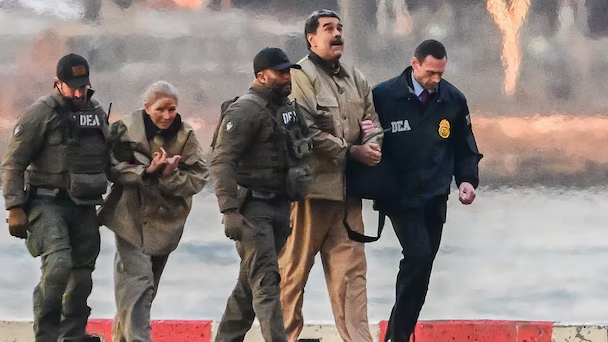
The hearing took place at the Daniel Patrick Moynihan United States Courthouse in Manhattan, presided over by Judge Alvin Hellerstein, a 92-year-old appointee of former President Bill Clinton. Maduro, 63, and his wife, Cilia Flores, 69, arrived wearing tan-issue pants and layered T-shirts. Maduro’s hands were cuffed behind him, and his legs were shackled as the couple was escorted under heavy security by US Marshals and DEA agents in what amounted to a highly publicized “perp walk.”
Tensions escalated immediately when Pedro Rojas, a Venezuelan political activist who claims he was jailed by Maduro in 2019, shouted at the former leader that he would “pay” for his crimes. Maduro responded vehemently, insisting that he was a “prisoner of war” and a “kidnapped president,” prompting Judge Hellerstein to intervene and remind him that there was a time and place for such remarks.
“I am Nicolás Maduro Moros,” he finally stated through a translator. “I am innocent. I am not guilty. I am still President of Venezuela.” Flores, identifying herself as the “First Lady of Venezuela,” echoed her husband’s plea of innocence. Both entered not guilty pleas to multiple charges, including narco-terrorism, cocaine importation conspiracy, and possession of machine guns and destructive devices.
The hearing highlighted not only the legal stakes but also the physical toll of the US operation on Maduro and Flores. Flores displayed visible bruising on her forehead and cheeks, and her lawyer, Mark Donnelly, requested an X-ray to assess potential rib fractures sustained during their capture. Judge Hellerstein instructed both the prosecution and defense to ensure the couple received full medical care, emphasizing the federal court’s duty to uphold humane treatment even amid high-profile criminal proceedings.
Maduro’s legal team, led by prominent criminal defense attorney Barry Pollack—who previously represented WikiLeaks founder Julian Assange—argued that the military abduction violated international law, given Maduro’s status as the head of a sovereign state. Pollack suggested that complex questions about legality and diplomatic immunity would dominate future proceedings.
The US operation that brought Maduro to Manhattan was unprecedented. In the early hours of Saturday, January 3, Delta Force units conducted a precision raid in Caracas, coordinated with intelligence from the CIA. Explosions were reported across the Venezuelan capital, and Maduro and Flores were seized from their heavily fortified residence. The former president reportedly attempted to shut himself in a safe room behind a six-inch-thick steel door just seconds before US forces breached the compound. There were no US casualties reported.
After their capture, Maduro and Flores were flown by helicopter out of Venezuela and eventually arrived in New York to face charges. President Donald Trump personally authorized the mission, describing it as a law enforcement operation rather than an invasion. The raid has sparked widespread debate over sovereignty, international law, and US foreign policy in Latin America.
Outside the courthouse, demonstrators gathered to voice both support and opposition for Maduro. Pro-Maduro groups, including members of Marxist organizations, demanded the couple’s release and chanted slogans against US intervention. Conversely, Venezuelan opposition figures and human rights advocates celebrated Maduro’s appearance in court as a moment of accountability.
David Cardenas, a lawyer with the Venezuelan opposition group OLV, said, “We have been waiting for this moment for 25 years. Maduro is a criminal and a terrorist. He was recently laughing at my group, saying don’t cry when they come for you. I don’t know who is crying now, me or him?”
The legal proceedings themselves were punctuated by moments of chaos. Maduro attempted to elaborate on his military capture during his initial statements, prompting Judge Hellerstein to admonish him. Maduro’s insistence that he remained Venezuela’s president and his reference to being “kidnapped” underscored the tension between his perception of sovereignty and the US assertion of jurisdiction.
During the hearing, both Maduro and Flores were allowed to retain notepads but were prohibited from keeping writing instruments. Their physical appearance highlighted the intensity of their apprehension: Flores had bruising reminiscent of a golf ball-sized injury on her forehead, and red marks on her cheeks, while Maduro appeared slightly unsteady despite his freedom from leg shackles.
The charges against Maduro are serious and carry significant potential penalties under US law. He is accused of narco-terrorism conspiracy, cocaine importation conspiracy, and possession of machine guns and destructive devices. Flores faces similar charges, though her specific accusations have not been fully disclosed. Both defendants will remain in federal custody until the next hearing, scheduled for March 17.
Internationally, the raid and extradition have stirred controversy. Trump has framed the Venezuelan operation as law enforcement, but critics argue that it represents a dangerous precedent for violating the sovereignty of other nations. Leaders across Latin America, including Colombia and Cuba, have been warned by the US president about possible scrutiny for alleged involvement in narcotics trafficking.
In Colombia, President Gustavo Petro has sharply rejected US accusations of involvement in drug trafficking, emphasizing his administration’s efforts to combat the cartels and replace coca cultivation with legal alternatives. Petro warned that any US military intervention would be met with resistance, asserting, “I swore not to touch a weapon again… but for the homeland I will take up arms again.”
Back in the courtroom, the day’s events underscored the human and political drama at the heart of the case. Pro- and anti-Maduro protesters outside the courthouse clashed, separated by barricades and law enforcement. Slogans ranged from calls for Venezuelan sovereignty to chants celebrating accountability for Maduro’s alleged crimes.
The US operation in Venezuela, known as Operation Absolute Resolve, involved approximately 150 military aircraft and hundreds of soldiers, demonstrating the scale of the mission. According to reports, the former leader and his wife were apprehended without casualties among US forces, despite the heavily fortified compound and apparent resistance.
The political ramifications are far-reaching. Trump has stated that the US will “run” Venezuela until a “safe, proper, and judicious transition” can be achieved. He also indicated that American oil companies may be deployed to exploit the country’s vast reserves, highlighting the strategic and economic dimensions of the operation.
While the court appearance focused on legal proceedings, it offered a glimpse into the wider international implications. Maduro’s claims of being “kidnapped” and “a prisoner of war” highlight tensions between US authority and international norms regarding the treatment of heads of state. The extraordinary public nature of the perp walk, the visible injuries sustained by both Maduro and Flores, and the confrontation with Rojas collectively emphasize the unique and unprecedented nature of this case.
The next hearing on March 17 will provide further insight into the legal strategies employed by both sides. Maduro’s defense is expected to challenge the legitimacy of the US operation, invoking arguments of diplomatic immunity and sovereignty, while prosecutors will pursue charges of narco-terrorism and weapons violations. Meanwhile, the broader geopolitical implications continue to unfold, with neighboring countries watching closely.
As Maduro and Flores were escorted back to federal custody at the conclusion of the hearing, their defiance was evident. Maduro raised a finger in response to Rojas’ accusations and insisted, “I am a man of God,” emphasizing his insistence on legitimacy and moral authority. The couple’s treatment, the US legal response, and international reactions will likely dominate headlines and diplomatic discussions in the weeks and months ahead.
The high-profile case represents a rare convergence of criminal law, international relations, and military intervention. It has placed the United States at the center of a global debate over the legality of removing a sitting foreign leader and the potential consequences for international norms and regional stability. The world is now watching as a former head of state navigates the US judicial system, facing the prospect of decades-long imprisonment under charges tied to narco-terrorism, firearms violations, and conspiracy.
With tensions simmering in Latin America, US political statements, and the dramatic courtroom confrontations, the story of Nicolás Maduro’s capture and arraignment is shaping up to be one of the most extraordinary legal and geopolitical episodes of the decade.

Emily Johnson is a critically acclaimed essayist and novelist known for her thought-provoking works centered on feminism, women’s rights, and modern relationships. Born and raised in Portland, Oregon, Emily grew up with a deep love of books, often spending her afternoons at her local library. She went on to study literature and gender studies at UCLA, where she became deeply involved in activism and began publishing essays in campus journals. Her debut essay collection, Voices Unbound, struck a chord with readers nationwide for its fearless exploration of gender dynamics, identity, and the challenges faced by women in contemporary society. Emily later transitioned into fiction, writing novels that balance compelling storytelling with social commentary. Her protagonists are often strong, multidimensional women navigating love, ambition, and the struggles of everyday life, making her a favorite among readers who crave authentic, relatable narratives. Critics praise her ability to merge personal intimacy with universal themes. Off the page, Emily is an advocate for women in publishing, leading workshops that encourage young female writers to embrace their voices. She lives in Seattle with her partner and two rescue cats, where she continues to write, teach, and inspire a new generation of storytellers.