A former Washington football standout has died suddenly at the age of 54, leaving behind a grieving family, former teammates, students, and a community that knew him both as a fierce competitor and a devoted mentor.
The ex-offensive guard, who spent the majority of his professional career protecting quarterbacks in Washington during the 1990s, passed away unexpectedly on Sunday while on a family trip, according to a statement from his wife.
News of his death has sent shockwaves through the football world and beyond. Though he had stepped away from the public spotlight years ago, those closest to him describe a man whose identity extended far beyond the gridiron — a father first, a teacher second, and always a student of the game.
His wife shared the heartbreaking announcement in a Facebook post, describing the loss as both “sudden and unexpected.” While she acknowledged that he had recently taken a leave of absence from his job due to health concerns, she said the family was not prepared for the tragedy that unfolded.
“Our family is devastated and in shock,” she wrote. “If you know him, you know what a devoted and loving father he was to his children.”
The former athlete leaves behind his wife Irene and their four children: Chloe, EJ, EZ, and Eden. According to his wife, his greatest joy in life came not from accolades or professional accomplishments, but from supporting his children in their daily pursuits.
“He lived for his kids’ sports activities and supported them through every practice and game until he took his last breath,” she wrote.
Those close to the family say he had been traveling to watch one of his sons compete when the incident occurred. According to longtime sportscaster Chick Hernandez, the former lineman was visiting Hampton University to see his son play football when he collapsed at his hotel.
Details surrounding the exact cause of death have not been publicly released.
Before his sudden passing, the former Pro Bowl guard had built a reputation as one of the more intelligent and thoughtful players of his era. Teammates often remarked that conversations with him rarely centered solely on football. Instead, discussions frequently drifted toward history, education, and life after sports.
“He was one of the smartest players I’ve ever met or covered,” Hernandez wrote. “The conversations always veered away from football.”
That intellectual curiosity ultimately shaped the second chapter of his life.
After retiring from professional football, he transitioned into education, becoming a history teacher at the Landon School in Bethesda, Maryland. There, he mentored young students — particularly young men — who looked up to him not only as a former NFL player but as a steady, thoughtful presence in the classroom.
Faculty members described him as beloved by students and respected by colleagues. Teaching, his wife said, became his “second career passion.”
But long before he stepped into a classroom, he had established himself as a formidable presence on the field.
Midway through the 1990s, Washington selected him in the second round of the 1994 NFL Draft, 31st overall. The Manhattan-born lineman had first made his mark at Temple University, where he developed into one of the most dependable offensive guards in college football.
His strength, intelligence, and technical skill quickly translated to the professional level. Over the course of eight seasons in Washington, he became a mainstay on the offensive line, earning respect across the league for his durability and command of the game.
In 1999, he achieved the pinnacle of individual recognition: a Pro Bowl selection, along with Second-Team All-Pro honors. It was a defining moment in a career built on consistency and quiet leadership rather than flash.
That player was Tre Johnson.
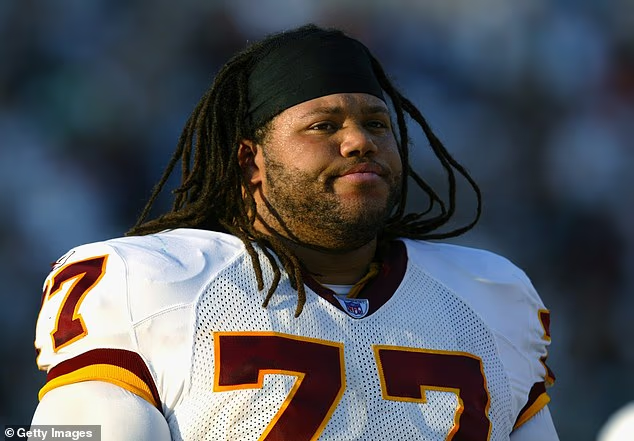
For Washington fans of the late 1990s, Johnson represented reliability during a transitional era for the franchise. As an offensive guard, his job rarely generated headlines, but his performance was critical to the team’s success.
He later spent one season with the Cleveland Browns before stepping away from professional football.
Despite the physical toll that comes with nearly a decade in the NFL trenches, Johnson remained active in retirement. Friends say he enjoyed riding motorcycles and spending time with close companions who shared his interests.
“He shared his passion for Frenchies and riding his motorcycle with me and his fellow biking buddies,” Irene wrote.
But those passions were secondary to his role at home. By all accounts, Johnson was deeply present in his children’s lives. Whether cheering from the sidelines, driving to practices, or offering quiet encouragement, he remained fully engaged as a father.
In recent months, however, health challenges had begun to surface. Irene disclosed that he had taken a leave of absence from teaching due to ongoing medical issues. Even so, his death came as a shock.
Former teammates and members of the Washington organization have begun sharing tributes, remembering not only Johnson’s strength on the field but his humility and intellect off it.
“He loved the game and prided himself on his tremendous knowledge of it,” Irene wrote of his football career.
That knowledge extended beyond schemes and formations. Johnson studied history with the same intensity he once devoted to defensive line matchups. In the classroom, he became known for making lessons engaging and relatable, often drawing parallels between historical conflicts and teamwork principles learned through sports.
Students reportedly gravitated toward him, inspired by the rare combination of professional athletic experience and academic depth.
His death at 54 marks a sobering reminder of the fragility of life, even for those who once appeared physically indestructible.
The NFL community has, in recent years, grappled with broader conversations surrounding player health and long-term medical consequences faced by former athletes. While no connection has been suggested in Johnson’s case, the loss of a former Pro Bowler in his early 50s inevitably reopens difficult discussions.
For now, however, those closest to him are focused not on broader implications, but on mourning a husband, father, friend, and teacher.
Hernandez reflected publicly on their friendship, expressing regret that they had lost touch over the years.
“Sorry we lost touch later in life,” he wrote. “RIP Big smarty.”
The nickname captures much of what defined Tre Johnson — intelligence wrapped in physical dominance, thoughtfulness beneath a powerful frame.
Funeral arrangements have not yet been publicly announced.
As tributes continue to pour in, one consistent theme emerges: Johnson’s legacy is not confined to the offensive line statistics or Pro Bowl honors listed on his résumé. It lives on in the students he mentored, the teammates he protected, and the children he raised with unwavering devotion.
In a sport often defined by aggression and spectacle, Tre Johnson built a life defined by steadiness, loyalty, and learning.
And for those who knew him best, that may be the legacy that matters most.

Emily Johnson is a critically acclaimed essayist and novelist known for her thought-provoking works centered on feminism, women’s rights, and modern relationships. Born and raised in Portland, Oregon, Emily grew up with a deep love of books, often spending her afternoons at her local library. She went on to study literature and gender studies at UCLA, where she became deeply involved in activism and began publishing essays in campus journals. Her debut essay collection, Voices Unbound, struck a chord with readers nationwide for its fearless exploration of gender dynamics, identity, and the challenges faced by women in contemporary society. Emily later transitioned into fiction, writing novels that balance compelling storytelling with social commentary. Her protagonists are often strong, multidimensional women navigating love, ambition, and the struggles of everyday life, making her a favorite among readers who crave authentic, relatable narratives. Critics praise her ability to merge personal intimacy with universal themes. Off the page, Emily is an advocate for women in publishing, leading workshops that encourage young female writers to embrace their voices. She lives in Seattle with her partner and two rescue cats, where she continues to write, teach, and inspire a new generation of storytellers.