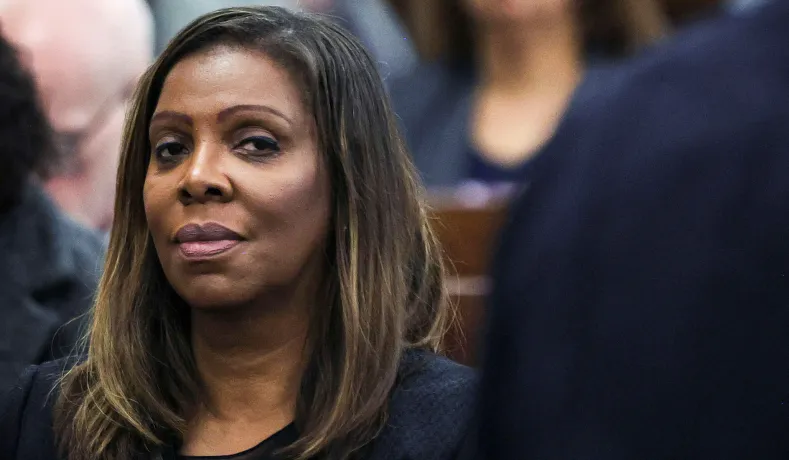
A federal judge has removed an acting U.S. attorney from overseeing investigations connected to New York Attorney General Letitia James, ruling that the prosecutor lacked the legal authority to hold the position at the time key actions were taken. The decision represents a significant judicial rebuke of the Justice Department’s appointment process and has halted parts of a federal probe that had drawn intense political scrutiny.
The ruling, issued by a judge in the Northern District of New York, disqualified John Sarcone, a Trump-appointed prosecutor who had been serving as acting U.S. attorney for the district. The court determined that Sarcone’s tenure violated federal law after local judges declined to extend his interim appointment, leaving him without lawful authority to issue subpoenas or supervise grand jury proceedings.
As a result, subpoenas issued under Sarcone’s direction were quashed, and he has been barred from any further involvement in the investigation. The case has reignited debate over the limits of executive power, judicial oversight of federal prosecutors, and the increasingly politicized nature of high-profile legal disputes involving elected officials.
Background of the Investigation
The investigation at issue focused on actions taken by Attorney General Letitia James and her office, particularly surrounding civil lawsuits and enforcement actions brought against former President Donald Trump and related entities. James, a Democrat, has been a prominent legal adversary of Trump, winning a civil fraud judgment against him in New York state court and pursuing other high-profile cases involving Trump’s business practices.
The federal inquiry, which included the issuance of grand jury subpoenas, raised immediate concerns among legal observers and James’ allies, who argued that the probe appeared politically motivated. Critics pointed to the timing of the investigation and Sarcone’s appointment as signs that the Justice Department under the Trump administration was attempting to retaliate against a political opponent.
Sarcone was appointed as acting U.S. attorney after the resignation of his predecessor. Under federal law, interim U.S. attorneys may serve for a limited period, after which district judges may either extend their tenure or allow the appointment to lapse. In this case, judges in the Northern District of New York declined to extend Sarcone’s appointment, effectively ending his authority to act in the role.
Despite that decision, Sarcone continued to function as acting U.S. attorney, authorizing subpoenas and overseeing investigative steps. The court found that these actions exceeded his legal authority.
The Judge’s Ruling
In a sharply worded opinion, the judge concluded that Sarcone’s continued service violated the Federal Vacancies Reform Act and other statutory provisions governing U.S. attorney appointments. The ruling emphasized that once the district judges declined to extend his interim role, Sarcone no longer had the power to act as U.S. attorney.
“The government cannot bypass clear statutory limits by relabeling an expired appointment,” the judge wrote, according to court filings. “The authority to prosecute carries extraordinary power, and that power must be exercised only by individuals lawfully appointed.”
The court rejected arguments from the Justice Department that Sarcone could continue serving under alternative legal theories, finding those arguments inconsistent with both the statute and constitutional separation-of-powers principles.
Because Sarcone lacked lawful authority, the court ruled that subpoenas issued during that period were invalid and unenforceable. The judge further ordered that Sarcone be removed from the investigation entirely, preventing him from participating in any related proceedings going forward.
Implications for the Case
The ruling effectively freezes portions of the federal investigation into James unless the Justice Department assigns a properly appointed prosecutor to the matter. Legal experts say the decision could force federal authorities to reevaluate whether the probe can continue at all, particularly given questions about the validity of evidence obtained under Sarcone’s supervision.
“This is not a minor procedural issue,” said one former federal prosecutor familiar with the case. “If the person running the investigation had no legal authority, everything that flowed from that authority is now suspect.”
The decision may also invite broader challenges to other actions taken by interim prosecutors whose appointments followed similar paths. Courts across the country have increasingly scrutinized efforts to sidestep Senate confirmation or judicial approval requirements for top prosecutorial roles.
Response from Letitia James’ Office
Attorney General James welcomed the ruling, calling it a victory for the rule of law and judicial independence. In a statement, her office said the decision confirmed long-standing concerns that the investigation was improperly conducted.
“This ruling makes clear that no one is above the law — including those entrusted with enforcing it,” the statement read. “The attempt to pursue investigations without lawful authority undermines public trust in the justice system.”
James has consistently denied any wrongdoing and has characterized the federal probe as politically driven retaliation for her enforcement actions against Trump. Her office has pledged continued cooperation with any legitimate legal inquiry while vowing to challenge what it views as abuses of prosecutorial power.
Justice Department Reaction
The Justice Department expressed disagreement with the ruling and signaled it is reviewing its options, including the possibility of appeal. In a brief statement, officials said the department “continues to believe that its appointment practices are consistent with federal law” and that it remains committed to enforcing the law without political bias.
However, the department did not immediately announce whether a new prosecutor would be appointed to take over the investigation or whether the probe would be narrowed or abandoned altogether.
Political and Legal Context
The decision comes amid heightened tensions between the judiciary and executive branch over the use of interim appointments, particularly during periods of divided government. Critics argue that reliance on temporary prosecutors undermines accountability and allows administrations to bypass Senate oversight.
Supporters of stricter enforcement say the judiciary’s role in approving or rejecting interim appointments serves as a critical safeguard against politicized prosecutions.
The ruling also underscores the sensitivity of investigations involving elected officials, especially when those officials are engaged in legal battles with prominent political figures. Legal analysts note that even the appearance of impropriety can damage public confidence in the justice system.
“This case highlights why appointment rules exist in the first place,” said a constitutional law professor. “When prosecutors are not properly appointed, it raises serious questions about legitimacy, fairness, and due process.”
What Comes Next
For now, the investigation into Letitia James remains in limbo. Any future prosecutorial actions would need to be authorized by a duly appointed U.S. attorney with clear legal authority. If the Justice Department chooses to continue the probe, it may need to reissue subpoenas and potentially revisit earlier investigative steps.
The ruling may also prompt congressional scrutiny of interim appointment practices, particularly if similar cases emerge in other jurisdictions.
As the legal and political fallout continues, the decision stands as a reminder of the judiciary’s role in enforcing the boundaries of executive power — and the consequences when those boundaries are crossed.

Emily Johnson is a critically acclaimed essayist and novelist known for her thought-provoking works centered on feminism, women’s rights, and modern relationships. Born and raised in Portland, Oregon, Emily grew up with a deep love of books, often spending her afternoons at her local library. She went on to study literature and gender studies at UCLA, where she became deeply involved in activism and began publishing essays in campus journals. Her debut essay collection, Voices Unbound, struck a chord with readers nationwide for its fearless exploration of gender dynamics, identity, and the challenges faced by women in contemporary society. Emily later transitioned into fiction, writing novels that balance compelling storytelling with social commentary. Her protagonists are often strong, multidimensional women navigating love, ambition, and the struggles of everyday life, making her a favorite among readers who crave authentic, relatable narratives. Critics praise her ability to merge personal intimacy with universal themes. Off the page, Emily is an advocate for women in publishing, leading workshops that encourage young female writers to embrace their voices. She lives in Seattle with her partner and two rescue cats, where she continues to write, teach, and inspire a new generation of storytellers.