

The family drama surrounding a relative of White House Press Secretary Karoline Leavitt has erupted into a public controversy, after the mother of Leavitt’s nephew was detained by Immigration and Customs Enforcement and now faces possible deportation to Brazil. What began as a quiet custody and immigration issue has escalated into a national talking point, as the detained mother’s relatives accuse the administration of hypocrisy while claiming she has spent nearly her entire life in the United States.
At the center of the crisis is 36-year-old Bruna Ferreira, who shares an 11-year-old son with Karoline Leavitt’s brother, Michael. Ferreira and Michael once were engaged, but their relationship ended more than a decade ago, leaving them to co-parent their son, Michael Jr. Now, Ferreira has been classified as a “criminal illegal alien,” a designation that has stunned her family, who insist she has no criminal convictions and has lived in America since childhood.
Reports revealed that Ferreira was detained at the South Louisiana ICE Processing Center, a facility known for holding individuals with final orders of removal. According to officials, Ferreira entered the United States on a B-2 tourist visa in the 1990s and never returned to Brazil when her visa expired in June 1999. A Department of Homeland Security spokesman confirmed that she also has a prior arrest for battery, though her attorney says she was never convicted of anything.
The controversy erupted publicly when Ferreira’s family spoke to multiple news outlets, accusing immigration officials of targeting someone who has spent almost her entire life in the U.S. Her sister, Graziela Dos Santos Rodrigues, offered a passionate defense, insisting that Ferreira’s identity is rooted entirely in America.
“She’s been here since she was six years old,” she said. “She’s more American than she is anything else. This is her home.”
To the family, the idea of deportation feels less like a legal process and more like a violent uprooting of a life built over three decades. They say Ferreira has no meaningful connection to Brazil and would be sent to a country she barely remembers.
Adding to the tension is a reported exchange between the Leavitt family and Ferreira. According to her sister, Karoline and Michael’s father, Bob Leavitt, contacted Ferreira directly — but not with reassurance or an offer of help. Instead, the family claims he told her to “self-deport.”
“They just kept saying, ‘tell her to self-deport,’” the sister recalled. “Self-deport to where? Brazil is not her home.”
While Ferreira’s attorney says voluntary departure is a legal option sometimes offered to undocumented immigrants who wish to avoid an official removal order, the family believes the suggestion came with no compassion for the consequences. Ferreira has a son, extended family, and deep roots in the community. Voluntarily leaving the country would mean abandoning all of that, possibly forever.
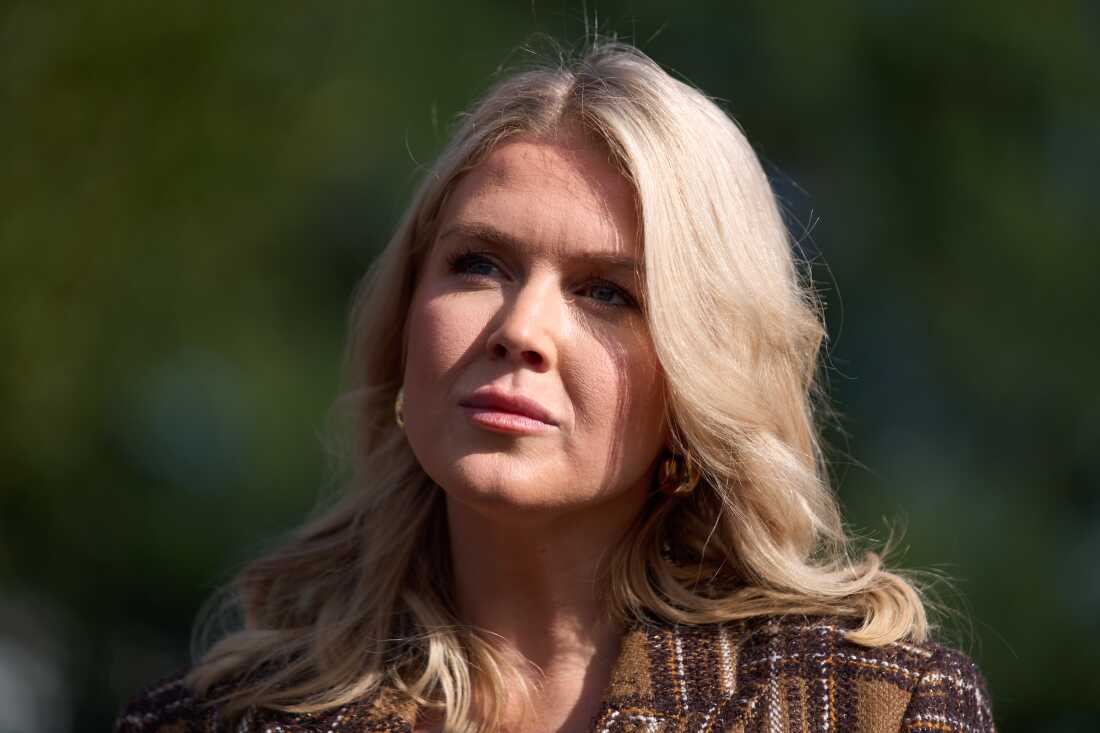
The political dimension of the situation is impossible to ignore. Karoline Leavitt, at 28, is the youngest White House press secretary in American history, appointed by President Trump after his 2024 election victory. As the public face of the administration’s messaging, Leavitt has defended the president’s hard-line immigration policies, including stricter enforcement actions and expanded deportation priorities.
DHS emphasized that under President Trump and Secretary Kristi Noem, all individuals unlawfully present in the U.S. are subject to removal proceedings, regardless of circumstances. The spokesman reiterated that Ferreira’s visa had expired decades ago and that she had remained in the country without legal status.
Ferreira’s attorney, John J. Loscocco, rejected the idea that she poses any risk or meets the criteria that would typically prompt ICE to detain someone abruptly. He said Ferreira is a mother, a longtime resident, and a cooperative member of her community — not a threat or a flight risk.
“She has no conviction of any kind,” Loscocco said. “She’s never been found guilty of any offense. So her detention is unusual.”
He added that he cannot understand the timing or motivation behind ICE’s decision to detain her preemptively, given that many undocumented individuals with far more serious criminal histories remain at large pending immigration proceedings.
Meanwhile, the family disputes the characterization of Ferreira as a criminal, saying the “battery arrest” referenced by DHS stems from an incident that never resulted in charges or formal legal consequences. “They’re using something from years ago that never led to a conviction,” her sister said. “It’s being exaggerated to justify what they’re doing to her.”
Beyond the legal and political friction lies a complicated family dynamic. Ferreira’s sister claims that while Bob Leavitt reached out, Karoline herself has not made any contact with the family — despite having known them for over 13 years.
“If she were willing to help in any way, she would have reached out by now,” the sister said. “She has my phone number. We’ve been family for a long time. I understand her job and the politics, but when it comes to family, you put certain things aside.”
According to the family, the silence feels deliberate and personal. They believe Leavitt is choosing her political position over compassion for the mother of her nephew — a decision they say contradicts the family values she often speaks about publicly.
The Leavitt family has not confirmed these allegations and has declined repeated requests for comment. The White House has also remained silent, offering no guidance on whether Karoline is even permitted to involve herself in a personal immigration case given her official role.
The situation has drawn attention not only for the immigration dispute but also because of Karoline Leavitt’s growing profile in national politics. Her tenure as press secretary has been marked by headline-grabbing moments, including the administration’s contentious relationship with traditional media and a high-profile lawsuit involving the Associated Press.
Leavitt’s personal life has also generated public curiosity. Recently she opened up about her marriage to 60-year-old businessman Nicolas Riccio, who is 32 years older than she is. The age gap has sparked debate and media fascination, with Leavitt addressing it directly during podcast interviews. She has spoken about the challenges of introducing her then-fiancé to her family and how her parents eventually embraced Riccio.
Supporters of Leavitt praise her confidence, loyalty, and role as a fiercely effective spokesperson for the Trump administration. Critics argue her rapid ascent has brought scrutiny she was not prepared for — scrutiny that is now extending to her relatives.
The case of Bruna Ferreira has become the latest flashpoint in that scrutiny. Immigration advocates say it highlights what they call the harshness and inconsistency of current enforcement policy. Meanwhile, supporters of the administration argue that long-expired visas and past arrests justify ICE intervention, regardless of the individual’s background.
For the family, though, the matter is deeply personal and painfully urgent. Ferreira’s sister said the focus now is simply ensuring she is not deported before she has the chance to argue her case.
“She grew up here. She raised her son here. Her whole life is here,” she said. “We’re fighting for her to stay in the only home she’s ever known.”
As Ferreira sits in detention awaiting legal proceedings, the political world watches closely to see whether Leavitt will publicly address the situation — or remain silent while her relative’s future hangs in the balance.

James Jenkins is a celebrated Pulitzer Prize-winning author whose work has reshaped the way readers think about social justice and human rights in America. Raised in Atlanta, Georgia, James grew up in a community that instilled in him both resilience and a strong sense of responsibility toward others. After studying political science and creative writing at Howard University, he worked as a journalist covering civil rights issues before dedicating himself fully to fiction. His novels are known for their sharp, empathetic portraits of marginalized communities and for weaving personal stories with broader political realities. Jenkins’s breakout novel, Shadows of Freedom, won national acclaim for its unflinching look at systemic inequality, while his more recent works explore themes of identity, resilience, and the fight for dignity in the face of oppression. Beyond his novels, James is an active public speaker, lecturing at universities and participating in nonprofit initiatives that support literacy and community empowerment. He believes that storytelling is a way to preserve history and inspire change. When not writing, James enjoys jazz music, mentoring young writers, and traveling with his family to explore cultures and stories around the world.