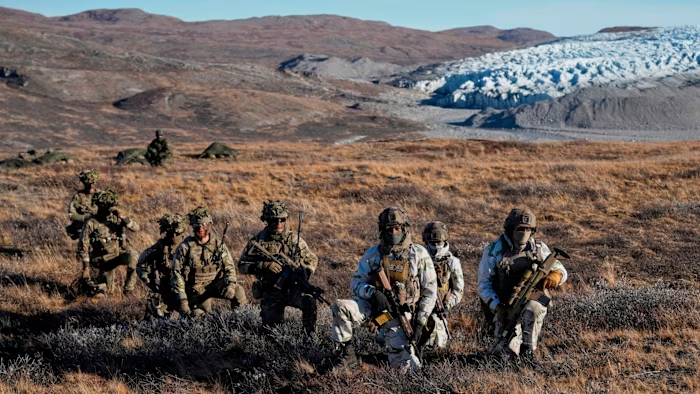
Forces from multiple European nations began arriving in Greenland on Thursday in a coordinated demonstration of military support for Denmark, as diplomatic discussions over the island’s future continue to reveal sharp disagreements. The deployments come against a backdrop of heightened international attention on the Arctic, where strategic interests from the United States, Russia, and China have intensified scrutiny of territorial and security arrangements.
Officials say the arrival of European troops is intended to emphasize solidarity among NATO members and underscore that collective defense mechanisms remain in place, even as discussions about Greenland’s status and future governance unfold. Observers note that the symbolic presence of foreign forces signals both reassurance to Denmark and a reminder to external powers that the security of the Arctic is a shared priority.
Denmark’s Response and Increased Military Presence
On Wednesday, the Danish government announced plans to bolster its military presence on Greenland, citing the need to maintain stability and security amid growing global competition for influence in the region. The Danish military said additional personnel and resources would be stationed on the island to ensure readiness for a range of scenarios, from natural disaster response to national defense operations. (reuters.com)
The deployment comes as Danish and Greenlandic officials prepared to meet with representatives of the U.S. administration in Washington, aiming to negotiate arrangements for cooperation and address recent proposals regarding American interest in the territory. Sources close to the discussions described the talks as tense, noting “fundamental disagreement” between U.S., Danish, and Greenlandic officials on the path forward.
European Allies Step In
Troops from France, Germany, the United Kingdom, Norway, Sweden, and the Netherlands were among those either already on the ground as of Wednesday or scheduled to arrive in the following days. While the numbers are limited, the deployments are highly symbolic, representing a united European front and a reaffirmation of NATO’s commitment to regional security.
Officials emphasized that the deployments are not intended as a direct challenge to the United States, but rather as a demonstration that Greenland’s security can be maintained collectively through existing alliances. European diplomats have consistently framed the movements as reassurance to Denmark and Greenland, while signaling that unilateral action by any external power is unnecessary. (apnews.com)
Strategic Importance of Greenland
Greenland occupies a unique position in global geopolitics due to its location between North America and the Arctic. Its strategic value has grown in recent years as climate change has opened new shipping lanes and resources in the Arctic have attracted international attention. Both Russia and China have expressed interest in Arctic development, heightening concern among NATO members about maintaining stability and ensuring freedom of navigation.
Analysts note that Greenland’s ice-covered terrain also provides a valuable vantage point for early warning systems, satellite communication, and military monitoring. Historically, Denmark has retained administrative authority over the island, but the region’s geostrategic significance has prompted discussion of increased cooperation among allied nations. (bbc.com)
Diplomatic Discussions With the United States
The troop deployments coincided with high-level meetings in Washington between representatives of Denmark, Greenland, and the U.S. government. While officials did not provide details of the conversations, diplomatic sources indicated that proposals from the Trump administration regarding a potential American presence on Greenland were met with cautious responses from the Danish and Greenlandic delegations.
The European deployments are widely interpreted as a signal to Washington that NATO allies are prepared to manage regional security collectively, reducing the perceived need for direct American intervention or acquisition of territory. Observers describe the situation as a balancing act between ensuring national security, maintaining alliance unity, and avoiding unnecessary escalation in the Arctic. (nytimes.com)
Regional and Global Implications
The arrival of European forces in Greenland highlights the evolving nature of international relations in the Arctic. With melting ice and increased access to natural resources, countries with Arctic interests are reevaluating security arrangements and partnerships. European leaders are keen to ensure that NATO remains central to the defense of the region, emphasizing cooperation rather than competition with other global powers.
Military analysts note that while the initial troop numbers are small, the symbolic effect is significant. The deployments send a message that NATO members can respond collectively to threats, and that sovereignty and territorial integrity are protected under established alliances. This demonstration also serves to reassure Greenlandic residents that their security concerns are being addressed collaboratively. (cnn.com)
Symbolism and Messaging
The coordinated arrival of troops is carefully calibrated to convey multiple messages: to Denmark, to Greenland, and to external observers. European governments hope to signal that, while the United States remains a key partner, it is neither necessary nor urgent for any single country to take unilateral control over Greenland. NATO, acting collectively, is portrayed as sufficient to deter external threats, whether military, economic, or political.
The symbolic nature of the deployments also reinforces the European commitment to shared defense. Officials have repeatedly stressed that the forces are not intended to be a permanent stationing, but rather a visible demonstration of solidarity and readiness. (reuters.com)
Historical Context
Greenland has historically been under Danish administration, with full control over domestic matters and defense largely delegated to Denmark. However, the island’s geostrategic importance has drawn attention from various global powers, particularly as climate change alters access to shipping routes and natural resources in the Arctic.
Past decades have seen intermittent debate over Greenland’s status, but the recent high-level diplomatic discussions and European troop deployments represent an unprecedented convergence of military, political, and international attention focused on the island. Observers say the events mark a significant moment in Arctic geopolitics, highlighting how traditional territorial relationships can intersect with modern alliance frameworks. (bbc.com)
Next Steps
Officials from Denmark, Greenland, and the European allies have indicated that additional discussions are expected in the coming weeks to clarify security commitments and the scope of military deployments. The situation remains fluid, with all parties emphasizing diplomacy while maintaining readiness to respond to evolving security challenges.
The United States, while not publicly committing to new troop deployments, continues to monitor the situation closely. Analysts predict that further communication between Washington and European capitals will be essential in shaping a coordinated approach to Arctic security. (cnn.com)
Conclusion
The arrival of European forces in Greenland represents both a practical and symbolic reinforcement of regional security and alliance solidarity. As discussions between Denmark, Greenland, and the United States continue, the deployments highlight the intersection of diplomacy, defense, and strategic messaging in the Arctic. With multiple powers vying for influence in the region, NATO’s collective approach is presented as a stabilizing factor, ensuring that Greenland remains secure while maintaining balance among competing interests.

Emily Johnson is a critically acclaimed essayist and novelist known for her thought-provoking works centered on feminism, women’s rights, and modern relationships. Born and raised in Portland, Oregon, Emily grew up with a deep love of books, often spending her afternoons at her local library. She went on to study literature and gender studies at UCLA, where she became deeply involved in activism and began publishing essays in campus journals. Her debut essay collection, Voices Unbound, struck a chord with readers nationwide for its fearless exploration of gender dynamics, identity, and the challenges faced by women in contemporary society. Emily later transitioned into fiction, writing novels that balance compelling storytelling with social commentary. Her protagonists are often strong, multidimensional women navigating love, ambition, and the struggles of everyday life, making her a favorite among readers who crave authentic, relatable narratives. Critics praise her ability to merge personal intimacy with universal themes. Off the page, Emily is an advocate for women in publishing, leading workshops that encourage young female writers to embrace their voices. She lives in Seattle with her partner and two rescue cats, where she continues to write, teach, and inspire a new generation of storytellers.