The chamber was already tense long before the moment happened. Cameras were fixed on the podium, lawmakers filled the aisles, and millions of viewers tuned in as Donald Trump delivered what would become the longest State of the Union address in American history.
The speech stretched deep into the evening, packed with political messaging, policy defenses, and appeals to supporters. But for many watching, one of the most powerful moments came not from the president’s words—but from a quiet, emotional reaction captured in the audience.
A Highly Charged Night
The annual address unfolded against a backdrop of deep political division. Some lawmakers chose not to attend at all, instead holding competing events across Washington in protest. Others sat in the chamber but made their dissent known through interruptions, signs, and visible displays of disapproval.
The speech itself covered a broad agenda. The president praised his party’s accomplishments, doubled down on his administration’s priorities, and framed the coming year as a defining chapter for the country. The address, delivered before a divided Congress and a nationwide audience, reflected the broader political climate—intense, polarized, and closely watched.
Yet even amid the political friction, the evening included moments of personal recognition for guests invited to attend. Those tributes, a tradition of the State of the Union, are often designed to highlight individual stories that align with the administration’s message.
A Tribute Turns Personal
Among the invited guests was Erika Kirk, who attended the address following a devastating loss. Her late husband, Charlie Kirk, had been killed months earlier in a shooting that shocked supporters and sparked national headlines.
As the president spoke about his friend and ally, he paused to acknowledge the widow seated in the gallery. The tone in the chamber shifted immediately.
The president described Charlie Kirk as a figure whose beliefs and activism had left a lasting impact. He called him a friend and spoke about the tragedy of his death, framing it as a moment that demanded unity and reflection.
Then, he directed his attention to Erika, addressing her directly in front of the nation.
“You’ve been through a lot,” he told her, as lawmakers rose to their feet in a standing ovation.
The Moment That Captured Attention
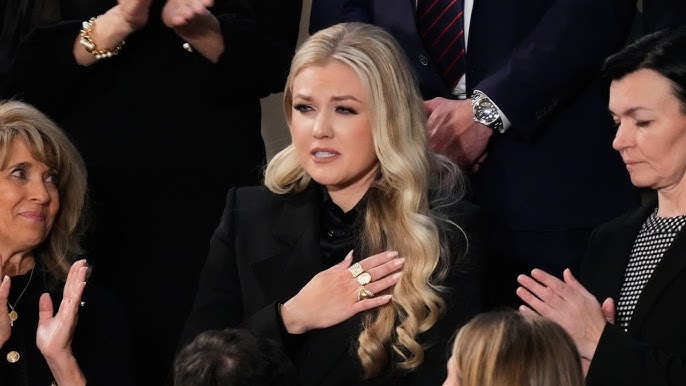
As the applause filled the chamber, cameras focused on Erika Kirk. She stood slowly, visibly emotional, her expression a mixture of grief and composure.
It was in that moment—brief, quiet, and almost easy to miss—that viewers noticed something remarkable.
As she looked forward, holding back tears, she appeared to mouth three simple words.
Across social media, viewers began replaying the clip, attempting to interpret what she had said. Many believed they could read her lips clearly.
“I miss you.”
Those three words, if that interpretation was correct, quickly became the most talked-about moment of the night.
A Wave Of Reaction
Within minutes, the clip spread widely online. Commentators from across the political spectrum paused their debates about policy and protest to focus on the emotional weight of that single moment.
Supporters expressed sympathy for Erika Kirk, describing the scene as heartbreaking and deeply human. Others, even those critical of the administration, acknowledged the sincerity of the moment and the rawness of her grief.
The image of a grieving widow, standing before a divided Congress while quietly expressing what she had lost, resonated far beyond the speech itself.
The Case Behind The Tragedy
The loss referenced in the tribute remains the subject of an ongoing legal case. A suspect, identified as Tyler Robinson, has been charged in connection with the killing and is facing a potential death penalty trial.
The investigation and legal proceedings continue to unfold, keeping the case in the national spotlight.
For Erika Kirk, however, the moment inside the chamber was not about politics or legal outcomes. It was about remembrance.
Protests And Disruptions
The emotional tribute stood in sharp contrast to the rest of the evening, which was marked by visible tension inside the chamber.
Some lawmakers protested openly during the address. One congressman was escorted out after repeated disruptions, while others shouted objections during sections of the speech.
Outside the chamber, demonstrations took place across Washington, reflecting ongoing disagreements with the administration’s policies and direction.
The combination of protest, applause, and emotional tributes created an atmosphere that felt both historic and deeply divided.
A Night Defined By Contrasts
In many ways, the State of the Union highlighted two different realities unfolding at the same time.
On one hand, there was the political theater—partisan messaging, heated exchanges, and competing narratives about the country’s future.
On the other, there were personal stories like Erika Kirk’s—moments that cut through ideology and reminded viewers of the human experiences behind public life.
Those moments are often what linger after the speech ends. Not the policy details or applause lines, but the faces in the gallery and the stories they represent.
The Three Words That Stayed
By the end of the night, the speech had made history for its length and its political intensity. But for many viewers, it was those three quiet words that defined the evening.
They were not part of the official transcript. They were not delivered from the podium. They were not meant for the cameras at all.
Yet they carried a weight that no prepared remarks could match.
A simple expression of grief.
A reminder of loss.
A moment of humanity in a room often defined by conflict.
And long after the applause faded and the speeches ended, those three words were what people continued to talk about.

Emily Johnson is a critically acclaimed essayist and novelist known for her thought-provoking works centered on feminism, women’s rights, and modern relationships. Born and raised in Portland, Oregon, Emily grew up with a deep love of books, often spending her afternoons at her local library. She went on to study literature and gender studies at UCLA, where she became deeply involved in activism and began publishing essays in campus journals. Her debut essay collection, Voices Unbound, struck a chord with readers nationwide for its fearless exploration of gender dynamics, identity, and the challenges faced by women in contemporary society. Emily later transitioned into fiction, writing novels that balance compelling storytelling with social commentary. Her protagonists are often strong, multidimensional women navigating love, ambition, and the struggles of everyday life, making her a favorite among readers who crave authentic, relatable narratives. Critics praise her ability to merge personal intimacy with universal themes. Off the page, Emily is an advocate for women in publishing, leading workshops that encourage young female writers to embrace their voices. She lives in Seattle with her partner and two rescue cats, where she continues to write, teach, and inspire a new generation of storytellers.