As the Super Bowl halftime spectacle unfolded before tens of thousands inside Levi’s Stadium and millions watching worldwide, a parallel production was taking place online — one designed to offer a markedly different tone and message from the NFL’s official broadcast. Turning Point USA, the conservative activist organization, launched its self-styled “All-American” halftime show, headlined by Kid Rock and promoted as a patriotic alternative to the league’s featured performance.
The decision to stage a competing event did not arise in a vacuum. The NFL’s choice of Bad Bunny as the official halftime headliner had already generated political commentary in the months leading up to the game. The Puerto Rican global music star, known for performing primarily in Spanish and for his outspoken cultural presence, became the first male solo Latin artist to headline the Super Bowl halftime show. While many celebrated the milestone as a reflection of the NFL’s expanding cultural reach, critics argued that the selection did not align with what they considered traditional American representation.
Rather than limit their response to commentary, Turning Point USA opted for counterprogramming. The organization announced an alternative halftime show featuring artists whose brand identities align more closely with conservative audiences. Kid Rock led the lineup, joined by country performers Brantley Gilbert, Lee Brice, and Gabby Barrett. The show streamed online and was promoted across social media platforms in the lead-up to kickoff.
Supporters framed the event as a celebration of faith, patriotism, and country music — a direct contrast to what they characterized as the increasingly global and progressive orientation of mainstream entertainment. Promotional materials emphasized themes of national pride and Christian values, signaling clearly that this was more than a musical production; it was a cultural statement.
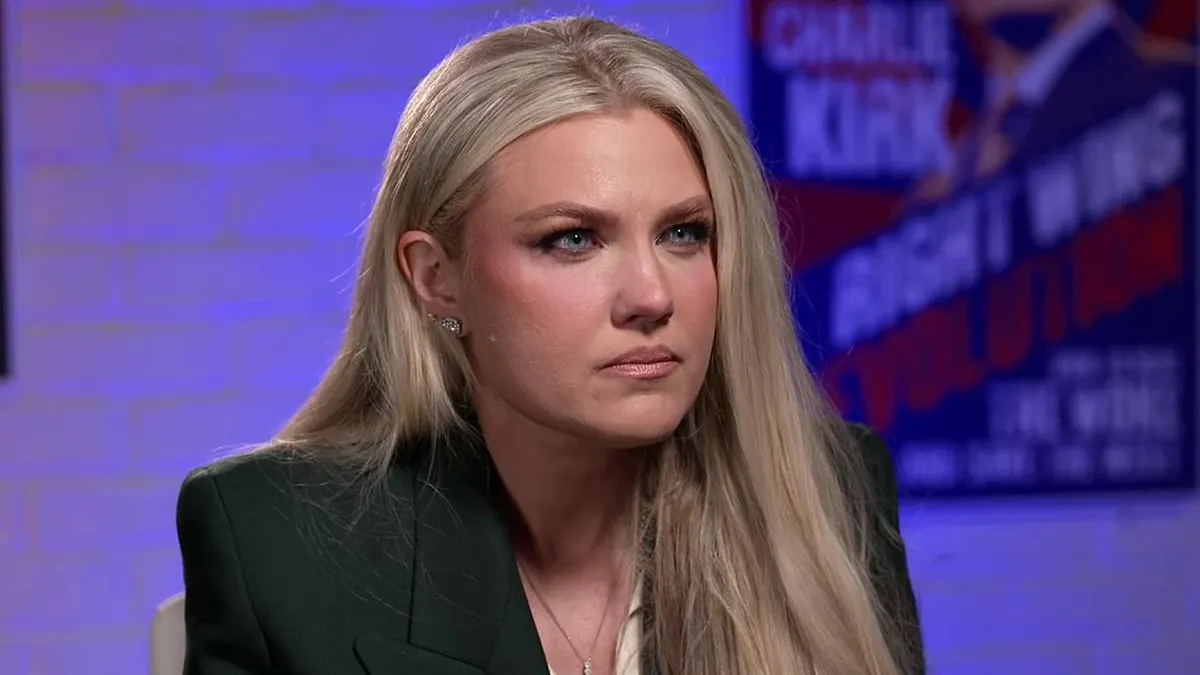
After the event aired, Erika Kirk, the newly appointed CEO of Turning Point USA, publicly praised the effort. She shared a montage honoring her late husband, the organization’s co-founder, and described the alternative halftime show as “incredible.” In her message, she thanked the performers and the audience she said had tuned in, expressing pride in the team behind the production.
The montage itself blended personal and political imagery, featuring archival footage of speeches, public appearances, and family moments. The framing reinforced the emotional and ideological connection between the organization’s leadership and the event. It also underscored how the halftime show functioned as a symbolic continuation of a broader mission rather than as a standalone entertainment product.
Reaction online was swift and polarized. Supporters praised the performers and applauded the organization for creating what they viewed as a values-driven alternative to the NFL’s offering. Many described it as refreshing to see an event centered explicitly on traditional American themes.
Critics, however, questioned both the necessity and the scale of the production. Some pointed out that the Super Bowl halftime show is, by design, a mass-market global event intended to appeal to a broad and diverse audience. Others focused on viewership comparisons, suggesting that the alternative stream drew only a fraction of the audience of the official halftime broadcast. Independent, verifiable metrics detailing exact viewership numbers have not been publicly released, making definitive comparisons difficult.
What is clear is that the alternative show was not structured to compete directly with the NFL in terms of production scale or reach. The official halftime performance benefits from decades of institutional infrastructure, major corporate sponsorships, and the built-in audience of the Super Bowl broadcast itself. By contrast, Turning Point USA’s stream operated within the constraints of digital distribution and an already segmented audience base.
Kid Rock’s involvement was unsurprising given his longstanding public alignment with conservative politics. His participation lent symbolic weight to the event, reinforcing its ideological positioning. The inclusion of established country artists further signaled the intended demographic appeal, aligning the production with a distinctly American musical tradition often associated with conservative cultural identity.
Meanwhile, the NFL’s halftime show proceeded as planned, delivering the high-production spectacle audiences have come to expect. The league has consistently framed its musical selections as reflective of evolving cultural trends and broad audience engagement. In that context, the choice of an internationally recognized Latin artist aligns with the NFL’s global expansion strategy and its desire to resonate with diverse fan bases.
The existence of a parallel halftime show highlights a broader trend: major sporting events increasingly serve as arenas for cultural and political signaling. What was once treated primarily as entertainment now carries layered meanings about identity, representation, and national values. For some viewers, the alternative show represented a corrective — a reclaiming of what they perceive as sidelined traditions. For others, it exemplified the deepening fragmentation of shared public experiences.
From a strategic standpoint, the move by Turning Point USA can be viewed as both a media play and a branding exercise. By leveraging the Super Bowl’s visibility, the organization inserted itself into one of the largest annual cultural conversations in the United States. Whether measured in raw viewership numbers or in social media engagement, the effort ensured attention.
Ultimately, the two halftime productions were less direct competitors than contrasting narratives unfolding simultaneously. One emphasized global pop culture and cross-cultural celebration; the other foregrounded faith, patriotism, and traditionalist themes. Together, they reflect an evolving media environment in which even the most unifying events can host parallel interpretations of national identity.
The Super Bowl remains a singular broadcast phenomenon, but the surrounding discourse increasingly extends beyond the field. In this case, music became the medium through which broader debates about culture and values were expressed. Whether viewed as unnecessary division or as legitimate pluralism, the presence of an alternative halftime show underscores how deeply intertwined entertainment and politics have become in contemporary American life.

Emily Johnson is a critically acclaimed essayist and novelist known for her thought-provoking works centered on feminism, women’s rights, and modern relationships. Born and raised in Portland, Oregon, Emily grew up with a deep love of books, often spending her afternoons at her local library. She went on to study literature and gender studies at UCLA, where she became deeply involved in activism and began publishing essays in campus journals. Her debut essay collection, Voices Unbound, struck a chord with readers nationwide for its fearless exploration of gender dynamics, identity, and the challenges faced by women in contemporary society. Emily later transitioned into fiction, writing novels that balance compelling storytelling with social commentary. Her protagonists are often strong, multidimensional women navigating love, ambition, and the struggles of everyday life, making her a favorite among readers who crave authentic, relatable narratives. Critics praise her ability to merge personal intimacy with universal themes. Off the page, Emily is an advocate for women in publishing, leading workshops that encourage young female writers to embrace their voices. She lives in Seattle with her partner and two rescue cats, where she continues to write, teach, and inspire a new generation of storytellers.