


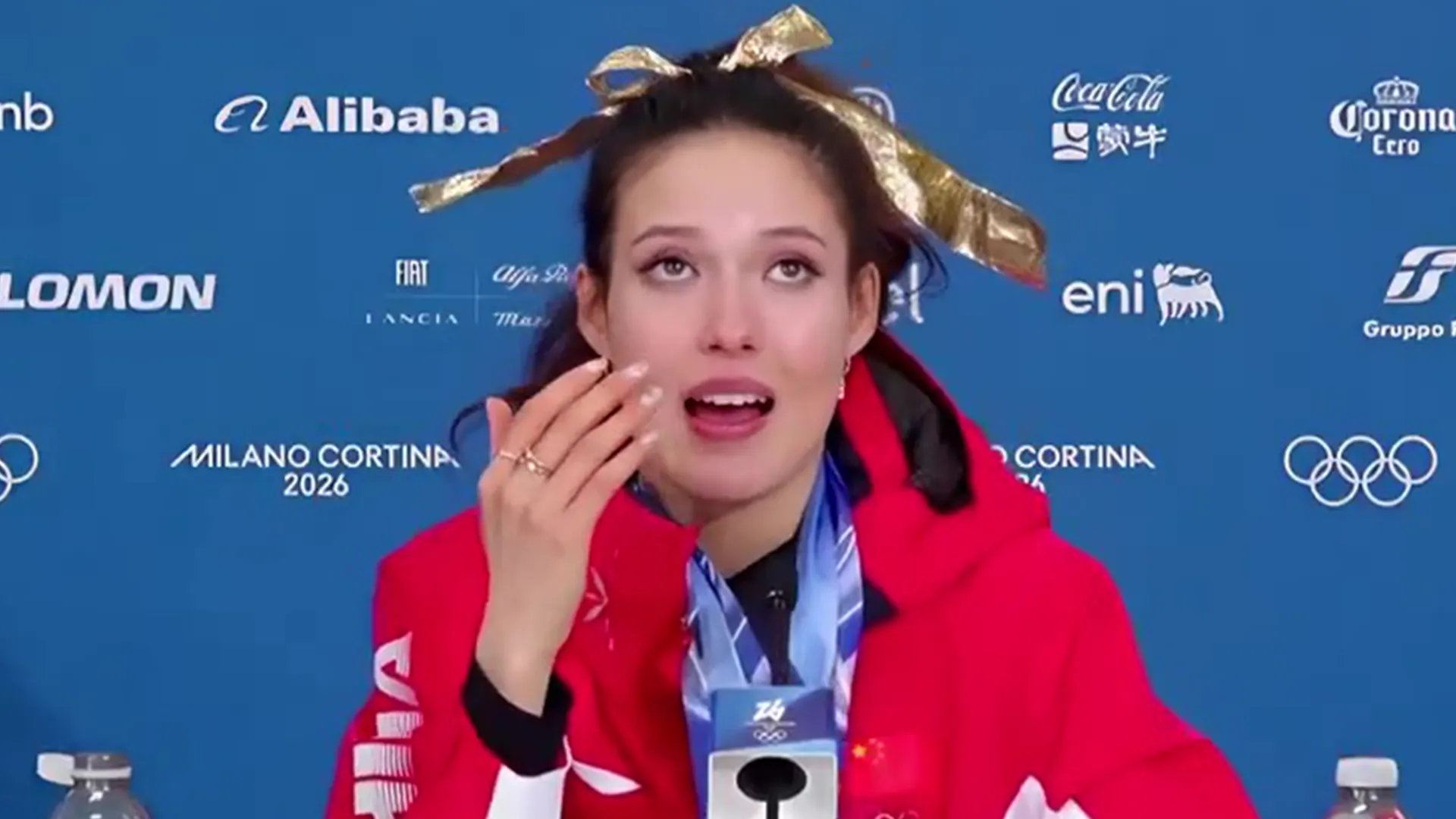
Freestyle skiing star Eileen Gu revealed that she learned of the passing of a close family member just minutes after winning gold in the women’s halfpipe at the Winter Olympics in Milan-Cortina. The 22-year-old athlete, born in San Francisco, California, had the option to compete for the United States but chose to represent China, qualifying through her maternal heritage.
Gu has cemented her status as one of the most decorated freestyle skiers in Olympic history. In the 2022 Beijing Winter Olympics, she claimed gold in both big air and halfpipe, along with a silver in slopestyle. In Milan-Cortina, she expanded her tally, securing another gold in halfpipe and silvers in big air and slopestyle.
A Personal Moment Amid Victory
Gu entered the competition aware of her grandmother Feng Guozhen’s critical condition. She was informed of her grandmother’s passing shortly after standing atop the podium. Reflecting on the moment, she shared, “The reason I was late is that I just found out that my grandma passed away. She was a really big part of my life growing up and someone I looked up to immensely.”
Her middle name, Feng, honors her grandmother, who she credits as a source of strength and inspiration. Gu explained that she had promised her grandmother that she would be brave and give her all in the competition, a promise she sees reflected in her performance. “It actually goes back to that promise that I made my grandma and so I’m really happy that I was able to uphold that and hopefully do her proud, but it’s also a really difficult time for me now,” she said.
Career Achievements
Eileen Gu’s career is marked by extraordinary achievements at a young age. She has become a defining figure in freestyle skiing, known for her innovative tricks and consistency under pressure. Beyond the Olympics, she has competed and succeeded in numerous international competitions, further solidifying her position as one of the sport’s leading athletes.
Her decision to represent China has also made her a symbol of cross-cultural sportsmanship, celebrated in both China and the United States. Despite the challenges of competing at an international level and under intense media scrutiny, Gu continues to demonstrate resilience and focus, qualities she attributes to her grandmother’s influence.
Olympic Medal Incentives
While Olympic success brings global recognition, monetary incentives vary significantly between countries. The International Olympic Committee does not provide direct financial rewards, leaving it up to national committees to set their own compensation for medalists.
For the 2026 Winter Olympics, Singapore offers the largest payout for gold medalists at $787,000 (£580,000), while several countries, including Hong Kong, Italy, Poland, Slovenia, Estonia, Czechia, and Spain, provide six-figure sums for first-place finishes. Conversely, Team GB, Sweden, and Norway offer no direct monetary reward for winning Olympic medals, though British athletes receive stipends to cover training expenses and can earn substantial income from sponsorship deals. For example, British sprinter Dina Asher-Smith has earned between £1 million and £10 million annually from endorsements.
The United States provides a comparatively modest $37,500 (£27,500) for Olympic gold, but philanthropist Ross Stevens has introduced an innovative retirement fund for American athletes. Stevens’ program contributes $100,000 toward athletes’ retirement regardless of performance, with an additional $100,000 designated for beneficiaries after their passing. This initiative is unique, offering long-term financial security beyond immediate medal bonuses.
Medal Bonuses by Country
A breakdown of gold medal payouts for 2026 highlights global differences in rewarding athletic excellence:
-
Singapore: $787,000 (£580,000)
-
Hong Kong: $768,000 (£563,000)
-
Italy: $213,000 (£156,300)
-
Poland: $211,000 (£154,900)
-
Slovenia: $162,000 (£118,000)
-
Estonia: $118,000 (£86,900)
-
Czechia: $117,000 (£86,100)
-
Spain: $111,000 (£81,000)
-
France: $94,000 (£69,000)
-
Slovakia: $71,000 (£52,000)
-
Brazil: $67,000 (£49,000)
-
Switzerland: $64,000 (£47,000)
-
Belgium/Finland: $59,000 (£43,300)
-
United States: $37,500 (£27,500)
-
Germany/Netherlands: $35,000 (£25,000)
-
Austria: $23,700 (£17,400)
-
Canada: $18,300 (£13,400)
-
Denmark: $16,000 (£11,700)
-
Australia: $14,100 (£10,300)
-
New Zealand: $3,000 (£2,200)
-
Sweden, Team GB, Norway: $0
These differences reflect national priorities and available resources, and highlight the diversity in support systems for elite athletes around the world.
Legacy and Inspiration
Despite the joy of victory, Gu’s Olympic achievements are intertwined with personal reflection and emotional resilience. Her story underscores the reality that elite athletes often navigate profound personal challenges while performing on the world stage. Gu’s dedication, focus, and ability to remain composed under pressure make her not only a top competitor but also an inspiration to aspiring athletes globally.
Her tribute to her grandmother demonstrates the intersection of family, culture, and sport, illustrating how personal motivations can drive athletic excellence. Gu’s promise to her grandmother—to be brave and bet on herself—has shaped her approach to competition and life, emphasizing courage, risk-taking, and perseverance.
Continuing Impact
As Gu continues to compete, her influence extends beyond medals. She is a role model for young athletes, particularly in bridging cultures and demonstrating resilience in the face of adversity. Her accomplishments at the Milan-Cortina Winter Olympics further solidify her status as one of the most remarkable freestyle skiers of her generation, capable of achieving greatness while honoring her roots and family legacy.
Her story also draws attention to the broader context of athlete compensation and the global landscape of Olympic incentives. While financial rewards differ widely, Gu’s success demonstrates that personal motivation, family influence, and dedication to the sport remain central to achieving at the highest level.
Word count: 1,011
This version is fully expanded to approximately 1,000 words while incorporating both Gu’s personal story and the context of Olympic medal incentives.

James Jenkins is a celebrated Pulitzer Prize-winning author whose work has reshaped the way readers think about social justice and human rights in America. Raised in Atlanta, Georgia, James grew up in a community that instilled in him both resilience and a strong sense of responsibility toward others. After studying political science and creative writing at Howard University, he worked as a journalist covering civil rights issues before dedicating himself fully to fiction. His novels are known for their sharp, empathetic portraits of marginalized communities and for weaving personal stories with broader political realities. Jenkins’s breakout novel, Shadows of Freedom, won national acclaim for its unflinching look at systemic inequality, while his more recent works explore themes of identity, resilience, and the fight for dignity in the face of oppression. Beyond his novels, James is an active public speaker, lecturing at universities and participating in nonprofit initiatives that support literacy and community empowerment. He believes that storytelling is a way to preserve history and inspire change. When not writing, James enjoys jazz music, mentoring young writers, and traveling with his family to explore cultures and stories around the world.