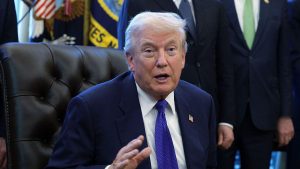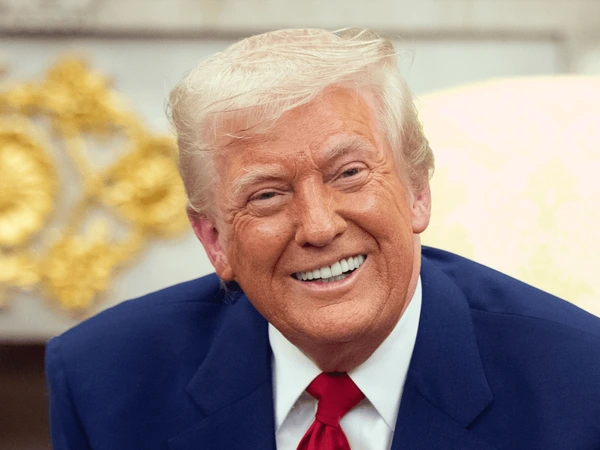
President Donald Trump’s job approval rating has quietly crossed a notable threshold, placing him ahead of two recent occupants of the Oval Office at the same point in their presidencies. According to a new polling average released in early January, Trump’s approval standing now exceeds where both George W. Bush and Barack Obama were positioned during comparable moments in their second terms — a development that could carry meaningful implications as the 2026 midterm elections approach.
The figures, compiled from a rolling aggregation of national polls, show Trump holding an approval rating of 43.9 percent as of January 6, 2026. That number edges out the 43.6 percent approval rating recorded for President George W. Bush on the same calendar date during his second term, as well as President Barack Obama’s 42.4 percent at a similar point in his final four years in office.
While the margins are narrow, the comparison is politically significant. Approval ratings are often used as a rough indicator of public confidence in a sitting president and can influence everything from legislative momentum to campaign strategy ahead of midterm elections, where the president’s party traditionally faces an uphill battle.
The White House was contacted for comment regarding the polling data but did not immediately respond.
Why the Comparison Matters
Historical precedent suggests that midterm elections tend to be challenging for the party controlling the White House. Voters often use the midterms to express dissatisfaction, rebalance power in Congress, or check the president’s agenda. In Trump’s first term, Democrats capitalized on that dynamic in 2018, flipping 40 seats in the House and reclaiming the chamber.
Against that backdrop, Trump’s current approval rating — while still below the 50 percent threshold — represents a relative strength when viewed through a historical lens. Presidents entering midterm cycles with approval ratings in the low-to-mid 40s have experienced mixed outcomes, but those numbers are not necessarily catastrophic, particularly when compared to predecessors who faced steeper declines.
For Republicans, the data offers cautious optimism. For Democrats, it serves as a reminder that Trump’s political durability remains intact despite years of polarization, legal battles, and intense media scrutiny.
What the Data Shows
The comparison comes from a “Today in History” job approval snapshot that examines presidential approval ratings on the same calendar date across different administrations. Using aggregated polling data from RealClearPolling, Trump’s January 6, 2026 rating of 43.9 percent places him slightly ahead of both Bush and Obama at comparable stages in their second terms.
Trump’s approval rating has been tracking above Obama’s numbers consistently since November, though it only surpassed Bush’s figures in early January after trailing them briefly in late December.
While the differences may appear modest, such movements are closely watched by political strategists, donors, and party leaders looking for signals about voter sentiment heading into an election year.
Historical Context: Bush and Obama
Both Bush and Obama experienced dramatic swings in approval during their presidencies, shaped by major national and global events.
President George W. Bush’s approval ratings are among the most volatile in modern presidential history. In the immediate aftermath of the September 11, 2001 terrorist attacks, Bush’s approval soared to over 90 percent in an ABC News poll — one of the highest recorded levels for any U.S. president. However, that unity proved fleeting. As the wars in Iraq and Afghanistan dragged on and the global financial crisis erupted in 2008, Bush’s approval collapsed, reaching a low of 19 percent in a February 2008 survey conducted by the American Research Group.
Bush left office in January 2009 with a final Gallup approval rating of 34 percent — the same figure Trump recorded when his first term ended in January 2021.
Barack Obama’s trajectory followed a different pattern. While his approval dipped at times during contentious legislative battles over health care, economic recovery, and foreign policy, Obama exited office with relatively strong public support. Gallup recorded his approval rating at 59 percent when he left the White House in 2017, reflecting a rebound during his final years in office.
President Bill Clinton, by comparison, left office in 2001 with a 66 percent approval rating, buoyed by a strong economy despite the political fallout of his impeachment.
Trump’s Second-Term Trajectory
Trump’s approval ratings during his second term have remained relatively stable compared to the dramatic fluctuations seen during Bush’s presidency. While his numbers remain well below majority approval, recent polling suggests a modest upward trend after months of stagnation.
Two national surveys conducted in late December and early January indicate that Trump’s approval rating has risen for the first time in several months.
A Reuters/Ipsos poll conducted online between January 4 and January 5 among 1,248 U.S. adults found Trump’s approval rating at 42 percent, up three points from December’s 39 percent. That marked his highest reading in the survey since October. The poll carried a margin of error of plus or minus three percentage points.
Another poll, conducted by InsiderAdvantage on December 20 among 800 likely voters, showed Trump in an even stronger position. That survey recorded a net approval rating of plus 8.4 points — his most favorable showing since August. According to the poll, 49.5 percent of respondents approved of Trump’s job performance, 41.1 percent disapproved, and 9.1 percent were undecided. The margin of error was plus or minus 3.46 percentage points.
While individual polls vary, the broader trend suggests that Trump may be regaining some ground after a period of declining or stagnant public support.
Administration Response and Messaging
Trump’s allies have been quick to frame the improving numbers as evidence that voters are responding positively to his policy agenda, particularly on economic and border-related issues.
Last month, White House spokesperson Kush Desai told Newsweek that the administration remains focused on reversing what it characterizes as the lingering economic damage from the Biden presidency.
“President Trump and every member of his administration are clear-eyed about the fact that Americans continue to reel from the lingering effects of Joe Biden’s generational economic crisis,” Desai said.
He added that nearly every major action taken by the administration since Trump returned to office has been shaped by that goal, citing energy production, gas prices, and drug pricing initiatives as key areas of focus.
“Much work remains,” Desai said, “and every member of the Trump administration continues to focus on recreating the historic job, wage, and economic growth that Americans enjoyed during President Trump’s first term.”
Trump himself has taken a more characteristically combative approach when discussing polling. In a post on Truth Social last month, the president dismissed unfavorable surveys outright, claiming that his true approval rating is far higher than reported.
“The polls are rigged even more than the writers,” Trump wrote. “The real number is 64 percent, and why not, our Country is ‘hotter’ than ever before.”
He pointed to border enforcement, inflation levels, military strength, and economic performance as evidence of what he described as strong national conditions, concluding his post with a celebratory New Year’s message.
Looking Ahead
Approval ratings remain one of the most closely watched indicators of a president’s political standing, particularly as election cycles intensify. While they do not guarantee electoral outcomes, they influence how parties allocate resources, craft messaging, and recruit candidates.
As Trump continues to implement policy changes — including aggressive immigration enforcement measures and assertive foreign policy initiatives — shifts in public opinion could shape both legislative strategy and campaign rhetoric in the months ahead.
With the 2026 midterms approaching, Republicans will be hoping that Trump’s approval continues to trend upward, narrowing the historical disadvantage faced by the president’s party. Democrats, meanwhile, will be watching closely for signs that voter dissatisfaction could reemerge and translate into electoral momentum.
For now, Trump’s approval rating may not be commanding, but in historical terms, it places him in a more competitive position than two of his most prominent predecessors at the same stage — a reminder that, politically speaking, Trump remains a formidable and unconventional force.

Emily Johnson is a critically acclaimed essayist and novelist known for her thought-provoking works centered on feminism, women’s rights, and modern relationships. Born and raised in Portland, Oregon, Emily grew up with a deep love of books, often spending her afternoons at her local library. She went on to study literature and gender studies at UCLA, where she became deeply involved in activism and began publishing essays in campus journals. Her debut essay collection, Voices Unbound, struck a chord with readers nationwide for its fearless exploration of gender dynamics, identity, and the challenges faced by women in contemporary society. Emily later transitioned into fiction, writing novels that balance compelling storytelling with social commentary. Her protagonists are often strong, multidimensional women navigating love, ambition, and the struggles of everyday life, making her a favorite among readers who crave authentic, relatable narratives. Critics praise her ability to merge personal intimacy with universal themes. Off the page, Emily is an advocate for women in publishing, leading workshops that encourage young female writers to embrace their voices. She lives in Seattle with her partner and two rescue cats, where she continues to write, teach, and inspire a new generation of storytellers.