

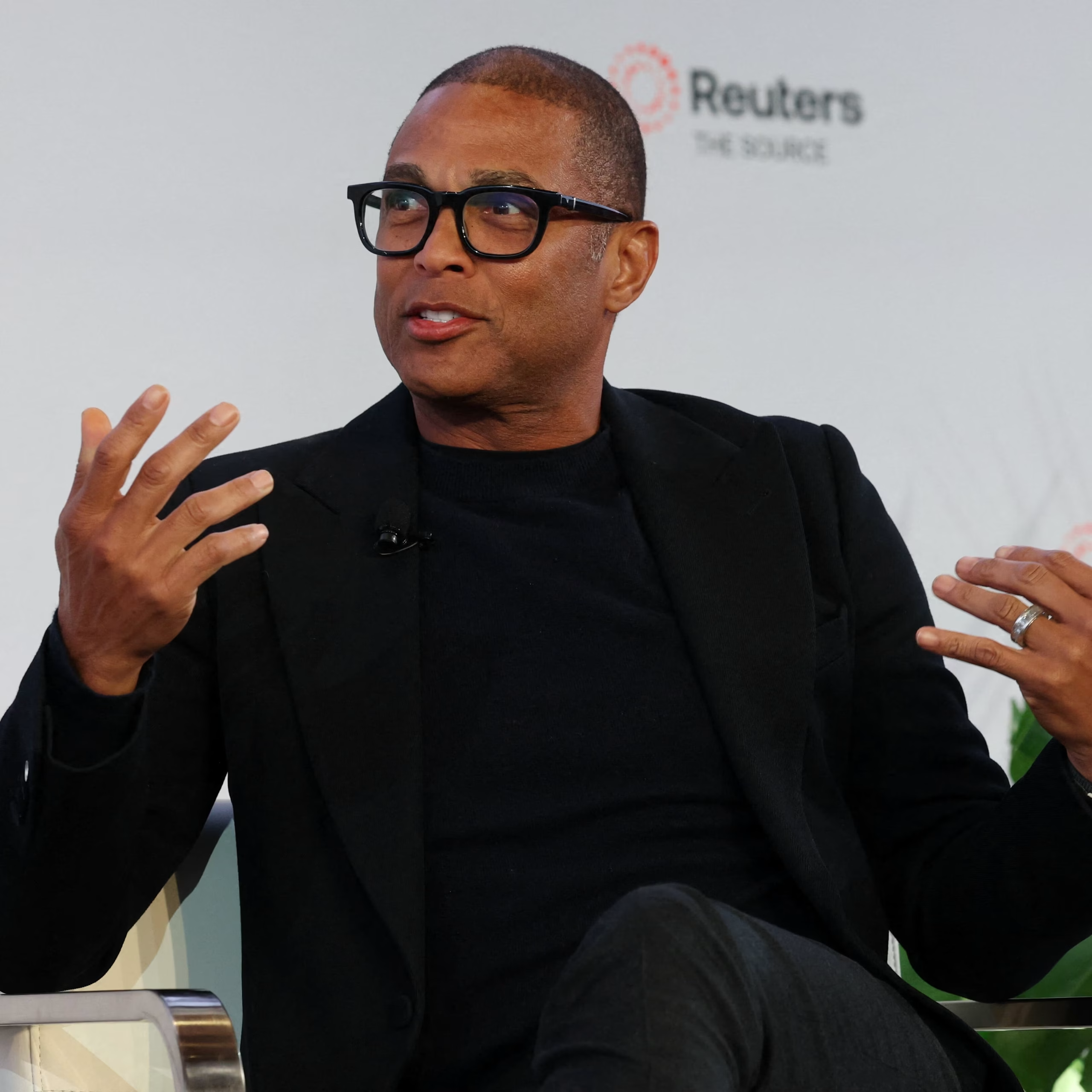
Independent journalist Don Lemon has addressed the backlash after being put “on notice” by the Department of Justice over his presence at a church protest in Minneapolis. The controversy stems from a video Lemon shared on January 18 showing demonstrators interrupting a service at Cities Church to protest Pastor David Easterwood, who is also a local Immigration and Customs Enforcement (ICE) agent. Lemon told viewers, “This is what the First Amendment is about, the freedom to protest. I’m sure people here don’t like it, but protests are not comfortable.”
The footage quickly went viral, drawing criticism from online commentators who accused Lemon of instigating or organizing the protest. Assistant Attorney General Harmeet Dhillon, 57, publicly condemned Lemon’s involvement, posting on X that, “A house of worship is not a public forum for your protest! It is a space protected from exactly such acts by federal criminal and civil laws! Nor does the First Amendment protect your pseudo-journalism of disrupting a prayer service. You are on notice!”
Dhillon further appeared on The Benny Johnson Show on January 19, where she detailed potential legal actions that could be taken against Lemon and other participants. She referenced multiple federal statutes, including the FACE Act, which protects individuals exercising their First Amendment right to religious freedom at places of worship, and the Ku Klux Klan Act (Enforcement Act of 1871), originally enacted to combat post-Civil War attacks by violent hate groups. The Klan Act empowers the president to enforce protections for citizens’ constitutional rights, including deploying federal troops and suspending habeas corpus if necessary.
Dhillon emphasized the severity of federal enforcement, saying, “The Klan Act is one of the most important federal civil rights statutes. Its a law that makes it illegal to terrorize and violate the civil rights of citizens. Whenever people conspire, this, the Klan Act can be used. Everyone in the protest community needs to know that the fullest force of the federal government is going to come down and prevent this from happening and put people away for a long time.”
In response, Lemon issued a statement to Fox News Digital defending his journalistic conduct. He criticized the framing of him as a central figure in the protest, noting that he was one of several reporters present: “It’s notable that I’ve been cast as the face of a protest I was covering as a journalist — especially since I wasn’t the only reporter there. That framing is telling.”
Lemon also highlighted the vitriol he has faced online, including homophobic and racist slurs from MAGA supporters, which he claims have been amplified by certain segments of the right-wing press. He added, “If this much time and energy is going to be spent manufacturing outrage, it would be far better used investigating the tragic death of Renee Nicole Good— the very issue that brought people into the streets in the first place. I stand by my reporting.”
The controversy further intensified when rapper Nicki Minaj publicly criticized Lemon on social media. Posting in all caps on X, Minaj wrote: “DON ‘C— SUCKIN’ LEMON IS DISGUSTING. HOW DARE YOU? I WANT THAT THUG IN JAIL!!!!! HE WOULD NEVER DO THAT TO ANY OTHER RELIGION. LOCK HIM UP!!!!!” alongside a photo of a Chucky doll.
Lemon, who is openly gay and married his longtime partner Tim Malone in 2024, responded to Minaj in a statement to TMZ, dismissing her criticism as uninformed commentary on journalism: “I’m not surprised Nicki Minaj does not understand journalism and is weighing in on matters that are above her capacity. However, the more appropriate image for her post is a ‘Pick Me’ Doll.”
The incident has drawn attention to the complex intersection of journalistic coverage, public protest, and federal enforcement of civil rights statutes. Lemon’s defenders argue that he was performing routine reporting on a newsworthy event, documenting demonstrators’ actions without participating in the protest itself. Meanwhile, critics maintain that his presence and recording may have encouraged the disruption of a religious service, raising legal and ethical questions about the role of journalists in volatile situations.
This episode highlights the broader tensions surrounding freedom of the press, protest rights, and religious protections under federal law. The FACE Act, cited by Dhillon, specifically criminalizes actions that intimidate or interfere with individuals exercising their First Amendment rights in places of worship. Similarly, the Ku Klux Klan Act provides mechanisms for federal intervention when citizens’ civil rights are threatened. These statutes underscore the gravity with which federal authorities view potential violations in sensitive contexts, particularly when protests intersect with religious gatherings.
As the situation develops, Lemon continues to defend his coverage and clarify his role in the events. He stresses that his reporting focused on documenting the protest rather than participating in or organizing it. Supporters of Lemon have noted that video footage shows him engaging with witnesses, church officials, and protestors in a professional capacity rather than directing or inciting actions.
The controversy has sparked a broader debate about the responsibilities of journalists in environments where tensions are high and the line between observing and influencing events can be thin. Legal experts have noted that while journalists are generally protected under the First Amendment, their actions can come under scrutiny if authorities believe they have contributed to criminal behavior.
In parallel, Lemon’s situation has drawn widespread attention online, with polarized reactions from the public. Some argue that he is being unfairly targeted for simply covering a controversial protest, while others contend that journalists must be cautious in settings that could escalate into violations of law or endanger public safety.
The dispute between Lemon and the DOJ also raises questions about political and legal pressures in high-profile cases. With federal statutes like the FACE Act and Klan Act invoked, observers are monitoring how aggressively authorities might pursue charges and whether this could set a precedent for journalistic coverage of protests that occur in sensitive locations such as houses of worship.
For Lemon, the fallout has been immediate. He has faced harassment online, public condemnation from celebrities and public figures, and the looming possibility of federal investigation. Nonetheless, he maintains that his coverage serves a critical role in documenting events that are of public interest, including the response to social issues such as the controversial actions of ICE agents and the death of Renee Nicole Good, which triggered the protest.
As debates over civil liberties, journalism ethics, and protest rights continue, Lemon’s case exemplifies the challenges journalists face when covering contentious events. It underscores the delicate balance between reporting news and navigating the legal and ethical boundaries that govern public demonstrations, particularly those involving sensitive locations like churches.
This incident may have lasting implications for the press, protest organizers, and law enforcement agencies, highlighting the ongoing tension between First Amendment protections, civil rights statutes, and the responsibilities of reporters in documenting public unrest. Lemon’s stance, framed as a defense of journalistic duty, will likely continue to fuel discussion about the boundaries of media coverage and the accountability of those documenting highly charged social events.

Emily Johnson is a critically acclaimed essayist and novelist known for her thought-provoking works centered on feminism, women’s rights, and modern relationships. Born and raised in Portland, Oregon, Emily grew up with a deep love of books, often spending her afternoons at her local library. She went on to study literature and gender studies at UCLA, where she became deeply involved in activism and began publishing essays in campus journals. Her debut essay collection, Voices Unbound, struck a chord with readers nationwide for its fearless exploration of gender dynamics, identity, and the challenges faced by women in contemporary society. Emily later transitioned into fiction, writing novels that balance compelling storytelling with social commentary. Her protagonists are often strong, multidimensional women navigating love, ambition, and the struggles of everyday life, making her a favorite among readers who crave authentic, relatable narratives. Critics praise her ability to merge personal intimacy with universal themes. Off the page, Emily is an advocate for women in publishing, leading workshops that encourage young female writers to embrace their voices. She lives in Seattle with her partner and two rescue cats, where she continues to write, teach, and inspire a new generation of storytellers.