The U.S. Department of Justice on Jan. 23 formally asked a federal court to prevent the public release of a report prepared by former special counsel Jack Smith concerning the classified documents investigation into President Donald Trump. The filing comes amid ongoing disputes over the legality of Smith’s appointment and renewed scrutiny of the investigation that unfolded during the Biden administration.
The request was submitted to U.S. District Judge Aileen Cannon in Florida, who previously issued a temporary injunction blocking the report’s release. That injunction is set to expire next month, prompting the DOJ to intervene and urge the court to impose a permanent ban on public disclosure of the report’s second volume.
Background of the Classified Documents Case
The underlying case stemmed from allegations that classified government materials were improperly retained at Trump’s Mar-a-Lago residence following his departure from the White House in January 2021. The investigation ultimately resulted in criminal charges against Trump, his former valet Waltine Nauta, and former Mar-a-Lago property manager Carlos de Oliveira.
Prosecutors alleged that classified materials were concealed and that efforts were made to obstruct the federal investigation. Trump and his co-defendants consistently denied wrongdoing, arguing that the prosecution was politically motivated and constitutionally flawed.
Judge Cannon’s Dismissal and Constitutional Ruling
In July 2024, Judge Cannon dismissed the superseding indictment against all three defendants. Her ruling centered on the legality of Smith’s appointment as special counsel, concluding that it violated the Appointments Clause of the U.S. Constitution.
Cannon found that Smith was neither nominated by the president nor confirmed by the Senate, and that no federal statute explicitly authorized then-Attorney General Merrick Garland to appoint him. As a result, she ruled that Smith lacked lawful authority to bring the prosecution in the first place.
The DOJ, then under the Biden administration, appealed Cannon’s decision. However, the legal landscape shifted significantly following the November 2024 election.
Case Dropped After Trump’s Election Victory
After Trump won the presidency and became president-elect, Smith dropped the prosecution. Trump was scheduled to return to office as the nation’s 47th president in January 2025, making continued prosecution politically and legally untenable.
Smith formally resigned as special counsel on Jan. 10, 2025, just days before Trump’s inauguration. Shortly afterward, the DOJ moved to dismiss remaining charges against Nauta and de Oliveira.
In February 2025, the U.S. Court of Appeals for the 11th Circuit granted the DOJ’s request to dismiss those charges, effectively closing the criminal case in its entirety.
The Fight Over Smith’s Report
Despite the dismissal of the case, Smith prepared a multi-volume report summarizing his investigations. The first volume, focused on Trump’s efforts to challenge the 2020 election, was released publicly in January 2025 shortly before President Joe Biden left office.
The second volume, which deals specifically with the classified documents investigation, has remained sealed under Judge Cannon’s injunction. Trump and his former co-defendants filed a motion on Jan. 20 seeking to permanently block its release.
The DOJ’s Jan. 23 filing supports that motion.
DOJ Argues Release Would Be Unfair and Prejudicial
In its court submission, the DOJ argued that releasing the second volume would unfairly prejudice Trump, Nauta, and de Oliveira. The filing emphasized that the investigation itself was later ruled unlawful and that publishing its conclusions would violate core constitutional principles.
Assistant U.S. Attorney Manolo Reboso, who filed the brief from Miami, stated that the DOJ now agrees with the defendants that the report should not be released outside the department.
“Smith not only weaponized the Department of Justice against a leading presidential candidate in pursuit of an antidemocratic end,” the filing said, “but he did so without legal authority and while targeting constitutionally protected activity.”
The DOJ described Smith’s tenure as “marked by illegality and impropriety,” asserting that his work product should not be treated as an authoritative or legitimate government document.
Separation of Powers and Privilege Concerns
The DOJ further argued that releasing the report would violate the separation of powers, a foundational constitutional doctrine designed to prevent overreach by any branch of government.
According to Trump’s motion, public disclosure would result in the irreversible dissemination of sensitive grand jury material, attorney-client privileged communications, and information derived from protected discovery.
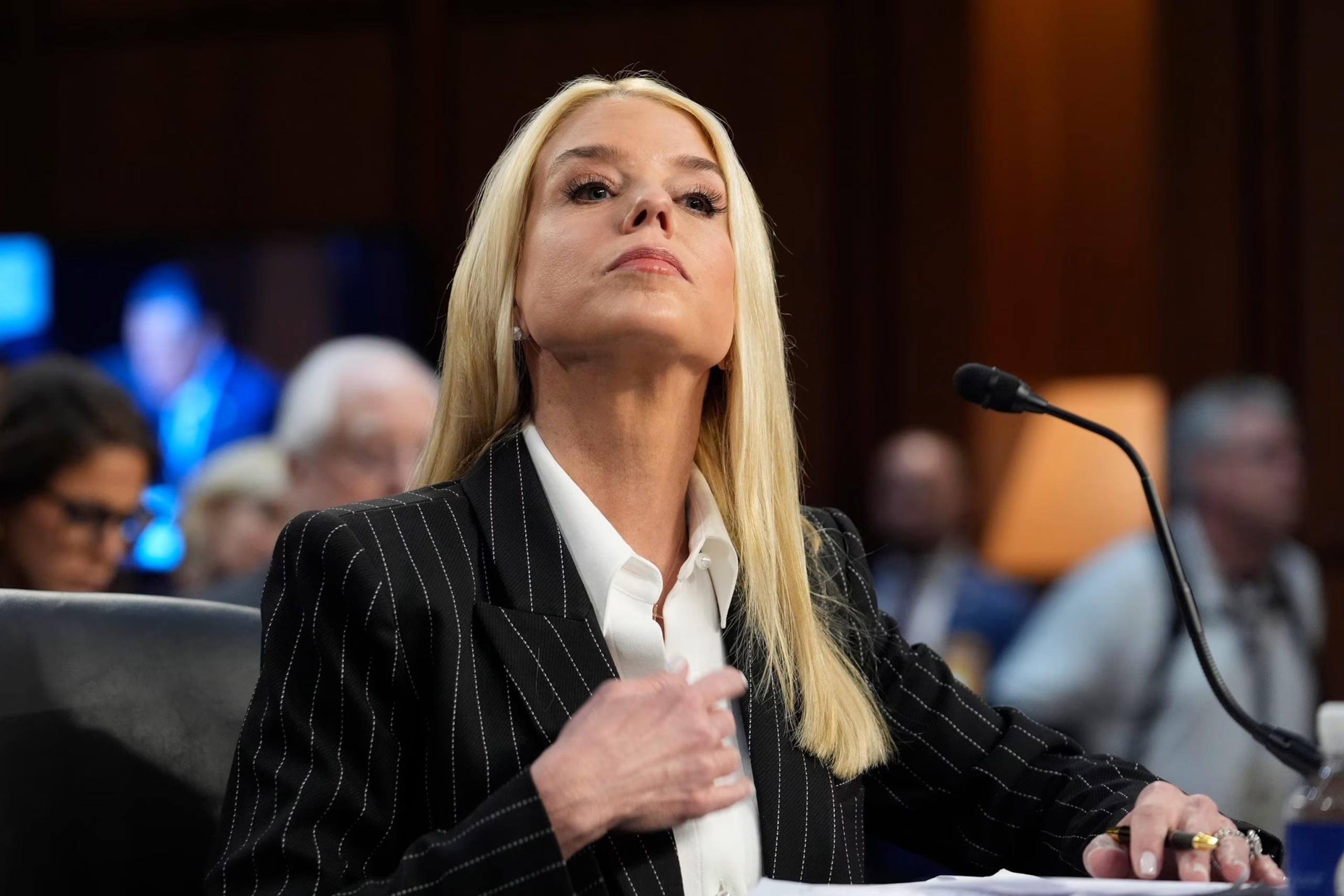
Attorney General Pam Bondi, according to the filing, believes that releasing the report would subject the defendants to “extraordinary unfairness and prejudice,” particularly given Trump’s assertion of attorney-client privilege over key aspects of the investigation.
The DOJ warned that once such information is released, the harm cannot be undone.
A Shift in DOJ’s Position
The filing marks a notable reversal from the DOJ’s earlier posture under the Biden administration, when it defended Smith’s authority and appealed Cannon’s dismissal.
Now, under Trump’s administration, DOJ officials argue that the report represents the “illicit product of an unlawful investigation” and should be consigned “to the dustbin of history.”
The department stressed that allowing publication would effectively legitimize an investigation that the courts have already deemed unconstitutional.
Smith Defends His Actions
Meanwhile, Smith appeared before the U.S. House Judiciary Committee on Jan. 22, where he defended his decision to prosecute Trump in both the classified documents case and the election-related case.
“No one should be above the law in our country,” Smith told lawmakers. “The law required that the president be held to account. So that is what I did.”
Smith has not publicly commented on the DOJ’s effort to block release of the second volume. The Epoch Times reported that it contacted Smith through his attorneys at Covington & Burling but received no response by publication time.
What Happens Next
Judge Cannon’s temporary injunction blocking release of the report expires on Feb. 24. If the court grants Trump’s motion and the DOJ’s supporting request, the second volume would remain permanently sealed.
Legal observers say the outcome could set an important precedent regarding the limits of special counsel authority and the handling of investigative reports after prosecutions collapse.
For now, the court must decide whether the public interest is served by releasing findings from an investigation that has been ruled unconstitutional—or whether shielding the report is necessary to protect due process, executive authority, and the integrity of the justice system.

Emily Johnson is a critically acclaimed essayist and novelist known for her thought-provoking works centered on feminism, women’s rights, and modern relationships. Born and raised in Portland, Oregon, Emily grew up with a deep love of books, often spending her afternoons at her local library. She went on to study literature and gender studies at UCLA, where she became deeply involved in activism and began publishing essays in campus journals. Her debut essay collection, Voices Unbound, struck a chord with readers nationwide for its fearless exploration of gender dynamics, identity, and the challenges faced by women in contemporary society. Emily later transitioned into fiction, writing novels that balance compelling storytelling with social commentary. Her protagonists are often strong, multidimensional women navigating love, ambition, and the struggles of everyday life, making her a favorite among readers who crave authentic, relatable narratives. Critics praise her ability to merge personal intimacy with universal themes. Off the page, Emily is an advocate for women in publishing, leading workshops that encourage young female writers to embrace their voices. She lives in Seattle with her partner and two rescue cats, where she continues to write, teach, and inspire a new generation of storytellers.