Colombia’s president has sharply escalated rhetoric against President Donald Trump, warning that he would “take up arms” if the United States carries out military action against Colombia, following remarks by Trump that accused the country’s leadership of involvement in narco-terrorism.
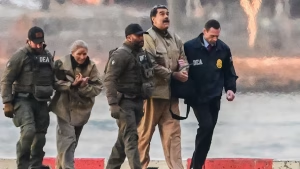
The confrontation erupted after Trump, speaking aboard Air Force One on Sunday, January 4, described Colombia as “very sick” and claimed it was being run by “a sick man who likes making cocaine and selling it to the United States.” The comments came just days after a US military operation in neighboring Venezuela that resulted in the capture of President Nicolás Maduro, who now faces drug trafficking and weapons charges in the United States.
Trump’s remarks marked a dramatic shift in tone toward Colombia, long considered one of Washington’s closest regional allies in the fight against drug cartels. When asked by reporters whether Colombia could face similar military action to that carried out in Venezuela, Trump responded, “It sounds good to me,” later adding that Colombian President Gustavo Petro should “watch his ass.”
Petro Responds With Defiant Warning
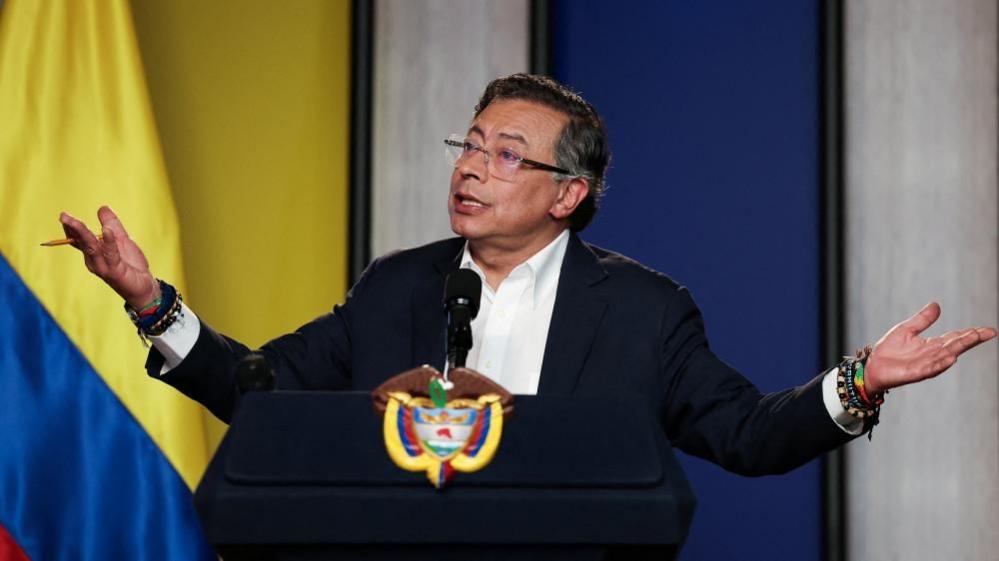
President Petro responded forcefully on Monday, delivering one of his most confrontational statements since taking office in 2022. A former member of the left-wing M-19 guerrilla movement before a peace agreement in 1989, Petro said he had sworn never to carry a weapon again—but suggested that could change if Colombia were attacked.
“I swore not to touch a weapon again,” Petro said. “But for the homeland, I will take up arms again.”
The statement underscored the seriousness with which Colombia’s leadership is taking Trump’s remarks, especially in the context of the recent US operation in Venezuela. Petro warned that any attempt to destabilize Colombia or remove its elected leadership would provoke fierce resistance.
Rejecting Narco-Terrorism Allegations
Petro strongly denied Trump’s claims that he is involved in drug trafficking or oversees cocaine production. He described the accusations as unfounded and politically reckless, arguing that they ignore Colombia’s ongoing efforts to combat narcotics production and organized crime.
“I am not illegitimate, nor am I a narco,” Petro wrote on X. “I only have as assets my family home that I still pay for with my salary. My bank statements have been published. No one could say that I have spent more than my salary. I am not greedy.”
The Colombian leader accused Trump of speaking “without knowledge” of the realities on the ground and warned that US military intervention would lead to civilian casualties and renewed insurgency.
“If you bomb even one of these groups without sufficient intelligence, you will kill many children,” Petro said. “If you bomb peasants, thousands of guerrillas will return to the mountains.”
Colombia’s Role in the Drug War
Colombia remains the world’s largest producer of cocaine, a reality that has shaped decades of cooperation between Bogotá and Washington. Despite this, Petro has positioned his administration as pursuing a different approach to the drug war, focusing on reducing coca cultivation through alternative crops while simultaneously intensifying operations against major criminal organizations.
Petro pointed to what he described as historic law enforcement achievements under his government, including the seizure of 14 metric tons of cocaine in a single operation—believed to be the largest seizure ever recorded. He also highlighted ongoing military actions against powerful armed groups such as the Gulf Clan, the National Liberation Army (ELN), and dissident factions of the Revolutionary Armed Forces of Colombia (FARC).
Trump, however, dismissed these efforts while speaking aboard Air Force One, claiming Petro “has cocaine mills and cocaine factories” and suggesting that his leadership would soon come to an end.
Fears of Regional Escalation
The clash between Washington and Bogotá has raised alarm across Latin America, particularly following the US operation in Venezuela. Regional analysts warn that aggressive rhetoric combined with military action could destabilize the continent and undo years of diplomatic and security cooperation.
Petro warned that arresting Colombia’s elected president or launching airstrikes would have severe consequences.
“If you arrest the president whom a good part of my people want and respect,” he said, “you will unleash the popular jaguar.”
He concluded his remarks with a defiant message directed at the Trump administration: “Know that you are facing a commander of the people. Free Colombia forever.”
US Silence on Specific Plans
The White House has not clarified whether Trump’s remarks reflect an actual policy shift or were intended as rhetorical pressure. US officials have declined to comment on whether Colombia is under investigation for narco-terrorism or whether military options are being considered.
Trump has previously framed US actions in Venezuela as “law enforcement” rather than military intervention, a characterization that has been widely disputed by international legal experts. Whether a similar argument could be applied to Colombia—one of the United States’ longest-standing security partners—remains unclear.
Alliance Under Strain
For decades, Colombia has been a cornerstone of US strategy in Latin America, receiving billions of dollars in military aid and training under initiatives such as Plan Colombia. Petro’s election as the country’s first left-wing president already complicated relations, but Trump’s recent remarks threaten to push the relationship into open hostility.
Diplomats and analysts warn that publicly accusing an allied head of state of narco-terrorism, while hinting at military action, risks undermining intelligence cooperation and emboldening criminal groups.
Uncertain Path Forward
As tensions rise, both governments appear entrenched. Petro has signaled that Colombia will not bow to threats, while Trump has shown little inclination to soften his stance following the dramatic operation in Venezuela.
Whether the confrontation remains a war of words or escalates further may depend on diplomatic backchannels that have so far remained silent. For now, the exchange has injected fresh instability into an already volatile region, leaving allies and adversaries alike watching closely for signs of what may come next.

Emily Johnson is a critically acclaimed essayist and novelist known for her thought-provoking works centered on feminism, women’s rights, and modern relationships. Born and raised in Portland, Oregon, Emily grew up with a deep love of books, often spending her afternoons at her local library. She went on to study literature and gender studies at UCLA, where she became deeply involved in activism and began publishing essays in campus journals. Her debut essay collection, Voices Unbound, struck a chord with readers nationwide for its fearless exploration of gender dynamics, identity, and the challenges faced by women in contemporary society. Emily later transitioned into fiction, writing novels that balance compelling storytelling with social commentary. Her protagonists are often strong, multidimensional women navigating love, ambition, and the struggles of everyday life, making her a favorite among readers who crave authentic, relatable narratives. Critics praise her ability to merge personal intimacy with universal themes. Off the page, Emily is an advocate for women in publishing, leading workshops that encourage young female writers to embrace their voices. She lives in Seattle with her partner and two rescue cats, where she continues to write, teach, and inspire a new generation of storytellers.