A political standoff is intensifying in Washington as former President Bill Clinton and former Secretary of State Hillary Clinton openly defy a congressional subpoena tied to the House investigation into Jeffrey Epstein. In a sharply worded letter released this week, the couple rejected demands that they appear before lawmakers, accusing Republican leaders of pursuing a legally flawed and politically motivated campaign that could, in their words, lead “directly to our imprisonment.”
The letter, addressed to House Oversight Committee Chairman James Comer, signals that the Clintons are prepared for a prolonged legal and political battle. It frames the subpoena not as a legitimate tool of oversight but as an abuse of congressional power designed to intimidate and punish. The couple pledged to “forcefully defend ourselves” and declared that the committee’s actions violate established legal standards.
Their refusal places Congress on a collision course with two of the most prominent figures in modern American politics, and it sets the stage for what could become one of the most dramatic contempt-of-Congress confrontations in decades.
At issue is the House Oversight Committee’s investigation into the government’s handling of Jeffrey Epstein and the broader network that enabled his crimes. Epstein, the disgraced financier accused of sex trafficking minors, died in federal custody in 2019 while awaiting trial. His death, and the failures that preceded it, continue to fuel public outrage and suspicion.
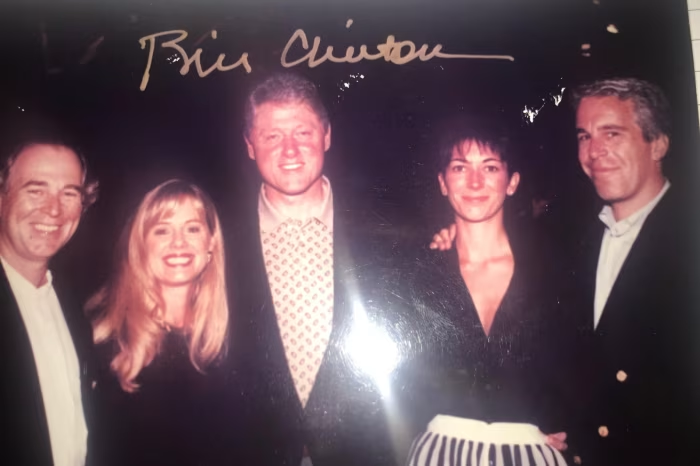
Republicans argue that the public deserves a complete accounting of who knew what, and when. They say the Clintons’ past association with Epstein—particularly Bill Clinton’s documented interactions with him in the 1990s and early 2000s—makes their testimony relevant.
The Clintons counter that they have already provided what little information they possess and that they were never accused of wrongdoing. In their letter, they stress that Epstein’s crimes were “horrific” and that the real focus should be on whether authorities failed to investigate and prosecute him properly. They accuse the committee of selectively enforcing subpoenas, allowing some former officials to submit written statements while insisting that the Clintons submit to in-person depositions.
“This is not about uncovering the truth,” the letter asserts in substance. “It is about using the machinery of Congress to single us out.”
Chairman Comer has responded by warning that if the Clintons do not comply, the committee will initiate contempt proceedings. Under congressional rules, contempt can lead to a referral to the Justice Department or, in rare cases, direct enforcement by Congress itself. While modern lawmakers seldom pursue the most extreme options, Comer has made clear that he is prepared to escalate.
“The Clintons have not confirmed their appearances for their subpoenaed depositions,” a committee spokesperson said earlier this week. “They are obligated under the law to appear and we expect them to do so. If they do not, the House Oversight Committee will initiate contempt of Congress proceedings.”
Comer has emphasized that the subpoena was not a partisan ambush. According to him, it was approved in a bipartisan vote by the full committee. He has repeatedly stated that no one is accusing the Clintons of criminal conduct, insisting that the goal is to answer outstanding questions surrounding Epstein and the government’s response.
“This wasn’t something I just issued as chairman,” Comer told reporters. “The entire committee voted to subpoena former President Clinton and former Secretary of State Hillary Clinton.”
Yet the Clintons’ letter portrays a very different reality. They argue that the committee is ignoring due process and long-standing norms, and that its approach appears designed to create a spectacle rather than gather facts. They describe the looming contempt process as “literally designed to result in our imprisonment,” a phrase that underscores how seriously they are treating the threat.
The political implications are significant. For Republicans, pressing forward reinforces their broader narrative that powerful elites have escaped accountability in the Epstein saga. For Democrats, the confrontation raises alarms about what they see as the weaponization of congressional authority against political opponents.
A Democratic spokesperson for the Oversight Committee urged cooperation but also cautioned against escalation, noting that the committee should continue working with Clinton’s legal team to obtain any relevant information. The statement reflected discomfort within the party about turning the investigation into a public brawl between Congress and a former president.
The episode also highlights the unusual nature of contempt proceedings in modern times. While Congress has the authority to compel testimony, it has rarely exercised its most aggressive enforcement tools in recent decades. Contempt referrals often stall in the Justice Department, particularly when the target is politically influential. Direct enforcement by Congress—such as ordering an arrest—exists largely in theory, having not been used in generations.
Still, the threat carries symbolic weight. Being held in contempt of Congress would be unprecedented for a former president and a former secretary of state acting jointly. It would deepen partisan divisions and almost certainly spark protracted court battles over executive privilege, congressional authority, and the limits of legislative power.
Beyond the legal mechanics, the confrontation is reshaping the political narrative around Epstein. The financier’s crimes have become a kind of national scar, representing institutional failure at multiple levels. Every new development rekindles public anger and suspicion. Republicans see an opportunity to demonstrate that no one, not even the Clintons, stands above scrutiny. The Clintons see a dangerous erosion of norms that protect individuals from what they describe as arbitrary coercion.
In their letter, the couple argue that the committee’s tactics undermine the very goal of justice. They write that if the government failed in its duty to investigate Epstein properly, that failure should be the central focus. Turning the process into a punitive spectacle, they suggest, risks distracting from the systemic breakdowns that allowed Epstein to operate for years.
Their public posture is defiant but carefully framed. They do not deny Epstein’s crimes or minimize their severity. Instead, they position themselves as cooperative in principle but resistant to what they consider an unlawful demand. The message is aimed not only at Congress but at the broader public: this is, in their words, “not about Right or Left, it’s about Right and Wrong.”
For Comer and his allies, backing down would carry its own political cost. Having warned that contempt is imminent, retreat would invite accusations of weakness. Moving forward, however, could entangle the committee in months or even years of litigation, shifting attention away from the substance of the Epstein inquiry and toward procedural battles.
The timing adds further volatility. The country is already strained by polarized politics, high-profile investigations, and widespread distrust of institutions. A showdown between Congress and a former president over subpoenas risks becoming another flashpoint in that environment.
If contempt proceedings begin, several paths are possible. The House could vote to hold the Clintons in contempt and refer the matter to the Justice Department. Prosecutors would then decide whether to pursue charges, a step that has historically been rare and politically sensitive. Alternatively, Congress could attempt civil enforcement through the courts, seeking a judicial order compelling testimony. That route would almost certainly prompt appeals, potentially reaching the Supreme Court.
Each option would test the balance of power between branches of government. Each would also keep the Epstein investigation in the headlines, but perhaps not in the way lawmakers intended.
For now, both sides are holding their ground. The Clintons insist that the subpoenas are invalid and that they will not submit to what they describe as an unlawful process. Comer insists that the law is on Congress’s side and that no one is above oversight.
What began as an inquiry into one of the darkest scandals in recent history has evolved into a constitutional confrontation. Whether it ultimately produces new facts about Epstein or merely deepens political divisions may depend less on what the Clintons know and more on how far Congress is willing to go to make them talk.

Emily Johnson is a critically acclaimed essayist and novelist known for her thought-provoking works centered on feminism, women’s rights, and modern relationships. Born and raised in Portland, Oregon, Emily grew up with a deep love of books, often spending her afternoons at her local library. She went on to study literature and gender studies at UCLA, where she became deeply involved in activism and began publishing essays in campus journals. Her debut essay collection, Voices Unbound, struck a chord with readers nationwide for its fearless exploration of gender dynamics, identity, and the challenges faced by women in contemporary society. Emily later transitioned into fiction, writing novels that balance compelling storytelling with social commentary. Her protagonists are often strong, multidimensional women navigating love, ambition, and the struggles of everyday life, making her a favorite among readers who crave authentic, relatable narratives. Critics praise her ability to merge personal intimacy with universal themes. Off the page, Emily is an advocate for women in publishing, leading workshops that encourage young female writers to embrace their voices. She lives in Seattle with her partner and two rescue cats, where she continues to write, teach, and inspire a new generation of storytellers.