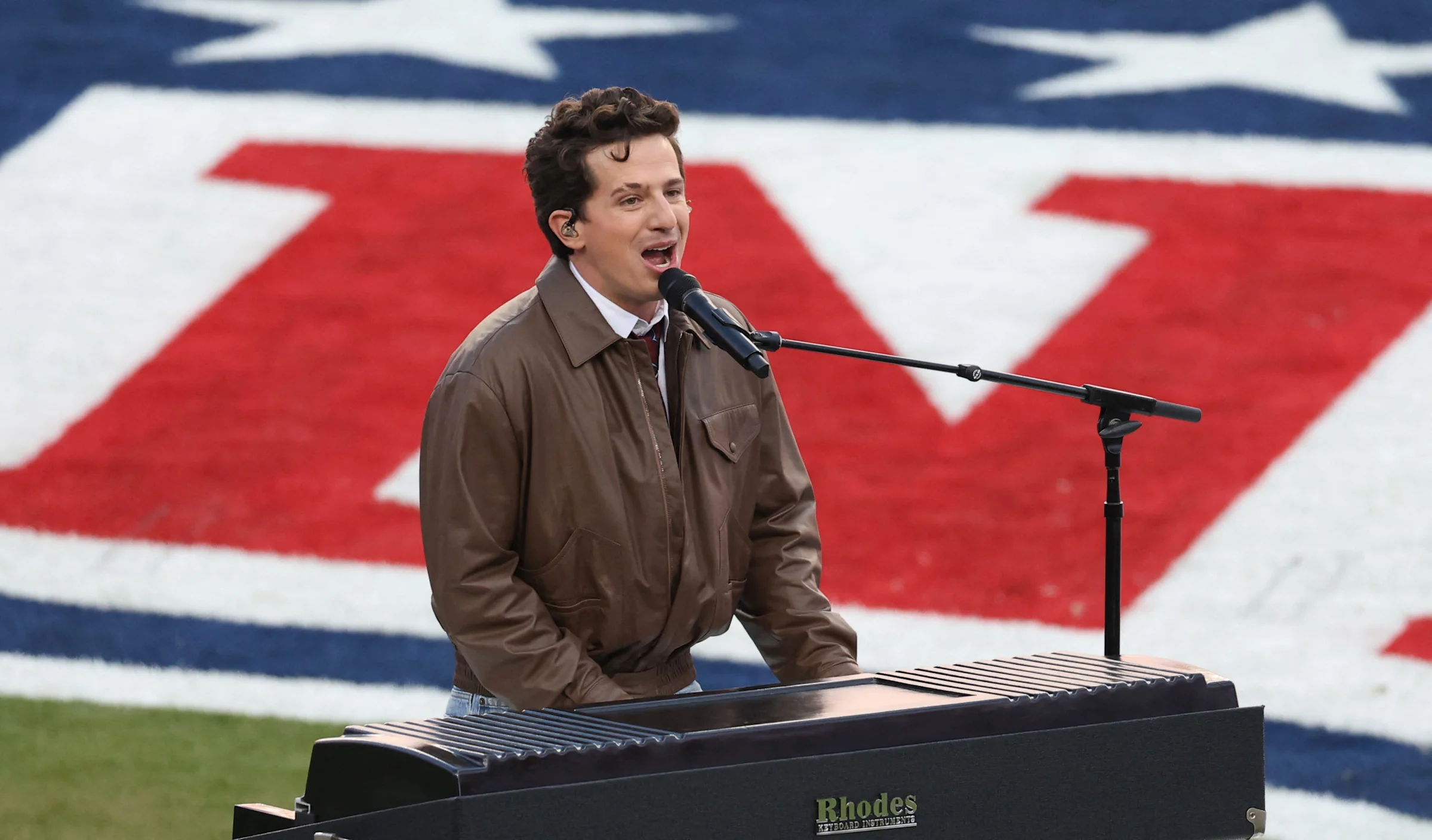
Charlie Puth has addressed the growing controversy surrounding his performance of the national anthem at Super Bowl LX, responding directly to accusations that he lip-synced the rendition during one of the most watched live broadcasts of the year.
The Grammy-nominated singer took center stage before kickoff, delivering a dramatic and vocally intricate version of “The Star-Spangled Banner.” The performance immediately drew strong reactions online. While many viewers applauded his technical control and emotional delivery, others were quick to criticize, with some questioning whether what they heard was truly performed live.
Within minutes of the anthem concluding, social media platforms were flooded with debate. A segment of viewers praised his pitch accuracy and stylistic restraint, noting that the arrangement felt polished and carefully constructed. Others, however, argued that the vocals sounded “too perfect,” fueling speculation that portions may have been pre-recorded.
One widely shared comment read: “I know Charlie Puth is known for perfect pitch, but it sounded lip-synced. The national anthem should always be live.” Another viewer questioned outright whether the performance had been pre-tracked.
The criticism escalated as some labeled it among the weakest anthem performances in Super Bowl history — a particularly strong claim considering the decades-long legacy of iconic renditions at the event. The Super Bowl anthem has long been treated as a defining cultural moment, often scrutinized as closely as the game itself. Performers are judged not only on vocal execution but on authenticity, emotional impact, and patriotic tone.
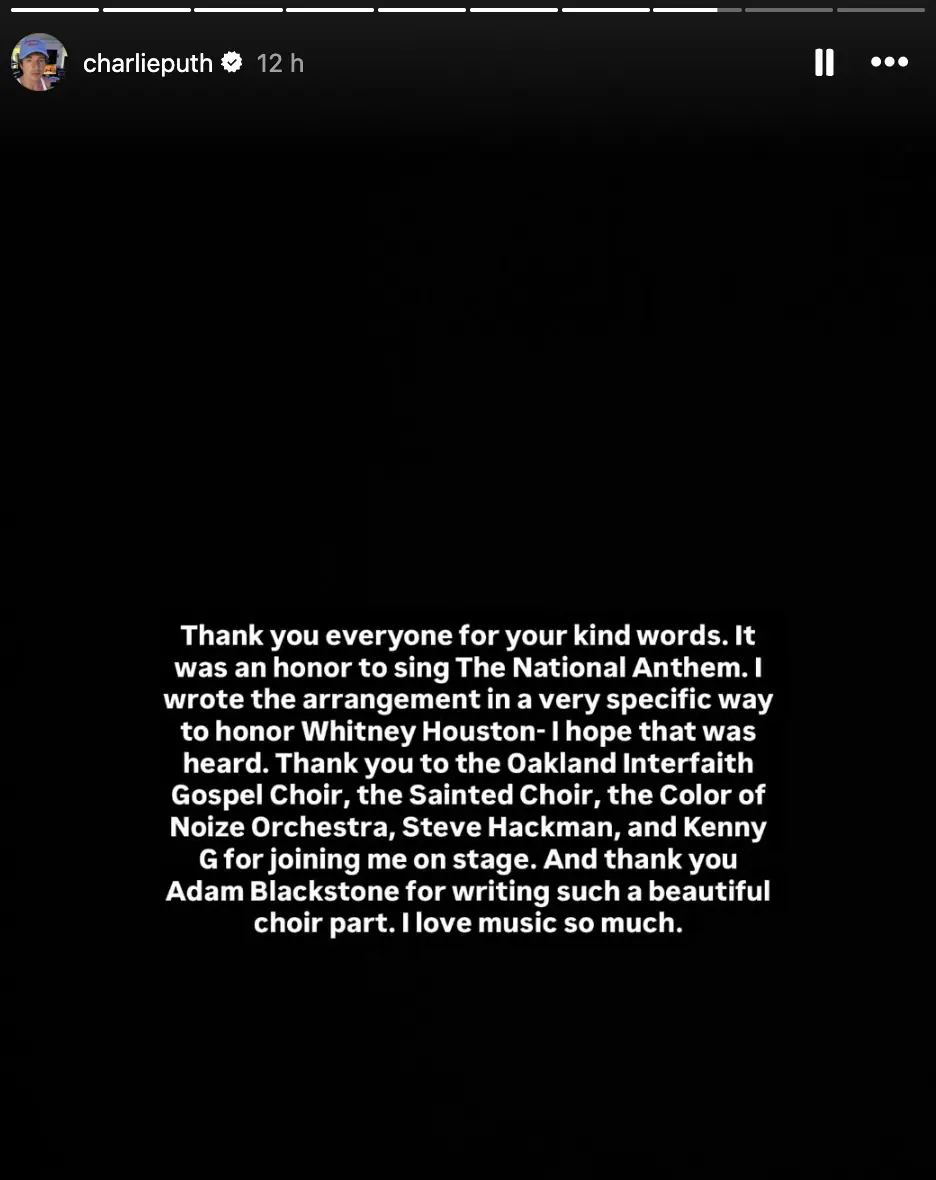
In response to the debate, Puth addressed the controversy on his Instagram story. Rather than confront critics directly, he focused on the artistic intent behind his arrangement and expressed gratitude for the opportunity.
“Thank you everyone for your kind words. It was an honor to sing The National Anthem,” he wrote. He went on to explain that the arrangement was deliberately structured as a tribute to Whitney Houston’s legendary 1991 Super Bowl performance — widely considered the gold standard for anthem renditions.
Houston’s interpretation during Super Bowl XXV remains one of the most iconic performances in NFL history, praised for its vocal strength, phrasing, and emotional resonance during a tense period marked by the Gulf War. By referencing her version, Puth signaled that his arrangement was not improvised but thoughtfully composed with historical context in mind.
He also acknowledged the collaborators who joined him on stage, including the Oakland Interfaith Gospel Choir, the Sainted Choir, the Color of Noize Orchestra, conductor Steve Hackman, saxophonist Kenny G, and music director Adam Blackstone. According to Puth, the choir arrangements and orchestration were intentionally layered to create a grand, symphonic feel that mirrored Houston’s influence while still reflecting his own musical identity.
“I wrote the arrangement in a very specific way to honor Whitney Houston — I hope that was heard,” he added. “I love music so much.”
Supporters quickly defended him, pointing out that Puth is widely recognized within the industry for his exceptional ear and technical precision. Known for absolute pitch — the rare ability to identify or recreate musical notes without reference — he has built much of his career around vocal accuracy and compositional detail. Fans argued that what some perceived as lip-syncing may simply have been the result of meticulous preparation and controlled live mixing.
It is also worth noting that large-scale televised events often employ vocal reinforcement systems. In stadium environments, performers sometimes sing live over a subtle backing track to ensure audio consistency due to wind, crowd noise, and broadcast logistics. While purists argue the anthem should be performed entirely live, broadcast production standards frequently incorporate safeguards to prevent technical mishaps during such high-stakes moments.
Neither the NFL nor Roc Nation — the entertainment company led by Jay-Z that oversees Super Bowl performances — has indicated that the anthem was pre-recorded. Historically, the league has required live vocals for anthem performances, though instrumentation may be partially pre-tracked depending on staging demands.
The debate underscores how intensely scrutinized the national anthem segment has become. From Whitney Houston to Beyoncé, Lady Gaga, Chris Stapleton, and others, each performer is inevitably compared to prior renditions. Social media has only amplified this phenomenon, turning real-time reactions into trending controversies within minutes.
Despite the criticism, many fans praised the performance for its emotional weight and contemporary gospel influence. Supporters described it as “cinematic,” “respectful,” and “technically brilliant.” Some music professionals noted that his vocal phrasing choices and sustained high notes required substantial breath control, suggesting a live element was evident in subtle tonal variations.
The controversy also highlights the broader tension between spectacle and authenticity in modern live broadcasts. As production values continue to rise, audiences simultaneously demand perfection and rawness — two qualities that can be difficult to balance on a global stage.
Puth’s appearance at the Super Bowl followed what sources described as a private audition process managed by Roc Nation, which collaborates with the NFL on entertainment programming. His selection placed him among a prestigious list of artists trusted to deliver one of the most symbolically significant performances of the evening.
For his part, Puth has not directly addressed the lip-sync allegations beyond emphasizing the thought and care that went into the arrangement. Instead of engaging in online back-and-forth, he chose to center the conversation on musical respect and gratitude.
As with many Super Bowl performances, public opinion may ultimately soften with time. Anthem renditions often face immediate scrutiny but are later reassessed with greater nuance once the initial wave of reaction subsides.
Whether viewed as a bold artistic tribute or an overproduced interpretation, the performance achieved one undeniable outcome: it sparked conversation. In the era of instant digital commentary, that alone ensures its place in Super Bowl history.
For now, the debate continues — but so does Puth’s insistence that his intention was rooted in homage, musicianship, and respect for one of the most iconic performances ever delivered on that stage.

Emily Johnson is a critically acclaimed essayist and novelist known for her thought-provoking works centered on feminism, women’s rights, and modern relationships. Born and raised in Portland, Oregon, Emily grew up with a deep love of books, often spending her afternoons at her local library. She went on to study literature and gender studies at UCLA, where she became deeply involved in activism and began publishing essays in campus journals. Her debut essay collection, Voices Unbound, struck a chord with readers nationwide for its fearless exploration of gender dynamics, identity, and the challenges faced by women in contemporary society. Emily later transitioned into fiction, writing novels that balance compelling storytelling with social commentary. Her protagonists are often strong, multidimensional women navigating love, ambition, and the struggles of everyday life, making her a favorite among readers who crave authentic, relatable narratives. Critics praise her ability to merge personal intimacy with universal themes. Off the page, Emily is an advocate for women in publishing, leading workshops that encourage young female writers to embrace their voices. She lives in Seattle with her partner and two rescue cats, where she continues to write, teach, and inspire a new generation of storytellers.