
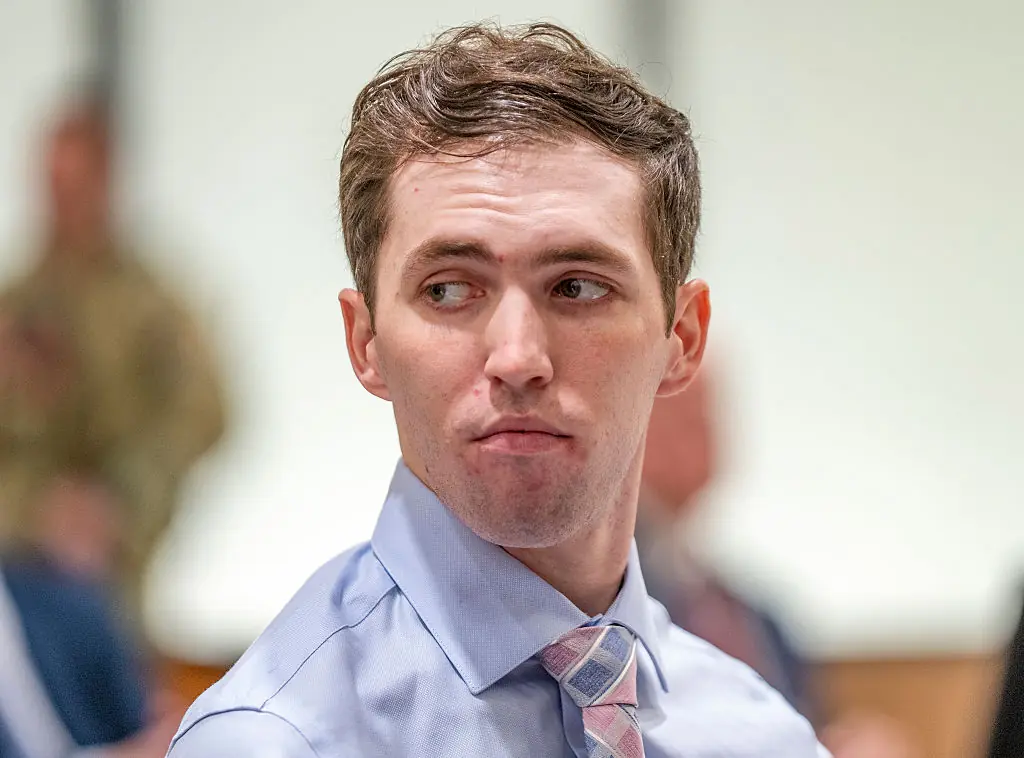
The man accused of fatally shooting conservative activist Charlie Kirk appeared in court Thursday for his first in-person hearing, drawing intense scrutiny amid emotional scenes, strict judicial controls, and mounting public interest in one of the most closely watched criminal cases in the country.
Tyler Robinson, 22, entered the Provo, Utah courtroom appearing calm and composed as he took his seat between defense attorneys. Wearing a blue shirt and tie rather than a jail-issued jumpsuit—a privilege granted by the court—Robinson appeared relaxed throughout the proceeding. At various moments, cameras captured him smiling and leaning toward his legal team to whisper, behavior that quickly sparked outrage among supporters of Kirk and intensified public reaction to the case.
The atmosphere inside the courtroom was tense. Robinson’s immediate family, including his parents and brother, were seated in the gallery just behind him. Their presence, however, became a point of contention when Judge Tony Graf ordered the courtroom cleared for a closed portion of the hearing. Defense attorneys requested that Robinson’s family be allowed to remain, but the judge denied the request.
Following the ruling, Robinson’s mother was seen outside the courtroom visibly distraught, sobbing as she exited into the hallway, according to reporters on the scene. The emotional moment underscored the strain surrounding the case, which has drawn extraordinary public attention since Kirk’s killing earlier this year.
Judge Graf acknowledged the unprecedented level of interest surrounding the proceedings and said additional precautions were necessary to preserve the integrity of the judicial process. Citing concerns over Robinson’s right to a fair trial, the judge implemented new restrictions on courtroom media coverage.
While television cameras were permitted to remain, the court prohibited any footage showing Robinson in shackles. Cameras were also ordered to be repositioned toward the back of the courtroom after defense attorneys complained that earlier footage had captured improper angles and inadvertently recorded private communications between Robinson and his legal team.
Both Robinson’s attorneys and the Utah County Sheriff’s Office supported the restrictions, arguing that excessive media exposure could complicate jury selection and create security risks. Utah courts already impose strict limits on media access, typically allowing only a single videographer and photographer to pool footage for distribution to news outlets. Authorities emphasized that the current measures were consistent with those policies, albeit heightened due to the case’s profile.
Not everyone involved agreed with the judge’s approach. Erika Kirk, the widow of Charlie Kirk, has publicly called for full transparency in the proceedings. She has argued that the public has a right to witness the trial of the man accused of murdering her husband during a public speaking event. Her stance reflects a broader debate over balancing a defendant’s rights with public accountability in high-profile cases.
Robinson faces a sweeping list of charges, including aggravated murder, obstruction of justice, felony discharge of a firearm causing serious injury, two counts of witness tampering, and committing a violent offense in the presence of a child. He has not yet entered a plea. If convicted, he could face the death penalty under Utah law, where execution by firing squad remains a legal option in certain cases, according to ABC News.
Prosecutors allege that Robinson opened fire during a speaking event at Utah Valley University on September 10. Kirk, 31, was reportedly struck in the neck in front of a large audience of students. Emergency responders pronounced him dead at the scene, sending shockwaves through political, media, and activist circles nationwide.
Investigators say Robinson fled the scene and remained at large for more than a day. Authorities allege he was arrested approximately 33 hours later after his father recognized him in surveillance images that had been circulated publicly and contacted law enforcement. Police have described the arrest as cooperative, with Robinson taken into custody without incident.
Court documents detail evidence prosecutors say links Robinson to the crime. Investigators recovered bullet casings from the scene bearing engraved phrases referencing video game culture and antifascist slogans. Among the inscriptions were messages such as “Hey fascist! Catch!” and lyrics from the Italian partisan song “Bella ciao,” which has been adopted in various political protest movements.
Authorities have also cited text messages allegedly sent by Robinson in which he admitted to the shooting and provided information about where the firearm used in the attack was hidden. Prosecutors argue that the messages, combined with physical evidence and eyewitness accounts, form a compelling case.
The judge’s decision to limit camera access followed the spread of digitally altered images online that falsely depicted Robinson crying or having emotional outbursts during the hearing. Court observers noted that these images were misleading; in reality, Robinson appeared calm and, at times, almost jovial. Officials expressed concern that misinformation could further inflame public sentiment and potentially influence prospective jurors.
WATCH:
Supporters of Kirk have expressed anger over Robinson’s demeanor in court, interpreting his smiles as a sign of disrespect toward the victim and his family. Defense attorneys, however, cautioned against drawing conclusions from courtroom behavior, emphasizing that Robinson is presumed innocent and that reactions can be misinterpreted under intense pressure.
Judge Graf reiterated that the court’s priority is to ensure a fair and orderly process, free from external influence. He warned that continued leaks or manipulated media content could prompt even stricter controls in future hearings.
As the case moves forward, it is expected to remain under heavy public scrutiny. Pretrial motions, evidentiary challenges, and debates over media access are likely to continue before a jury is ever seated. For now, the courtroom scenes have set the tone for what promises to be a lengthy and emotionally charged legal battle—one that sits at the intersection of criminal justice, public transparency, and national political tension.
The next hearing date has not yet been announced, but both sides are preparing for an aggressive legal fight as the court seeks to navigate the complexities of one of Utah’s most consequential criminal cases in recent history.

Emily Johnson is a critically acclaimed essayist and novelist known for her thought-provoking works centered on feminism, women’s rights, and modern relationships. Born and raised in Portland, Oregon, Emily grew up with a deep love of books, often spending her afternoons at her local library. She went on to study literature and gender studies at UCLA, where she became deeply involved in activism and began publishing essays in campus journals. Her debut essay collection, Voices Unbound, struck a chord with readers nationwide for its fearless exploration of gender dynamics, identity, and the challenges faced by women in contemporary society. Emily later transitioned into fiction, writing novels that balance compelling storytelling with social commentary. Her protagonists are often strong, multidimensional women navigating love, ambition, and the struggles of everyday life, making her a favorite among readers who crave authentic, relatable narratives. Critics praise her ability to merge personal intimacy with universal themes. Off the page, Emily is an advocate for women in publishing, leading workshops that encourage young female writers to embrace their voices. She lives in Seattle with her partner and two rescue cats, where she continues to write, teach, and inspire a new generation of storytellers.