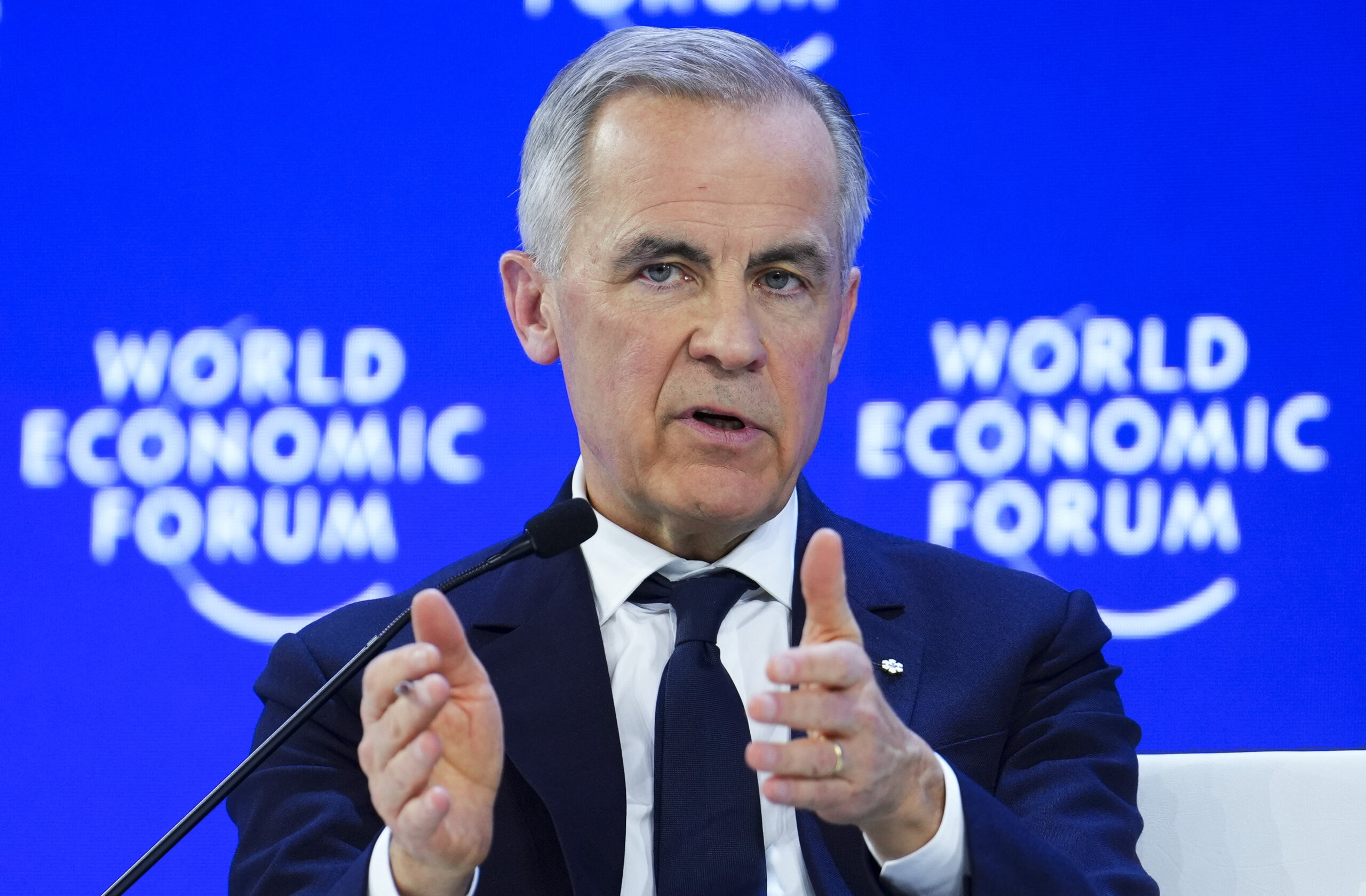
Canadian Prime Minister Mark Carney delivered a stark assessment of the global political and economic landscape this week, warning that the world is entering a period of profound disruption rather than gradual change. Speaking at the World Economic Forum’s annual meeting, Carney addressed growing tensions among major powers, the erosion of multilateral institutions, and the increasing use of economic leverage as a geopolitical weapon — remarks that earned him an unusually strong standing ovation from the audience.
While Carney avoided mentioning President Donald Trump by name, the substance of his speech left little doubt about its focus. His comments came amid escalating trade disputes, renewed tariff threats, and controversial foreign policy positions taken by the United States during Trump’s second term, moves that have strained relationships with longstanding allies and injected uncertainty into global markets.
Carney framed the current moment as a decisive break from the post–Cold War assumptions that shaped international cooperation for decades. “We are in the midst of a rupture, not a transition,” he said, arguing that recent developments represent a fundamental shift in how nations interact rather than a temporary adjustment within existing systems.
For much of the past generation, Carney noted, economic globalization was treated as an inherently stabilizing force, one that would bind nations together through shared prosperity and interdependence. But a series of overlapping crises — financial collapses, pandemics, energy shocks, and geopolitical conflicts — have exposed vulnerabilities embedded within that model.
More recently, he argued, those vulnerabilities have been actively exploited. Major powers, Carney said, are increasingly using economic integration as a tool of coercion rather than cooperation. Tariffs have become instruments of political pressure, financial systems are leveraged for strategic gain, and global supply chains are manipulated to create dependence rather than resilience.
“You cannot sustain the fiction of mutual benefit when integration itself becomes the source of subordination,” Carney said, emphasizing that many countries are reassessing the costs of deep economic entanglement under these conditions.
The prime minister warned that institutions long viewed as the backbone of international stability — including the World Trade Organization, the United Nations, and global climate frameworks — are now under strain. These bodies, he argued, were designed to manage disputes and encourage collective problem-solving, but they are increasingly sidelined or weakened by unilateral actions.
As confidence in multilateral mechanisms erodes, Carney said, nations are drawing similar conclusions: they must build greater strategic autonomy. That shift is already visible, he explained, in renewed focus on domestic energy production, food security, access to critical minerals, and the restructuring of supply chains to reduce exposure to political risk.
Although Carney acknowledged that the previous global order was far from perfect, he cautioned that the alternative emerging in its place could be significantly more dangerous. A retreat into aggressive nationalism, he said, risks producing what he described as a “world of fortresses” — one that is economically poorer, politically more fragile, and environmentally less sustainable.
The speech resonated strongly with an audience of policymakers, business leaders, and economists gathered in Davos, many of whom have been grappling with the implications of growing geopolitical fragmentation. Observers noted that standing ovations at the forum are rare, underscoring the impact of Carney’s remarks.
Online, clips of the address spread quickly, drawing praise from journalists, analysts, and political commentators across several countries. Many highlighted the clarity with which Carney articulated concerns that have often been discussed only cautiously in diplomatic settings.
Journalist Carole Cadwalladr described the speech as “one for the history books,” arguing that it marked a turning point in how global leaders publicly discuss the so-called rules-based international order. In her assessment, Carney did not merely lament its decline but openly acknowledged that it had always been more fragile and uneven than commonly portrayed.
Others echoed that sentiment, noting that Carney’s remarks reflected a growing willingness among allied leaders to challenge U.S. policy direction more openly. British political strategist Alastair Campbell pointed to the standing ovation as evidence that Carney had voiced what many in the room were thinking but had been reluctant to say aloud.
“Those do not happen often,” Campbell wrote of the reaction, calling the speech a “brutally honest assessment” of the global consequences of current U.S. actions.
The backdrop to Carney’s address includes several recent policy decisions that have unsettled allies, including renewed tariff threats, a more transactional approach to security alliances, and provocative rhetoric surrounding territorial issues. While the administration has defended these moves as necessary to protect American interests, critics argue they risk undermining trust built over decades.
Canada, as one of the United States’ closest economic and security partners, has been particularly sensitive to shifts in Washington’s approach. Cross-border trade, integrated supply chains, and shared defense commitments mean that policy changes in the U.S. often have immediate consequences north of the border.
Carney’s speech reflected that reality, positioning Canada as a country caught between reliance on a powerful neighbor and the need to adapt to a less predictable global environment. His call for strategic autonomy did not suggest isolation, but rather diversification — reducing dependence on any single partner while reinforcing cooperation with a broader range of allies.
Despite the gravity of his warnings, Carney avoided framing the situation as irreversible. Instead, he emphasized the importance of deliberate choices in shaping what comes next. Countries, he said, still have agency in deciding whether competition descends into conflict or is managed through renewed frameworks for cooperation.
However, he made clear that returning to the status quo ante is unlikely. The forces reshaping the global order — technological change, geopolitical rivalry, climate pressures, and shifting demographics — demand new approaches rather than nostalgic appeals to past arrangements.
For many observers, the significance of Carney’s speech lay not only in its content but in its tone. At a forum often criticized for cautious language and diplomatic hedging, his remarks stood out for their directness and willingness to confront uncomfortable truths.
As global leaders continue to navigate an increasingly fractured landscape, Carney’s warning served as both diagnosis and challenge: a recognition that the old assumptions no longer hold, and a call to confront the consequences of that reality with clarity rather than denial.
Whether the international community will heed that call remains uncertain. But judging by the reaction in Davos and beyond, Carney’s words have already helped crystallize a debate that is likely to shape global politics for years to come.

Emily Johnson is a critically acclaimed essayist and novelist known for her thought-provoking works centered on feminism, women’s rights, and modern relationships. Born and raised in Portland, Oregon, Emily grew up with a deep love of books, often spending her afternoons at her local library. She went on to study literature and gender studies at UCLA, where she became deeply involved in activism and began publishing essays in campus journals. Her debut essay collection, Voices Unbound, struck a chord with readers nationwide for its fearless exploration of gender dynamics, identity, and the challenges faced by women in contemporary society. Emily later transitioned into fiction, writing novels that balance compelling storytelling with social commentary. Her protagonists are often strong, multidimensional women navigating love, ambition, and the struggles of everyday life, making her a favorite among readers who crave authentic, relatable narratives. Critics praise her ability to merge personal intimacy with universal themes. Off the page, Emily is an advocate for women in publishing, leading workshops that encourage young female writers to embrace their voices. She lives in Seattle with her partner and two rescue cats, where she continues to write, teach, and inspire a new generation of storytellers.