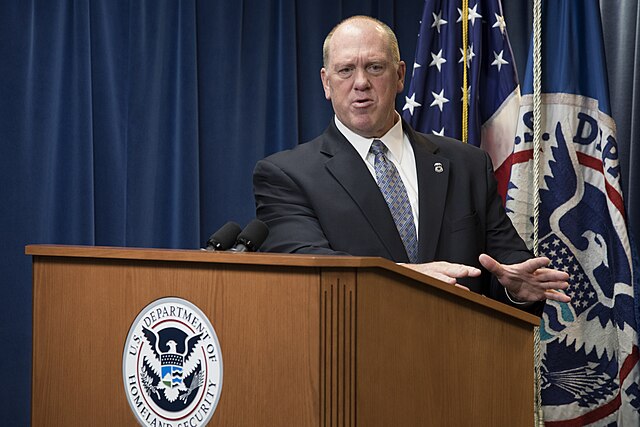
America’s border enforcement policies have once again been thrust into the political spotlight following a striking public claim by Tom Homan, the Trump administration’s current border czar and one of the most influential voices in immigration enforcement. Speaking during a recent public appearance, Homan asserted that an extraordinary number of children were removed from dangerous and exploitative situations during large-scale enforcement operations tied to Trump-era border policies.
The claim immediately ignited national controversy.
Supporters of aggressive immigration enforcement hailed the statement as proof that strict border controls protect vulnerable children from trafficking and exploitation. Critics, however, quickly called for independent verification, questioning how such figures are tracked and whether the claim is being politically amplified during an already volatile election climate.
Homan, who has built his career inside federal immigration enforcement and now serves as the administration’s top border authority, framed the issue not as a political talking point, but as a humanitarian crisis unfolding in real time.
According to Homan, criminal smuggling networks use the border as a gateway to move children into forced labor, sexual exploitation, drug trafficking operations, and other illicit industries. Many of these children, he said, are transported repeatedly across state lines, hidden from authorities, and treated as commodities by organized crime groups.
“These aren’t numbers on a spreadsheet,” Homan told his audience. “These are children who were abused, trafficked, and sold.”
For the first portion of his remarks, Homan avoided citing exact figures. He described law enforcement operations carried out across multiple states, involving ICE, Homeland Security Investigations, and local police departments. He spoke of warehouses, farms, private homes, and underground operations where children were allegedly found working under coercion.
Only midway through his address did he finally reveal the figure that stunned the room.
Homan stated that approximately 62,000 children had been located, removed from exploitative situations, or recovered through enforcement actions linked to Trump-era immigration policies.
The reaction was immediate.
Within hours, the number began circulating widely across social media, cable news, and political commentary platforms. Supporters of the Trump administration described the figure as “proof of success” and evidence that border enforcement saves lives. Critics responded with skepticism, demanding detailed documentation and warning against turning child exploitation into a political weapon.
Immigration researchers note that tracking rescued children is far more complex than a single statistic suggests. Victims may be identified across multiple agencies, jurisdictions, and time periods, often under differing legal definitions of exploitation and trafficking. Some are placed into protective custody, others into foster systems, and some into immigration proceedings that can last years.
Advocacy groups working directly with trafficking survivors have also emphasized that being “recovered” does not guarantee long-term safety. Many children face lasting trauma, unstable living conditions, and ongoing legal uncertainty even after being removed from immediate danger.
Nevertheless, Homan stood firmly by his claim, arguing that without aggressive interior enforcement, many of those children would have remained trapped inside criminal networks indefinitely.
He credited workplace investigations, multi-agency raids, and expanded tracking of smuggling operations as key tools that led to the recoveries. He also insisted that enforcement actions dismantled trafficking routes that prey on families desperate to enter the United States illegally.
“This didn’t happen by accident,” Homan said. “It happened because we enforced the law.”
The Trump administration’s immigration strategy remains one of the most polarizing issues in modern U.S. politics. Policies such as strict deportation enforcement, asylum restrictions, and the expansion of detention facilities were praised by supporters as necessary for national security, while condemned by critics as inhumane.
Homan’s claim now adds a powerful emotional dimension to that policy debate.
Those defending the enforcement approach argue that immigration is not only about borders, but about combating transnational crime, particularly trafficking organizations that profit from vulnerable children. They say that loosening enforcement gives these networks more freedom to operate.
Opponents, however, argue that humanitarian protections should not be subordinated to political ideology. They stress that child protection requires investment in social services, legal advocacy, and survivor care — not just raids and deportations.
Federal agencies have not yet publicly confirmed or disputed the 62,000 figure. However, government data does show a steady rise in unaccompanied minors entering the U.S. immigration system over recent years, many of whom face significant risks during their journeys.
Law enforcement officials acknowledge that trafficking tied to illegal migration is real and growing, but caution that large numbers should be interpreted carefully. Each case involves unique circumstances, overlapping investigations, and long-term judicial outcomes that cannot be captured fully by a single statistic.
For the public, however, the emotional impact of Homan’s claim has been profound.
To many, the idea that tens of thousands of children may have been trapped inside criminal exploitation — and then removed — is both horrifying and morally clarifying. To others, the lack of transparent documentation raises concerns about political exaggeration.
What remains undeniable is that child trafficking at the border is no longer a distant policy issue. It is now central to the national immigration conversation, referenced not only in law enforcement briefings but in political speeches, campaign narratives, and media battles.
As the election cycle intensifies, Homan’s statement is likely to be repeated, scrutinized, disputed, and defended with growing intensity. Whether the full data behind that number will ever be publicly released remains uncertain.
But the claim itself has already reshaped the narrative — placing the fate of thousands of children at the heart of America’s ongoing immigration conflict.

Emily Johnson is a critically acclaimed essayist and novelist known for her thought-provoking works centered on feminism, women’s rights, and modern relationships. Born and raised in Portland, Oregon, Emily grew up with a deep love of books, often spending her afternoons at her local library. She went on to study literature and gender studies at UCLA, where she became deeply involved in activism and began publishing essays in campus journals. Her debut essay collection, Voices Unbound, struck a chord with readers nationwide for its fearless exploration of gender dynamics, identity, and the challenges faced by women in contemporary society. Emily later transitioned into fiction, writing novels that balance compelling storytelling with social commentary. Her protagonists are often strong, multidimensional women navigating love, ambition, and the struggles of everyday life, making her a favorite among readers who crave authentic, relatable narratives. Critics praise her ability to merge personal intimacy with universal themes. Off the page, Emily is an advocate for women in publishing, leading workshops that encourage young female writers to embrace their voices. She lives in Seattle with her partner and two rescue cats, where she continues to write, teach, and inspire a new generation of storytellers.