Bill and Hillary Clinton are facing the prospect of being held in contempt of Congress after once again failing to confirm their appearances before a House committee investigating Jeffrey Epstein. Lawmakers have warned that if the former president and former secretary of state do not comply with subpoenas and appear for sworn testimony next week, the House Oversight Committee will move forward with contempt proceedings.
The couple was originally scheduled to testify in December, but their attorneys requested a postponement, citing conflicts. Committee leaders agreed to reschedule the depositions for January 13 for Bill Clinton and January 14 for Hillary Clinton. However, with those dates approaching, the committee says it has yet to receive confirmation that either will appear.
Rep. James Comer of Kentucky, the Republican chairman of the Oversight Committee, has made clear that patience is wearing thin. According to committee staff, the Clintons are “obligated under the law to appear,” and failure to do so will trigger formal action. If held in contempt, the matter could escalate rapidly, with Congress empowered to refer the case for enforcement that can include arrest by U.S. Capitol Police.
The subpoenas are part of the committee’s expanding inquiry into Epstein’s network of associates and the extent to which powerful figures may have had knowledge of, or involvement in, his activities. Lawmakers argue that testimony from both Clintons is essential due to Bill Clinton’s documented association with Epstein in the early 2000s and Hillary Clinton’s role as a senior political figure during that period.
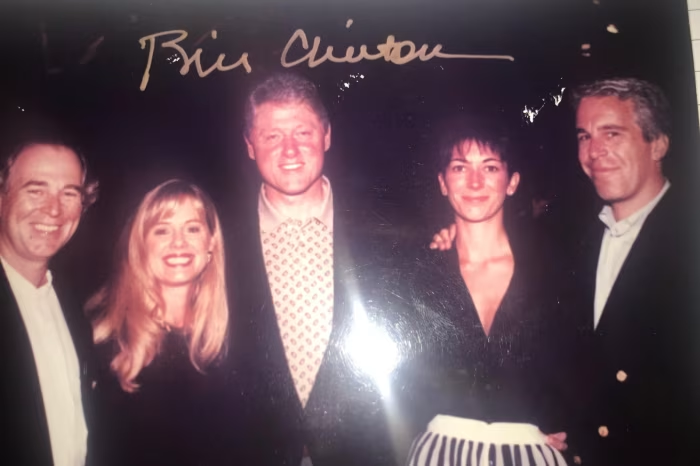
Bill Clinton has repeatedly denied any wrongdoing and has said he regrets having any association with Epstein. He has also denied ever visiting Epstein’s private island. Still, the release of additional Justice Department records last month reignited public scrutiny. Among the materials were photographs showing Clinton in social settings with Epstein, including one image that has circulated widely and fueled renewed debate over the former president’s past ties.
Committee members say the public deserves clarity, not evasions. They argue that the Clintons, as two of the most prominent political figures of the modern era, should be held to the same standards as any other subpoenaed witness. “No one is above the law,” a senior committee aide said, emphasizing that voluntary cooperation would resolve the matter quickly.
Contempt of Congress is not merely symbolic. If the committee votes to hold the Clintons in contempt, the House can refer the case to prosecutors or take enforcement steps of its own. In rare circumstances, Congress can direct Capitol Police to detain individuals who defy subpoenas and compel their appearance before lawmakers. While such actions are uncommon, committee leaders have signaled they are prepared to pursue every available option.
The standoff comes amid broader political tensions surrounding the Epstein investigation. Lawmakers from both parties have faced pressure from constituents demanding transparency about how Epstein was able to operate for years while maintaining relationships with influential figures in politics, business, and media. The Oversight Committee has framed its inquiry as an effort to expose institutional failures and ensure that similar abuses cannot occur again.
Supporters of the Clintons argue that the couple has already faced years of public scrutiny and that Bill Clinton’s association with Epstein, while regrettable, does not imply criminal behavior. They contend that the subpoenas are politically motivated and designed to generate headlines rather than uncover new facts. Critics counter that public figures who wielded enormous power have a special responsibility to answer questions fully and under oath.
The committee’s insistence on sworn depositions reflects a broader shift in congressional investigations. Lawmakers increasingly rely on closed-door testimony to establish a factual record before public hearings. Such sessions allow investigators to probe details, compare accounts, and identify inconsistencies without the theatrics of televised proceedings. Committee staff say the Clintons’ testimony is needed to clarify timelines, contacts, and the nature of any interactions with Epstein.
The situation places the former first couple in a precarious position. Appearing could subject them to intense questioning and renewed media attention. Refusing to appear risks escalating the matter into a constitutional confrontation between Congress and two of the most recognizable names in American politics.
Legal experts note that while contempt referrals are serious, they often become entangled in lengthy legal battles. Subpoena recipients can challenge congressional authority in court, arguing over scope, relevance, or procedural defects. However, such challenges can take months or years, and lawmakers argue that delay undermines the purpose of oversight.
For Rep. Comer and his colleagues, the issue is not only about Epstein but about congressional authority itself. “If high-profile figures can simply ignore subpoenas, the investigative power of Congress becomes meaningless,” one committee member said privately. “This is about enforcing the rule of law.”
As the January dates approach, the committee is watching closely for any response from the Clintons’ legal team. So far, there has been no public confirmation that either will appear. A spokesperson for the couple has not responded to multiple requests for comment.
The outcome could set a significant precedent. A voluntary appearance would defuse the standoff and allow the investigation to proceed. A refusal could trigger a high-profile contempt battle, further politicizing the Epstein inquiry and drawing even more attention to the Clintons’ past associations.
In Washington, the message from the Oversight Committee is blunt: subpoenas are not invitations. They are legal commands. Whether one is a private citizen or a former president and first lady, Congress expects compliance. If that expectation is not met, lawmakers say they are prepared to act.