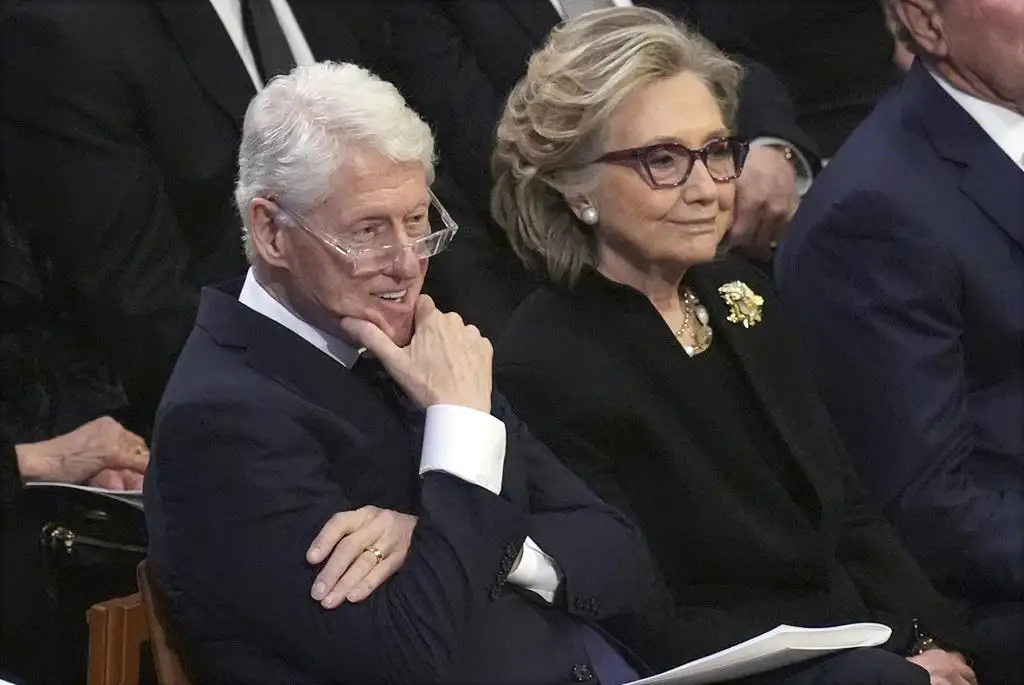
Former President Bill Clinton and former Secretary of State Hillary Clinton are mounting an increasingly forceful defense against a Republican-led congressional investigation into the late financier Jeffrey Epstein, accusing lawmakers of turning the probe into a political weapon designed to deflect scrutiny from President Donald Trump.
The dispute has escalated sharply in recent days after Representative James Comer, the Republican chair of the House Oversight Committee, threatened to initiate contempt of Congress proceedings if the Clintons fail to comply with subpoenas compelling them to testify in person about their past interactions with Epstein.
In a letter sent to the committee last week, the Clintons’ attorney, David Kendall, accused Republicans of abusing congressional authority and selectively enforcing investigative standards. He argued that the inquiry has been shaped not by legitimate oversight concerns but by partisan motivations tied to the 2026 election cycle.
“President Trump has consistently sought to divert attention from his own relationship with Mr. Epstein,” Kendall wrote, adding that the Oversight Committee appeared “complicit” in that effort.
The comments mark one of the most direct accusations yet that the investigation is being used to shield the current president while politically targeting long-standing Democratic figures.
Subpoenas and the Threat of Contempt
The Oversight Committee subpoenaed both Bill and Hillary Clinton in August as part of its broader review of the government’s handling of Epstein, whose 2019 death in federal custody and extensive network of powerful associates have fueled years of public distrust and conspiracy theories.
Comer has demanded that the Clintons appear before the committee for in-person questioning on December 17 and 18, or at a mutually agreed date in January. He has warned that failure to do so could result in criminal contempt referrals, which carry potential penalties including a fine of up to $100,000 and a possible one-year prison sentence.
In a statement released Friday, Comer accused the Clintons of “delaying, obstructing, and largely ignoring” efforts by committee staff to schedule testimony.
“The former president and former secretary of state have refused to cooperate in good faith,” Comer said, framing their response as emblematic of what he described as a pattern of elite immunity from accountability.
Claims of Unequal Treatment
Kendall has rejected those accusations, arguing that the Clintons are being held to a different standard than other high-profile figures subpoenaed by the same committee.
According to the attorney, five former attorneys general were permitted to submit written statements rather than testify in person. Former FBI directors James Comey and Robert Mueller were also allowed to respond in writing. Only one former attorney general, William Barr, appeared before Congress in person.
“The committee has selectively insisted on live testimony for my clients while extending written-testimony accommodations to others,” Kendall wrote. “That disparity underscores the political nature of this investigation.”
Kendall said he has sent three letters to the committee since August and met with Comer’s team in September in an attempt to reach a resolution. He maintains that the Clintons have cooperated within reasonable bounds and that the threat of contempt is unwarranted.
Clinton–Epstein Ties Revisited
The renewed scrutiny stems largely from Bill Clinton’s past association with Epstein, which has been documented in photographs, flight logs, and social accounts dating back more than two decades.
Kendall acknowledged that Clinton flew on Epstein’s private jet a total of six times — one domestic flight and five international trips — but emphasized that the travel occurred in connection with philanthropic and humanitarian work conducted through the Clinton Foundation.
He stated that neither Bill nor Hillary Clinton ever visited Epstein’s private island and that neither had any knowledge of Epstein’s criminal activities or those of his associate Ghislaine Maxwell.
“President Clinton’s contact with Epstein ended more than twenty years ago,” Kendall wrote. “Given what came to light much later, he has expressed regret for even that limited association.”
Maxwell, who was convicted on sex-trafficking charges, is currently serving a lengthy prison sentence.
New Images and Renewed Political Fire
The controversy intensified after the Oversight Committee released a new batch of photographs from what it has dubbed the “Epstein Files.” The images include previously unseen photos of Epstein alongside a number of high-profile figures, including Bill Clinton and President Trump.
Trump has dismissed images showing him with Epstein as insignificant, describing them as “no big deal.” One widely circulated photograph shows Trump smiling alongside Epstein and several women whose faces were blurred out. The president has repeatedly stated that he cut ties with Epstein years before his arrest and has described the financier as a “creep.”
Trump has not been accused of any criminal wrongdoing related to Epstein.
Nonetheless, Kendall’s letter argues that Republicans are selectively amplifying Clinton-related material while downplaying or reframing evidence involving Trump.
Political Calculations and Backlash
Philippe Reines, a longtime adviser to Hillary Clinton, warned that Republicans may face political consequences for pursuing the Clintons so aggressively.
“Even a first-year law student knows that finding someone politically contemptible isn’t the legal basis for contempt of Congress,” Reines said in an interview. “This isn’t about oversight — it’s about spectacle.”
Reines suggested that voters are more concerned with economic pressures than relitigating decades-old controversies.
“If Republicans want to spend 2026 fixated on an endless vendetta against the Clintons rather than addressing runaway prices and household costs, that’s their choice,” he said. “Democrats won’t complain about the electoral consequences.”
Transparency Law Raises Stakes
The clash is unfolding against the backdrop of the recently passed Epstein Files Transparency Act, which mandates the release of all Justice Department documents related to Epstein within 30 days. The deadline for disclosure falls on Friday, December 19.
The law’s passage exposed fractures within Trump’s political base, particularly among lawmakers and commentators who have long demanded full transparency in the Epstein case.
President Trump sharply criticized some former allies who supported the legislation, including Representative Marjorie Taylor Greene. In a series of posts, he derided Greene as “Marjorie ‘Traitor’ Green” and “Marjorie Taylor Brown,” accusing her of fueling what he called a Democratic “hoax.”
Trump has repeatedly argued that renewed focus on Epstein is being used to undermine his presidency and distract from policy priorities.
Broader Implications
Legal experts say the standoff highlights ongoing tensions between congressional oversight authority and the rights of private citizens and former officials.
While Congress has broad subpoena powers, enforcing contempt charges is politically fraught and rarely leads to prosecution, particularly when disputes involve executive privilege, legal counsel negotiations, or claims of unequal treatment.
“The optics matter as much as the law,” said one former congressional investigator. “If this appears selective or retaliatory, it risks weakening the credibility of legitimate oversight.”
For now, the Clintons have not indicated whether they will comply with Comer’s demand for in-person testimony. Kendall’s letters suggest they remain open to submitting written statements but oppose what they view as a politicized public spectacle.
As the document release deadline approaches and new material continues to surface, the Epstein investigation shows no sign of fading from the political landscape. Instead, it has become a flashpoint in a broader struggle over power, accountability, and narrative control in Washington — with implications likely to extend well beyond the current Congress.

Emily Johnson is a critically acclaimed essayist and novelist known for her thought-provoking works centered on feminism, women’s rights, and modern relationships. Born and raised in Portland, Oregon, Emily grew up with a deep love of books, often spending her afternoons at her local library. She went on to study literature and gender studies at UCLA, where she became deeply involved in activism and began publishing essays in campus journals. Her debut essay collection, Voices Unbound, struck a chord with readers nationwide for its fearless exploration of gender dynamics, identity, and the challenges faced by women in contemporary society. Emily later transitioned into fiction, writing novels that balance compelling storytelling with social commentary. Her protagonists are often strong, multidimensional women navigating love, ambition, and the struggles of everyday life, making her a favorite among readers who crave authentic, relatable narratives. Critics praise her ability to merge personal intimacy with universal themes. Off the page, Emily is an advocate for women in publishing, leading workshops that encourage young female writers to embrace their voices. She lives in Seattle with her partner and two rescue cats, where she continues to write, teach, and inspire a new generation of storytellers.