
For decades, viewers across the Bay Area welcomed a familiar, steady presence into their living rooms each evening. His delivery was calm but authoritative, his reporting meticulous without ever feeling detached. Whether covering elections, protests, disasters, or moments of quiet civic importance, he became a trusted voice for generations who relied on television news to make sense of a changing world.
This week, that voice fell silent.
A longtime television journalist and presenter has died at the age of 78, according to a statement released by his family. The news sparked an immediate outpouring of tributes from former colleagues, newsroom staff, and viewers who remembered him not just as a broadcaster, but as a professional who embodied the standards of an earlier era of journalism.
The cause of death has not been disclosed. Family members confirmed he passed away on January 14.
A Career Shaped by Turbulent Times
Those closest to him say his path into journalism was not accidental. He came of age during a period of profound social and political unrest in the United States, when cities became stages for protest, civil rights movements reshaped public life, and trust in institutions was repeatedly tested.
Covering the political demonstrations and riots of the late 1960s and early 1970s proved formative. Friends and family members have said witnessing those events firsthand instilled in him a sense of responsibility — a belief that accurate, careful reporting mattered deeply, especially during moments of division.
That conviction would guide his work for more than four decades.
Early Recognition and National Attention
By the mid-1970s, his reporting had already drawn national attention. In 1974, he was part of a team that won an Emmy Award for coverage of one of the most notorious criminal cases of the era: the kidnapping of Patty Hearst. The reporting required not only persistence and accuracy, but restraint — qualities that would become hallmarks of his style.
Colleagues from that period recall a journalist who was deeply prepared, rarely rattled, and intensely focused on getting the facts right before going on air. While others chased headlines, he concentrated on context.
That approach earned him the respect of peers and newsroom leaders alike.
A Familiar Face Through Historic Moments
Over the years, he would go on to cover elections, public policy debates, court cases, and natural disasters that left lasting marks on California history. One of the most significant moments came in 1989, when a massive earthquake struck the Bay Area during the World Series.
As chaos unfolded, he was part of a reporting team whose work later received a Peabody Award, one of journalism’s highest honors. The coverage balanced urgency with clarity, providing critical information while avoiding sensationalism — a balance many now say feels increasingly rare.
By this point, he had become a fixture on local television, trusted across political lines and generations.
The Name Behind the Legacy
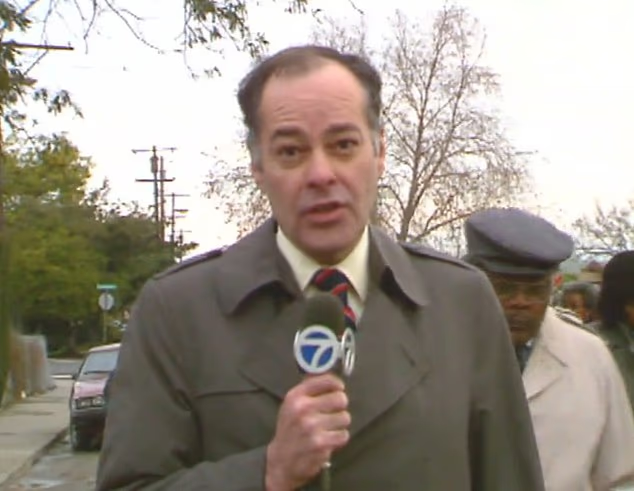
Midway through his long career, viewers came to know him simply by name: Jim Vargas.
Vargas spent roughly two decades with ABC7, becoming closely associated with the station’s coverage of politics and public affairs. His calm demeanor and measured delivery made him especially well-suited for complex stories, from ballot initiatives to city hall disputes.
Before and after his time at ABC, Vargas also worked at other major Bay Area stations, including KRON and KTVU, building a résumé that reflected both longevity and adaptability in a rapidly changing industry.
A Reporter Who Could Cover Anything
Former colleagues often described Vargas as the “ultimate all-round reporter” — someone equally comfortable covering breaking news in the field or anchoring a carefully produced segment in the studio.
Paul Jeschke, a former KGO-TV reporter who worked alongside Vargas for decades, recalled his professionalism and reliability.
“He could, and did, cover everything with professionalism and style,” Jeschke said. “He was always a reliable reporter, colleague, and friend.”
Others echoed that sentiment, emphasizing not only his skill but his consistency. In an industry known for big personalities and strong egos, Vargas stood out for his steadiness.
A Mentor and a Friend
Beyond his on-air work, Vargas left a lasting impression on those who worked behind the scenes. Assignment editors, producers, camera operators, and young reporters have all spoken about the respect he showed colleagues at every level of the newsroom.
Shelley Kilburn, a former assignment editor, remembered his dry wit and his willingness to trust others.
“He treated me with respect and dignity,” she wrote. “He trusted me with assignments and directions and made sure I didn’t get him and the crew lost in the field.”
She recalled that while he was deeply professional, he also knew how to relax and enjoy camaraderie — a reminder that newsrooms were once as much communities as workplaces.
Recognition After Retirement
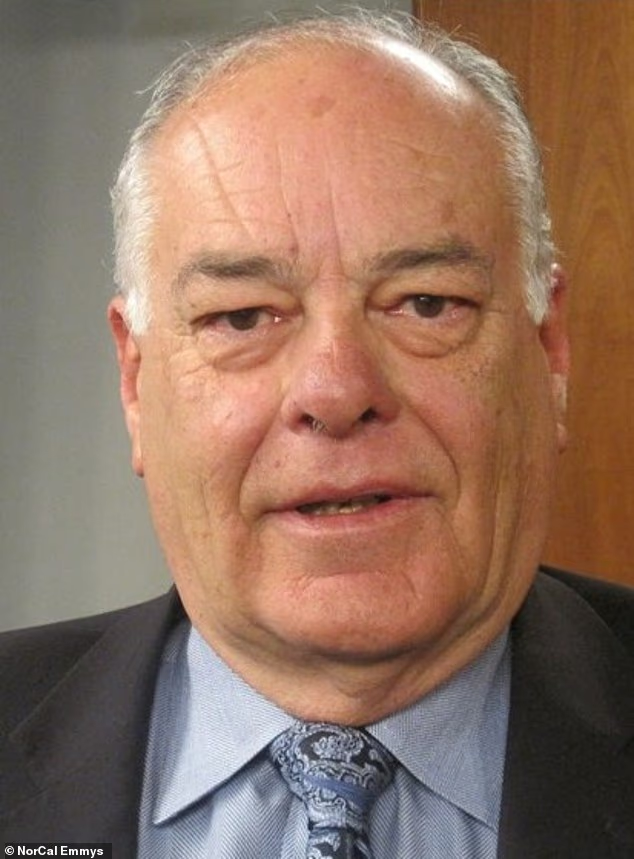
Vargas retired from broadcast journalism in 2011, closing a chapter that spanned more than 40 years. Retirement did not diminish his standing in the field.
Shortly afterward, he was inducted into the National Academy of Television Arts and Sciences’ Silver Circle, an honor reserved for those who have made significant contributions to television for 25 years or more.
The recognition formalized what many already believed: that Vargas had helped shape the standards of local television journalism during a pivotal era.
Tributes From Across the Community
Since news of his death broke, tributes have continued to arrive from former coworkers and friends.
Carol Ivy and Ed Leslie, also former reporters, described Vargas as their best friend. They said they remained in contact with him until the end of his life.
“We will miss him greatly,” they said.
Others recalled his humor, his calm presence during stressful breaking-news moments, and his ability to make even tense situations feel manageable.
For viewers, memories often center on his voice — familiar, reassuring, and trustworthy — delivering news night after night.
Remembering a Different Era of Journalism
Vargas’s death has prompted reflection not just on his life, but on the era of journalism he represented. His career spanned the rise of 24-hour news, the transition from film to digital reporting, and the early days of online media.
Through it all, he remained committed to fundamentals: verification, fairness, and clarity.
For many who worked with him, his legacy lies not in any single broadcast or award, but in the example he set — that journalism, at its best, serves the public quietly and consistently.
As tributes continue to pour in, colleagues and viewers alike remember Jim Vargas not only as a beloved ABC presenter, but as a professional who helped define what local news could be at its best.

Emily Johnson is a critically acclaimed essayist and novelist known for her thought-provoking works centered on feminism, women’s rights, and modern relationships. Born and raised in Portland, Oregon, Emily grew up with a deep love of books, often spending her afternoons at her local library. She went on to study literature and gender studies at UCLA, where she became deeply involved in activism and began publishing essays in campus journals. Her debut essay collection, Voices Unbound, struck a chord with readers nationwide for its fearless exploration of gender dynamics, identity, and the challenges faced by women in contemporary society. Emily later transitioned into fiction, writing novels that balance compelling storytelling with social commentary. Her protagonists are often strong, multidimensional women navigating love, ambition, and the struggles of everyday life, making her a favorite among readers who crave authentic, relatable narratives. Critics praise her ability to merge personal intimacy with universal themes. Off the page, Emily is an advocate for women in publishing, leading workshops that encourage young female writers to embrace their voices. She lives in Seattle with her partner and two rescue cats, where she continues to write, teach, and inspire a new generation of storytellers.