A new political controversy is emerging in Washington that could have far-reaching consequences not just for U.S. policy on citizenship, but for members of the First Family themselves. A bill introduced this week by Ohio Senator Bernie Moreno seeks to eliminate dual citizenship in the United States, demanding that anyone holding multiple nationalities either renounce their foreign citizenship or lose their American one.
Moreno, a Republican who became a U.S. citizen at the age of 18 after being born in Colombia, framed the proposal as a necessary measure to ensure that American citizens maintain “exclusive allegiance” to the United States. The legislation, officially named the Exclusive Citizenship Act of 2025, has drawn immediate attention because it challenges long-standing legal and cultural norms around dual nationality, a status held by millions of Americans today.
The bill is straightforward in its language and sweeping in its implications. Under the proposal, any individual who simultaneously holds citizenship in another country would be required to give it up. The Department of Homeland Security and the State Department would be tasked with enforcing the law, tracking dual nationals, and providing a one-year window for them to surrender foreign citizenship. Failure to comply would result in automatic loss of U.S. citizenship.
“This is about the honor and privilege of being an American,” Moreno said in a statement unveiling the proposal. “If you want to be an American, it’s all or nothing. We can no longer allow divided loyalties. Dual citizenship ends here.”
The legislation is already stirring debate among lawmakers, legal scholars, and civil rights organizations. Critics argue that enforcing such a law would be legally complex, potentially unconstitutional, and politically risky. They note that dual citizenship is increasingly common in a globalized world, with Americans maintaining family, business, or cultural ties across borders.
Supporters, by contrast, say the bill would reinforce national identity and security, particularly at a time when questions about foreign influence, loyalty, and espionage are increasingly sensitive in public discourse. They emphasize that requiring exclusive allegiance would provide clarity in cases where Americans are serving in government, military, or sensitive positions involving national security.
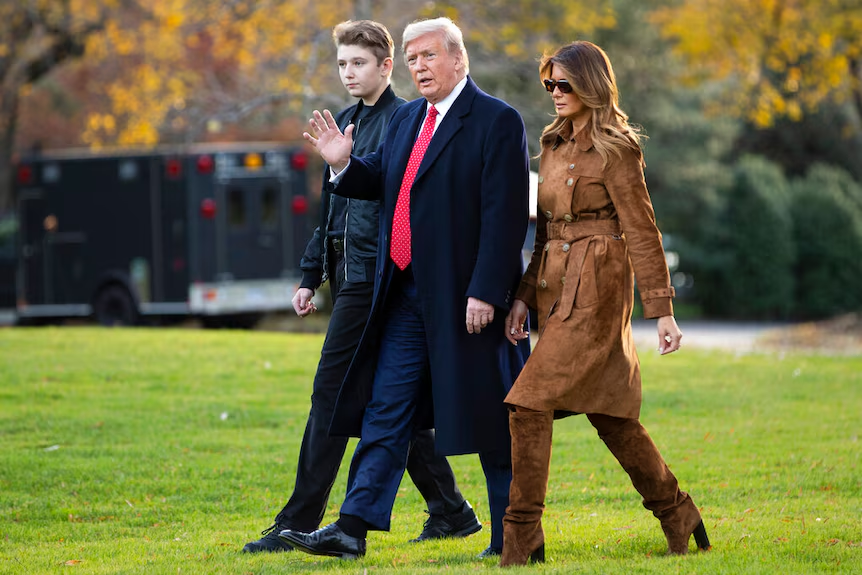
However, as lawmakers and commentators began scrutinizing the bill, an unavoidable complication emerged: the proposal would directly affect the First Family. Both the president’s wife and youngest son currently hold dual citizenship, making them potential targets of the law if it were enacted in its current form.
The First Lady, who was born abroad and later naturalized, and Barron, her youngest child, each hold U.S. and Slovenian citizenship. Under Moreno’s plan, they would be forced to choose between their American nationality and their Slovenian passport — a decision with both symbolic and practical implications.
The First Lady officially became a U.S. citizen in July 2006, several months after the birth of Barron, who automatically acquired U.S. citizenship at birth because of his father’s status. Her citizenship was obtained through the EB-1 visa program, a special category designed for individuals with “extraordinary ability” or exceptional achievements in fields recognized at a national or international level. The program typically applies to award-winning actors, athletes, and other highly accomplished professionals. In her case, it provided a fast track to naturalization based on her accomplishments and public profile prior to entering the United States.
Barron, born in March 2006, holds U.S. citizenship by birthright, and his Slovenian citizenship comes from his mother. As a result, he would also be affected by Moreno’s legislation despite being born in the United States. While previous administration efforts to limit birthright citizenship remain tied up in court, this new bill represents a separate legislative effort to enforce citizenship exclusivity for all Americans, including those in the highest levels of government.
The potential impact on the First Family has brought renewed attention to the broader dual-citizenship debate in the U.S. Historically, Americans have been allowed to hold multiple citizenships without renouncing either, with the government tacitly accepting that individuals can maintain allegiance to more than one country. Legal scholars have noted that U.S. courts have long recognized dual citizenship and that efforts to strip it away would likely face legal challenges under constitutional protections, including due process and equal protection clauses.
Beyond the First Family, the bill could affect a significant number of Americans. Estimates suggest that between 5 and 10 million U.S. citizens hold dual nationality, representing diverse communities across the country. Many are immigrants, children of immigrants, or Americans who have acquired foreign citizenship through marriage, ancestry, or professional obligations. Enforcing exclusive allegiance could force families to make difficult decisions or even risk legal penalties, including loss of citizenship, fines, or restrictions on travel.
Moreno’s proposal also raises questions about enforcement. How would the government identify dual nationals? Would Americans be required to submit proof of citizenship status regularly? And what would happen to Americans living abroad who hold passports in countries with mandatory military service, taxation, or other obligations that complicate exclusive allegiance? Critics argue that these practical issues make the law difficult, if not impossible, to enforce comprehensively.
In addition to its domestic implications, the legislation could have foreign policy consequences. Countries with large American expatriate populations or historical ties to the U.S. may view such a law as punitive or discriminatory, potentially complicating diplomatic relations. International law experts note that unilateral measures restricting dual nationality are rare and can create tensions in bilateral agreements or consular protections.
Supporters of the bill, however, frame the issue as a matter of principle. They argue that U.S. citizenship carries not only rights but responsibilities, and that requiring exclusive allegiance is a reasonable expectation for anyone claiming to be fully American. Moreno emphasized this in his statement, framing the law as a moral obligation as much as a legal one.
The bill has also sparked discussion about broader citizenship issues. Beyond dual nationality, the debate touches on birthright citizenship, naturalization standards, and the legal interpretation of allegiance. Critics have pointed out that recent political rhetoric around citizenship often intersects with partisan debates on immigration, national identity, and eligibility for public office.
For now, it remains unclear whether the legislation will move forward in Congress. While Moreno has considerable support among certain segments of the Republican Party, other lawmakers have expressed hesitation. Some argue that targeting dual citizens, particularly in the context of the First Family, could be politically sensitive and potentially backfire with the electorate.
The timing of the bill also coincides with ongoing court cases regarding birthright citizenship, heightening the stakes. Legal analysts warn that if the law were passed, it would almost certainly be challenged in federal courts, potentially reaching the Supreme Court. Arguments could center on constitutional protections, international norms, and historical precedent recognizing dual nationality.
Meanwhile, public reaction has been swift and polarized. Supporters praise the legislation as a reaffirmation of national loyalty and a corrective to what they see as an over-tolerant approach to citizenship. Opponents view it as an unnecessary attack on personal freedom and a politically motivated measure with limited practical benefit.
The bill’s introduction has also reignited debate about the First Family’s citizenship status, an issue that has long attracted media attention and partisan commentary. Analysts suggest that, even if the law does not pass, the discussion will have lasting political repercussions, highlighting the complex intersection of law, policy, and personal status for high-profile Americans.
Legal scholars have weighed in on the potential impact. Some argue that retroactively revoking citizenship from individuals who lawfully obtained dual nationality could be unconstitutional. Others note that Congress has the authority to regulate citizenship requirements, though enforcement mechanisms would need careful design to withstand judicial scrutiny.
Ultimately, the bill has sparked a broader conversation about identity, allegiance, and the rights of Americans in an increasingly interconnected world. While the immediate controversy centers on the First Family, the implications reach far beyond, potentially affecting millions of dual nationals across the country.
The First Lady and her son are now at the center of a legal and political debate with high stakes for themselves and for U.S. policy on dual nationality. If Moreno’s legislation moves forward, it could force them to make a decision that few Americans have ever faced: choosing between one citizenship or another, with the loss of American nationality as the ultimate consequence.
Observers are watching closely to see how lawmakers, the courts, and the public respond. Whatever the outcome, the debate underscores the complex and sometimes controversial nature of citizenship in the United States, highlighting tensions between law, politics, and personal identity that are unlikely to be resolved quickly.

Emily Johnson is a critically acclaimed essayist and novelist known for her thought-provoking works centered on feminism, women’s rights, and modern relationships. Born and raised in Portland, Oregon, Emily grew up with a deep love of books, often spending her afternoons at her local library. She went on to study literature and gender studies at UCLA, where she became deeply involved in activism and began publishing essays in campus journals. Her debut essay collection, Voices Unbound, struck a chord with readers nationwide for its fearless exploration of gender dynamics, identity, and the challenges faced by women in contemporary society. Emily later transitioned into fiction, writing novels that balance compelling storytelling with social commentary. Her protagonists are often strong, multidimensional women navigating love, ambition, and the struggles of everyday life, making her a favorite among readers who crave authentic, relatable narratives. Critics praise her ability to merge personal intimacy with universal themes. Off the page, Emily is an advocate for women in publishing, leading workshops that encourage young female writers to embrace their voices. She lives in Seattle with her partner and two rescue cats, where she continues to write, teach, and inspire a new generation of storytellers.