



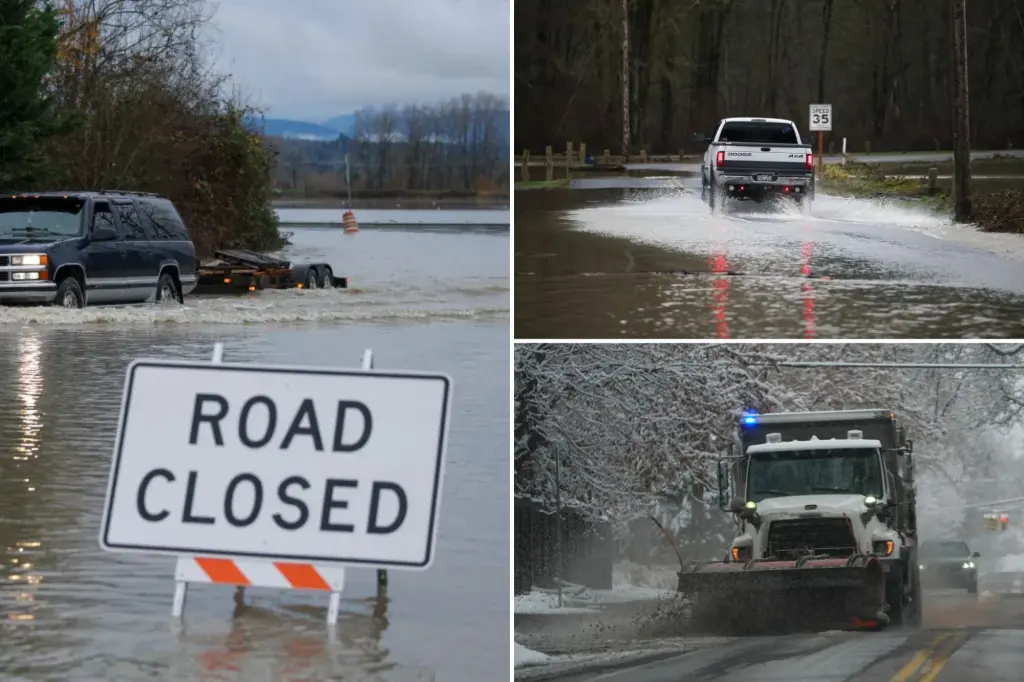
A destructive storm system sweeping across the Pacific Northwest has left at least one person dead, injured multiple children, flooded communities, and plunged nearly half a million residents into darkness as hurricane-force wind gusts battered an already waterlogged region.
The powerful system, which followed days of relentless rainfall, intensified overnight into Wednesday, unleashing violent winds that toppled trees, damaged infrastructure, and complicated emergency response efforts across multiple states. Authorities warned that the worst impacts may not yet be fully known, as floodwaters remain high and damage assessments are still underway.
Wind gusts reached as high as 85 miles per hour in parts of eastern Washington and northern Idaho early Wednesday morning, according to meteorological reports. Cities including Pullman, Washington, and Moscow and Lewiston, Idaho, experienced some of the strongest conditions, with sustained winds powerful enough to uproot trees and knock down power lines.
As of late Wednesday evening, nearly 430,000 utility customers across Idaho, Washington, Oregon, and Montana were without electricity, according to data compiled by Poweroutage.us. Utility crews worked around the clock to restore service, but officials cautioned that widespread damage and hazardous conditions could delay repairs for days in some areas.
Tragedy struck in northern Idaho when a falling tree crashed through a home during the height of the storm, killing a man as he slept. Emergency responders were dispatched to a residence in the small town of Fernan shortly after dawn following a 911 call reporting structural damage. Inside the home, responders discovered the victim deceased in his bed beneath the fallen tree. Other occupants of the house were able to escape and did not suffer serious injuries, authorities said.
The same violent winds caused additional injuries elsewhere in Idaho. In Twin Falls County, several aging trees weakened by internal rot were knocked over by powerful gusts, critically injuring two young children who were waiting for a school bus. Both children, under the age of 10, were struck when a tree suddenly collapsed near the bus stop. A third sibling standing nearby was not injured.
Despite extreme weather conditions, emergency crews were able to coordinate medical evacuations. One child was airlifted to a hospital after an air ambulance managed to land amid the high winds, while the other was transported by ground ambulance. Authorities described the injuries as serious and said the incident underscored the unpredictable dangers posed by severe wind events.
The storm’s reach extended well beyond the Pacific Northwest. In Colorado, utility providers took preemptive action as forecasts predicted wind gusts approaching 90 miles per hour along the Front Range. Xcel Energy, the state’s largest electric utility, temporarily shut off power to roughly 50,000 homes and businesses in an effort to reduce the risk of wildfires sparked by downed power lines. While the move caused short-term disruption, officials said it was a necessary precaution given the extreme conditions.
For Washington state, the ferocious winds arrived on the heels of days of heavy rain that had already pushed rivers to dangerous levels and inundated low-lying communities. A series of Pacific storms dumped nearly two feet of rain in parts of the Cascade Mountains, overwhelming drainage systems and forcing water far beyond riverbanks.
The cumulative impact has been severe. Flooding damaged roads, submerged homes, and cut off entire neighborhoods, complicating rescue and evacuation efforts. Emergency crews across the state have conducted hundreds of rescues and assisted evacuations as residents scrambled to escape rising water.
Governor Bob Ferguson warned that the state faces a long and difficult recovery. Speaking at a news conference, he urged residents to heed evacuation orders and emphasized that conditions remain volatile.
“We’re in for the long haul,” Ferguson said. “If you get an evacuation order, for God’s sake, follow it.”
The governor noted that the full scope of the damage remains unclear, as crews cannot safely assess many areas until floodwaters recede and the risk of landslides diminishes. In mountainous regions, saturated soil has increased the likelihood of slope failures, threatening homes, roads, and utility corridors.
One major transportation route, State Route 2, which connects western Washington with mountain communities and the town of Leavenworth, could remain closed for months due to extensive damage, officials said. The prolonged closure would have significant economic and logistical consequences, particularly for rural areas that rely on the highway for access to goods and services.
Near the Seattle metropolitan area, conditions turned especially tense earlier in the week when a river embankment failed south of the city. Emergency sirens and mobile alerts warned residents in several communities to evacuate immediately after a section of a levee along the Green River breached.
The failure occurred near Todd Boulevard, affecting parts of Tukwila, Renton, and Kent. According to the National Weather Service, the breach followed the collapse of a paved bike path atop the embankment after water eroded the soil beneath it. Emergency crews rushed to the scene and worked through the night to stabilize the structure, stacking massive sandbags—each weighing roughly a ton—to plug the gap and prevent further flooding.
City officials said the breach was relatively small and primarily affected industrial zones rather than residential neighborhoods, though they cautioned that conditions could change rapidly.
“What we understand is that the area is being managed and the breach has been controlled,” said Laura Pettitt, a spokesperson for the city of Renton. “However, that’s not to say that there wouldn’t be future impact with any changing situation.”
The levee has a troubled history. It sustained major damage during flooding in February 2020, and long-term repairs are not expected to be completed until 2031. Just days before the latest breach, crews had installed a temporary stabilization measure known as a seepage blanket in an attempt to reinforce the aging structure.
Flood dangers remain widespread across the region. As of Tuesday, emergency responders in Washington had carried out at least 629 rescues and assisted with 572 evacuations, according to state officials. Many residents were forced to flee with little notice as water levels rose rapidly.
Those returning to flooded homes face additional risks beyond structural damage. County health officials warned that sewage overflows have contaminated floodwaters in some areas, posing serious health hazards. Residents were advised to wear protective gear such as rubber gloves, boots, and masks during cleanup efforts and to be alert for mold, which can begin growing within 24 to 48 hours in damp environments.
Public safety officials across the region emphasized that dangers persist even as the storm system begins to weaken. High water levels, unstable ground, fallen trees, and widespread power outages continue to pose threats to residents and first responders alike.
Authorities in northern Idaho issued reminders about the risks associated with severe wind events, noting that trees can fall without warning, even after winds begin to subside.
“During wind events, residents are encouraged to stay away from large trees, avoid sleeping near exterior walls when possible, and report hazardous conditions to local authorities,” the local sheriff’s office said in a statement.
Meteorologists cautioned that while the most intense winds have passed, additional storms could move into the region later in the week, potentially exacerbating flooding and delaying recovery efforts. Officials urged residents to remain vigilant, monitor weather alerts, and prioritize safety as crews work to restore power and repair damaged infrastructure.
As the Pacific Northwest begins to take stock of the destruction, emergency managers warn that the combination of saturated ground, damaged levees, and lingering instability means the crisis is far from over.

Emily Johnson is a critically acclaimed essayist and novelist known for her thought-provoking works centered on feminism, women’s rights, and modern relationships. Born and raised in Portland, Oregon, Emily grew up with a deep love of books, often spending her afternoons at her local library. She went on to study literature and gender studies at UCLA, where she became deeply involved in activism and began publishing essays in campus journals. Her debut essay collection, Voices Unbound, struck a chord with readers nationwide for its fearless exploration of gender dynamics, identity, and the challenges faced by women in contemporary society. Emily later transitioned into fiction, writing novels that balance compelling storytelling with social commentary. Her protagonists are often strong, multidimensional women navigating love, ambition, and the struggles of everyday life, making her a favorite among readers who crave authentic, relatable narratives. Critics praise her ability to merge personal intimacy with universal themes. Off the page, Emily is an advocate for women in publishing, leading workshops that encourage young female writers to embrace their voices. She lives in Seattle with her partner and two rescue cats, where she continues to write, teach, and inspire a new generation of storytellers.