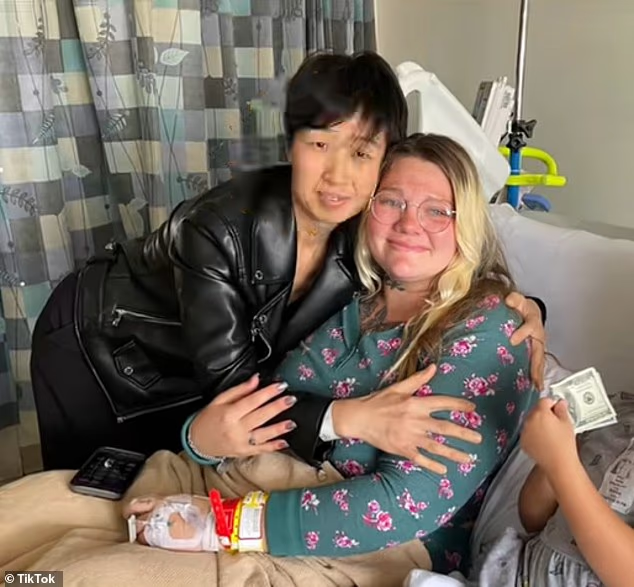
A new investigation and forthcoming book by author and political commentator Peter Schweizer has reignited debate over birthright citizenship, surrogacy laws, and national security, raising concerns among policymakers and experts about how U.S. legal frameworks may be used by foreign nationals. The claims center on the use of American birth tourism and surrogacy arrangements by wealthy Chinese citizens, including individuals allegedly connected to the Chinese Communist Party, to secure U.S. citizenship for their children.
The issue has drawn attention in Washington and among national security analysts, not because of confirmed wrongdoing by the children involved, but because of what critics argue could be long-term vulnerabilities embedded in existing U.S. laws.
Birth Tourism and Citizenship
Birth tourism is the practice in which foreign nationals travel to the United States to give birth so their children receive automatic U.S. citizenship under the 14th Amendment. While legal under current law, the practice has long been controversial, and administrations from both parties have debated how it should be regulated.
According to Schweizer’s reporting, birth tourism involving Chinese nationals has expanded significantly over the past decade and a half. Estimates cited in his work suggest that between 750,000 and 1.5 million individuals born in the U.S. to Chinese parents may currently hold American citizenship while being raised primarily or entirely overseas.
Schweizer alleges that many of these children return to China shortly after birth and grow up within the Chinese education system. Upon reaching adulthood, they retain the legal right to reenter the United States, vote, and sponsor family members for residency.
Experts caution, however, that citizenship alone does not determine political loyalty and that the overwhelming majority of such individuals have not been accused of wrongdoing. Still, critics argue that the scale of the phenomenon warrants closer examination.
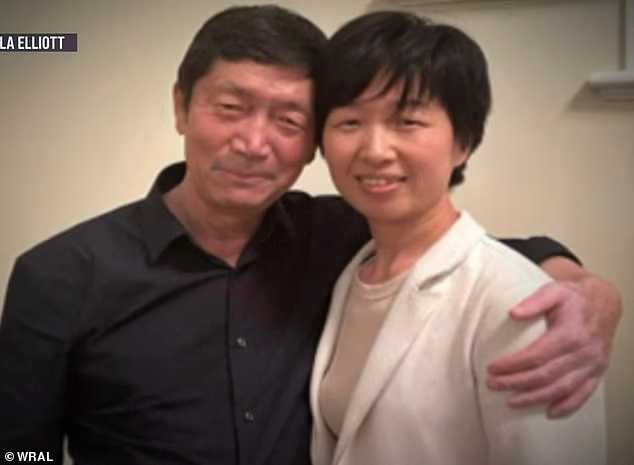
Guojun Xuan, 65, (left) and his partner Silvia Zhang, 38, (right) were arrested for felony child endangerment in May, before a search warrant found they had 21 children from surrogate mothers, cops said
Claims of Long-Term Strategic Concerns
Schweizer describes what he terms a potential “Manchurian Generation,” borrowing language from Cold War-era fiction to describe individuals who are American citizens by birth but raised entirely abroad. He argues that such individuals could theoretically participate in civic life without the cultural or civic grounding traditionally associated with U.S. upbringing.
National security analysts emphasize that these claims remain speculative. However, some warn that foreign governments have historically sought influence through legal and nonviolent means, including economic, academic, and political engagement.
“Citizenship laws were designed for a different era,” said one former intelligence official not directly involved in the investigation. “That doesn’t mean they’re broken, but it does mean they deserve review in light of modern global competition.”
Surrogacy as a Separate but Related Issue
Beyond birth tourism, the investigation highlights concerns about commercial surrogacy, particularly in states where the practice is legal and lightly regulated. Schweizer alleges that some wealthy foreign nationals have used American surrogate mothers to have children born in the U.S., conferring citizenship from birth.
One case cited involves Guojun Xuan, a Chinese businessman accused by authorities of child endangerment following an incident at a California property. Law enforcement later discovered that multiple children connected to him had been born through surrogacy arrangements across several states.
Xuan has not been charged with crimes related to citizenship fraud or national security violations, and his representatives have denied broader allegations. Authorities have emphasized that the case remains limited to child welfare concerns.
Still, Schweizer argues that the case illustrates broader systemic vulnerabilities, particularly when surrogacy intersects with international wealth, limited oversight, and citizenship law.
The Role of Surrogacy Agencies
According to the investigation, California alone is home to more than 100 surrogacy-related businesses owned by Chinese nationals. While ownership itself is legal, critics argue that the lack of transparency and oversight creates opportunities for abuse.
Medical ethicists note that the surrogacy industry operates in a complex legal environment that varies widely by state. “This is less about nationality and more about regulation,” said one bioethics professor. “Weak oversight affects everyone.”
Advocacy groups stress that surrogate mothers themselves should not be stigmatized, noting that most enter such agreements legally and voluntarily, often for financial reasons.
Government Warnings and Legal Context
The U.S. State Department has previously warned that large-scale birth tourism could pose long-term challenges, particularly if foreign governments were to coordinate or exploit the practice. However, no federal law currently prohibits foreign nationals from pursuing birthright citizenship for their children.
Some experts have called for revisiting Cold War-era statutes or drafting modern equivalents to address foreign influence operations, while others caution against measures that could infringe on civil liberties or unfairly target ethnic communities.
Former Navy officer and Asia policy expert Brent Sadler has argued that reforms should focus on foreign government activity rather than ethnicity. “The issue is state influence, not immigration,” he said. “We must protect Americans of Chinese descent while remaining alert to actions by the CCP.”
High-Level Allegations and Caution
Schweizer’s reporting also references unverified claims involving senior Chinese officials who allegedly had children born in the U.S. While such claims have circulated in media and policy circles, experts stress that they remain difficult to confirm and should be treated cautiously.
Legal scholars emphasize that being born in the U.S. does not equate to allegiance to any foreign government, and that American law presumes individual rights and responsibilities regardless of ancestry.
A Debate Likely to Grow
As geopolitical tensions between the United States and China continue, scrutiny of citizenship, immigration, and influence operations is likely to intensify. Lawmakers from both parties have signaled interest in reviewing birth tourism practices, surrogacy regulation, and foreign ownership of related businesses.
For now, the issue remains largely a policy debate rather than a criminal one. Still, it raises fundamental questions about how laws written more than a century ago function in a globalized world where borders, technology, and influence have evolved rapidly.
Whether reforms come through legislation, regulation, or enforcement remains uncertain. What is clear is that the conversation around citizenship and national security is no longer theoretical—and is increasingly entering the public sphere.

Emily Johnson is a critically acclaimed essayist and novelist known for her thought-provoking works centered on feminism, women’s rights, and modern relationships. Born and raised in Portland, Oregon, Emily grew up with a deep love of books, often spending her afternoons at her local library. She went on to study literature and gender studies at UCLA, where she became deeply involved in activism and began publishing essays in campus journals. Her debut essay collection, Voices Unbound, struck a chord with readers nationwide for its fearless exploration of gender dynamics, identity, and the challenges faced by women in contemporary society. Emily later transitioned into fiction, writing novels that balance compelling storytelling with social commentary. Her protagonists are often strong, multidimensional women navigating love, ambition, and the struggles of everyday life, making her a favorite among readers who crave authentic, relatable narratives. Critics praise her ability to merge personal intimacy with universal themes. Off the page, Emily is an advocate for women in publishing, leading workshops that encourage young female writers to embrace their voices. She lives in Seattle with her partner and two rescue cats, where she continues to write, teach, and inspire a new generation of storytellers.