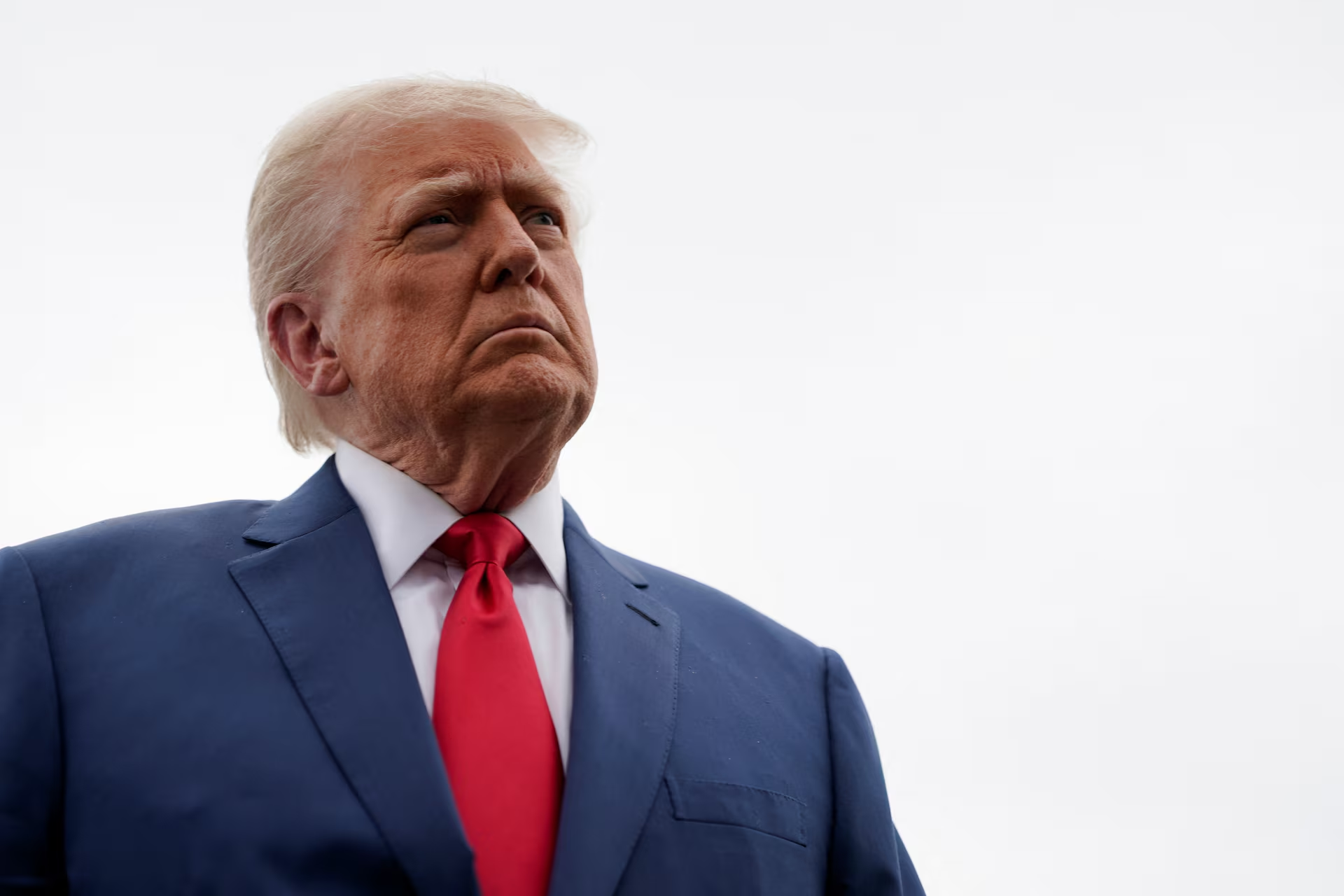
A detailed simulation of the 2028 U.S. presidential election is drawing attention after a YouTube channel used Elon Musk’s AI, Grok, to forecast the outcome, complete with a state-by-state breakdown and projected Electoral College results. The analysis considers early primary polling, betting market odds, and historical voting trends, offering a glimpse at a potential future election without incumbent Donald Trump, who is barred by the 22nd Amendment from seeking a third term.
For context, the 22nd Amendment restricts any individual from being elected president more than twice, and it prevents anyone who has served more than two years of a term to which someone else was elected from being elected again. As a result, attention has turned to other potential candidates who could shape the next presidential race.
Democratic Primary Outlook
On the Democratic side, former Vice President Kamala Harris emerged as the frontrunner in early 2028 primary polls. According to data shared on February 12, Harris had 32 percent support among Democratic voters, ahead of California Governor Gavin Newsom, who trailed at 23.8 percent. Other potential candidates included Pete Buttigieg, Representative Alexandria Ocasio-Cortez, Pennsylvania Governor Josh Shapiro, Illinois Governor JB Pritzker, Senator Cory Booker, and Minnesota Governor Tim Walz.
Polling trends indicate that Harris has regained momentum following her defeat in 2024, with betting markets showing a 56 percent probability that she would seek the Democratic nomination. Analysts noted that her resurgence might surprise some observers, given that many had initially written off her prospects after her earlier loss.
Harris’ projected solid states in the simulation mirror much of her 2024 coalition, including California, Washington, Hawaii, Vermont, Massachusetts, Connecticut, Delaware, Maryland, the District of Columbia, and Maine’s first congressional district. Notably, Delaware and Connecticut, which were closely contested in 2024, are forecasted as secure wins for her in the 2028 cycle.
Republican Primary and Frontrunner
On the Republican side, Vice President JD Vance is portrayed as the leading contender. Early primary polling shows Vance commanding 49.2 percent support, with Donald Trump Jr. trailing at 19.5 percent. Other Republican prospects include Senators Marco Rubio and Ted Cruz, former Florida Governor Ron DeSantis, former presidential candidate Robert Kennedy Jr., former United Nations Ambassador Nikki Haley, and entrepreneur Vivek Ramaswamy.
Market predictions, including those from the platform Kalshi, suggest a 46 percent chance that Vance will secure the Republican nomination. Analysts have highlighted that if nothing dramatically changes in the GOP landscape, Vance is well-positioned to carry forward the party’s agenda into the 2028 election.
Electoral Map Predictions
Using Grok’s simulation, Vance’s solid states—those expected to be won by margins of 15 points or more—include Utah, Idaho, Montana, Wyoming, North Dakota, South Dakota, Nebraska (excluding its second district), Kansas, Oklahoma, Missouri, Arkansas, Louisiana, Mississippi, Alabama, Tennessee, Kentucky, West Virginia, Indiana, South Carolina, and Ohio. These projections reflect the continued rightward shift of key Midwestern and Southern states.
Harris’ solid states encompass the West Coast, parts of New England, and the District of Columbia, largely replicating her 2024 winning coalition. The AI model also considered “likely” and “lean” states, which are projected to have narrower margins and serve as battlegrounds. For Vance, likely states include Iowa, North Carolina, Florida, Texas, Arizona, Alaska, and Maine’s second district, while Harris is projected to perform strongly in Oregon, Colorado, New Mexico, Illinois, New York, Rhode Island, and Virginia.
Two tilt states—Minnesota and New Hampshire—are forecasted as razor-thin contests, with Grok suggesting Vance could edge out victories in both, a notable shift given their recent Democratic leanings. Minnesota, for instance, was carried narrowly by Harris in 2024, while New Hampshire has historically leaned Democratic in recent cycles.
Projected Outcome
The simulation gives JD Vance 326 electoral votes compared to Harris’ 212, suggesting a Republican victory with broader support than Donald Trump achieved in 2024. Vance is predicted to win every state Trump carried in the previous election, as well as Minnesota and New Hampshire, expanding Republican influence in the Upper Midwest and Northern battlegrounds.
The forecast reflects a broader context of public sentiment: recent polling indicates challenges for Republicans, with 55 percent of respondents viewing Trump’s presidency negatively and 60 percent believing the country is heading in the wrong direction. Despite this, Grok’s projections suggest that Vance, as a new figure in the Republican Party, could consolidate support across both traditional red states and key swing areas.
Implications and Limitations
While Grok’s prediction provides a compelling scenario, experts caution that any AI-generated forecast is based on current polling, market odds, and historical trends. Factors such as economic shifts, foreign policy developments, candidate debates, and unforeseen political events could significantly alter voter sentiment before the 2028 election.
Nonetheless, the simulation highlights potential dynamics for both parties. Democrats will need to expand their base beyond coastal strongholds, while Republicans may benefit from consolidation in swing states previously trending right. The simulation also underscores the importance of battleground states like Minnesota, New Hampshire, and Arizona, where narrow margins could determine the overall outcome.
The use of AI in electoral forecasting demonstrates the increasing intersection of technology and politics. Platforms like Grok allow analysts and the public to explore possible scenarios, providing early insights into candidate viability, state-level trends, and potential electoral strategies. However, political analysts note that simulations should supplement, rather than replace, traditional polling and field analysis.
As the 2028 election approaches, both parties will likely refine their strategies based on emerging polling data, primary results, and shifting voter attitudes. Grok’s simulation provides a provocative early picture, but the final outcome will depend on the complex interplay of campaign dynamics, public sentiment, and unforeseen events that characterize every U.S. presidential election.
In summary, if the AI projection holds, the United States could see another four years of Republican leadership under JD Vance, with Kamala Harris mounting a strong but ultimately unsuccessful challenge. While the forecast is not a certainty, it underscores the evolving landscape of American politics and the influential role that technology is beginning to play in shaping public understanding of electoral prospects.

Emily Johnson is a critically acclaimed essayist and novelist known for her thought-provoking works centered on feminism, women’s rights, and modern relationships. Born and raised in Portland, Oregon, Emily grew up with a deep love of books, often spending her afternoons at her local library. She went on to study literature and gender studies at UCLA, where she became deeply involved in activism and began publishing essays in campus journals. Her debut essay collection, Voices Unbound, struck a chord with readers nationwide for its fearless exploration of gender dynamics, identity, and the challenges faced by women in contemporary society. Emily later transitioned into fiction, writing novels that balance compelling storytelling with social commentary. Her protagonists are often strong, multidimensional women navigating love, ambition, and the struggles of everyday life, making her a favorite among readers who crave authentic, relatable narratives. Critics praise her ability to merge personal intimacy with universal themes. Off the page, Emily is an advocate for women in publishing, leading workshops that encourage young female writers to embrace their voices. She lives in Seattle with her partner and two rescue cats, where she continues to write, teach, and inspire a new generation of storytellers.