


NOTE: VIDEO AT THE END OF ARTICLE
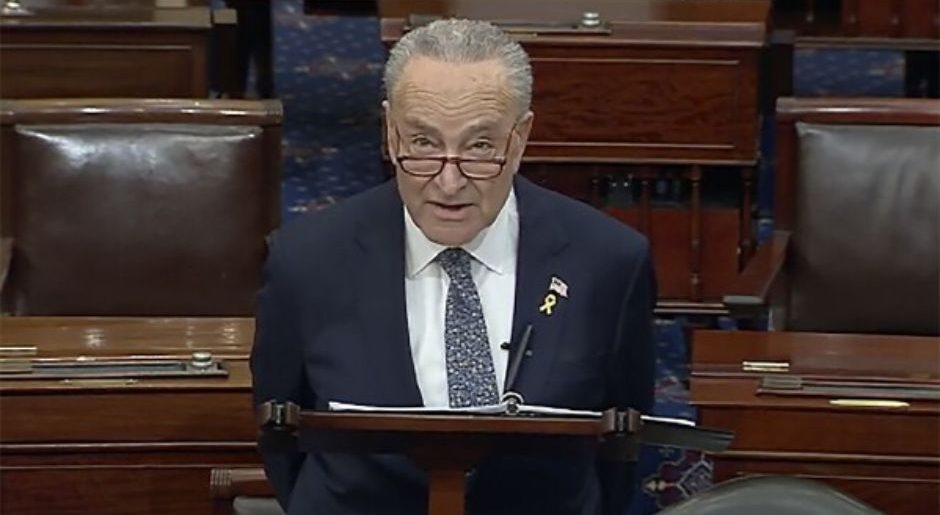
In a fiery floor speech on Wednesday, Senate Minority Leader Chuck Schumer lashed out at President Donald Trump’s signature budget legislation—officially titled the “One Big Beautiful Bill”—mockingly suggesting it be renamed the “Well, We’re All Going to Die Act.” His remarks came as part of a broader Democratic effort to challenge the Republican-led proposal, which Schumer argued would devastate key social safety nets while enriching the wealthiest Americans.
“Let’s be honest about what this bill really does,” Schumer said, brandishing a graphic reading “We’re All Going to Die Act” during his Senate remarks. “It rips health care from 14 million Americans, ends food assistance for 11 million people, and pays for it all with tax cuts for billionaires.”
His comments ignited a wave of mockery and backlash online. Critics noted that Democrats have a long history of describing GOP policies in apocalyptic terms, often with little real-world consequence.
“If every Republican bill caused death like they claim, most of us would be ghosts by now,” one user joked on X. Others pointed to similar warnings issued during past debates over net neutrality, tax reform, and border policies, mocking the recurring “people will die” rhetoric as increasingly unpersuasive.
AG Hamilton, a conservative commentator, wrote: “This is like a parody. Remember when repealing net neutrality was going to kill us? Or when voting laws were supposed to bring back segregation? The left has worn out the phrase ‘people will die.’”
CNN commentator Scott Jennings was even more blunt: “No one should take this melodrama seriously anymore. It’s political theater.”
Meanwhile, new polling data from CNN and Reuters has only added to Democratic woes. CNN data analyst Harry Enten expressed astonishment this week that Republicans continue to dominate on economic trust despite months of negative press around Trump’s tariff policies and market volatility.
“After all the recession fears and tariff complaints, you’d expect Democrats to be leading. But they’re not,” Enten said. “Republicans are ahead by 12 points on who has the better economic plan. That’s after the so-called economic chaos.”
With economic credibility slipping and rhetorical attacks failing to gain traction, Democrats appear to be struggling to shift public perception—while Republicans push forward with their budget plan and a growing advantage on fiscal issues.

James Jenkins is a celebrated Pulitzer Prize-winning author whose work has reshaped the way readers think about social justice and human rights in America. Raised in Atlanta, Georgia, James grew up in a community that instilled in him both resilience and a strong sense of responsibility toward others. After studying political science and creative writing at Howard University, he worked as a journalist covering civil rights issues before dedicating himself fully to fiction. His novels are known for their sharp, empathetic portraits of marginalized communities and for weaving personal stories with broader political realities. Jenkins’s breakout novel, Shadows of Freedom, won national acclaim for its unflinching look at systemic inequality, while his more recent works explore themes of identity, resilience, and the fight for dignity in the face of oppression. Beyond his novels, James is an active public speaker, lecturing at universities and participating in nonprofit initiatives that support literacy and community empowerment. He believes that storytelling is a way to preserve history and inspire change. When not writing, James enjoys jazz music, mentoring young writers, and traveling with his family to explore cultures and stories around the world.