

I bought thirty-three pounds of beef for our Sunday family barbecue. Thirty-three pounds. That might sound ridiculous for eight people, and maybe it was. But in my house, the rule was simple: nobody leaves hungry. If you came over, you got a plate, a cold drink, and enough leftovers to last the week.
That meat cost me $250 out of my own pocket. I remember the exact number because I stood at the butcher counter at Davis Market in our Fort Worth suburb, looked at the white paper packages, and told myself it was worth it. Family was worth it. At least, that’s what I believed that morning.
I never imagined my daughter-in-law, Rachel, and her mother, Stella, would walk in empty-handed with a canvas tote bag stuffed with empty Tupperware—treating my backyard like a free buffet with better furniture. And I never imagined my own son, Julian, would stand there at my patio table, smiling like everything was fine, while he packed up the beef I paid for and handed it over to them. But that’s exactly what happened. And when I finally opened my mouth, I said three words that made the entire yard go dead silent.
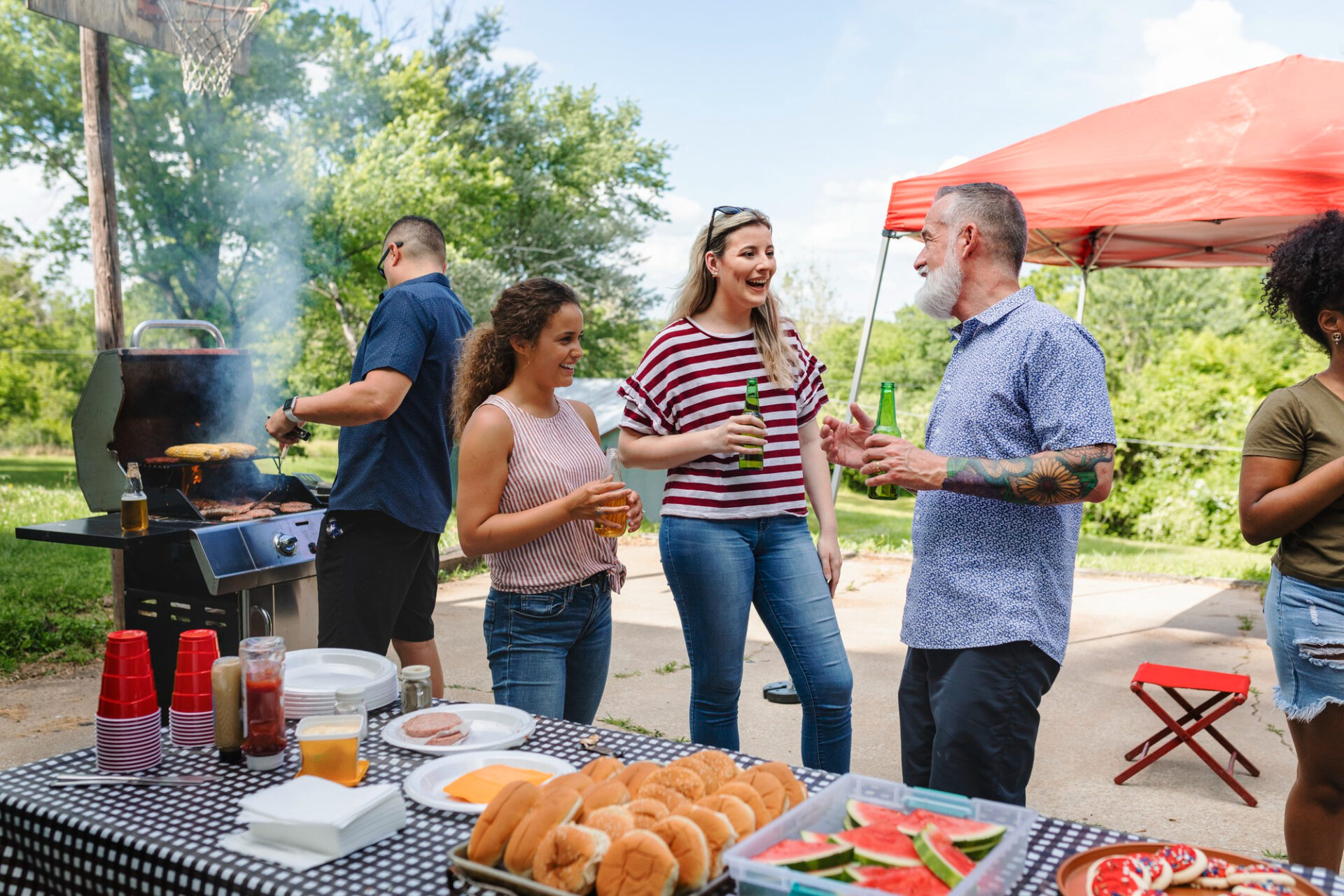
But I should start at the beginning. My name is Betty Miller. I’m sixty-five, married to a good man named Tom, and for most of my life, I was proud to be the one who hosted everyone. Our home sits in a quiet neighborhood where people still wave at neighbors they don’t know and water their lawns before the Texas heat hits. Our backyard isn’t fancy, but it’s ours. A brick patio, a long wooden table, and a grill Tom has babied for almost twenty years.
We’ve hosted birthdays, graduations, and more Sunday lunches than I can count. I loved the noise, the screen door slamming, and seeing people pass plates around. I loved feeling like our home was warm and alive.
Tom always said I had a gift for keeping people fed in more ways than one. Maybe that was true. Or maybe I’d just spent too many years believing love meant doing all the work and pretending not to notice when nobody reciprocated.
That Saturday morning, I woke up early to make my grocery list. Tom was across from me reading the paper. “Betty,” he said, looking over my notepad. “Are you feeding the Dallas Cowboys?” I just smiled. After thirty-nine years of marriage, Tom knew better than to argue once I’d decided to cook.
At the market, Mr. Davis pulled out the best cuts he had—brisket with a perfect fat cap, meaty short ribs, and thick skirt steak. When he weighed it all, the scale hit thirty-three pounds. “Big crowd?” he asked. “Just family,” I told him. He smiled. “Family eats more than a crowd sometimes.” I laughed, thinking it was a sweet comment. Later, those words would feel a lot heavier.
Julian is our only child. He’s thirty-two, smart, and used to be incredibly thoughtful. Then he married Rachel.
I won’t say she changed him overnight, but little by little, Julian became quieter. He started checking her face before answering questions and canceling plans if she didn’t feel like coming. He’d laugh nervously at her sharp little comments, trying to smooth things over before anyone noticed. But I noticed. Mothers notice everything.
Rachel was beautiful in a very polished, Instagram-ready way, but her smile rarely reached her eyes. Her mother, Stella, was sixty, divorced, and proud of being “particular.” In my house, “particular” usually meant someone who criticized everything and called it honesty. Still, I invited Stella because she lived alone and I wanted to be welcoming. That was my usual mistake—confusing being gracious with being a doormat.
When I called Julian on Saturday to confirm, he mentioned Stella wanted to come too. “Of course,” I said. “You know everyone is welcome here.” He sounded relieved. I wish I’d paid more attention to that.
By noon on Sunday, the house smelled incredible. Tom was outside in his Rangers cap, getting the grill going. My nieces, Erica and Louisa, arrived first. Erica brought a warm apple pie wrapped in a dish towel, and Louisa brought a fresh fruit salad and a bottle of wine. “Aunt Betty, what can we do?” Louisa asked, immediately setting her purse down to help. That’s how people who were raised right behave. They don’t walk into a home and expect to be served like they’re at a hotel.
At twelve-thirty, Julian walked in. I hugged him, and for a second, he hugged me back like he used to. Then Rachel stepped in, wearing a sundress better suited for a rooftop brunch than grass, followed by Stella, whose jewelry clicked as she moved.
Rachel gave me one of those air kisses. “Betty, it smells amazing.” Stella nodded. “Yes, very lived-in.” A polite person might have meant comfortable. Stella meant old. Then I noticed the bags. Rachel had a large canvas tote over her shoulder, open just enough for me to see stacked plastic containers. Stella had a folded grocery bag tucked under her arm, clattering with more of the same.
I just stared for a second, waiting for them to say they’d brought a side dish. They hadn’t.
Out on the patio, Tom proudly mentioned I’d bought thirty-three pounds of beef. I watched Rachel and Stella exchange a quick look. It wasn’t gratitude; it was calculation. “Thirty-three pounds?” Rachel laughed. “No wonder we brought containers! I mean, you always make so much, Betty. We just didn’t want anything to go to waste.” We hadn’t even served the food yet.
Lunch started off fine on the surface, though Rachel and Stella sat down immediately and waited to be served. Then the little comments started. Stella pointed out that my roses looked tired in the heat. Rachel ran a hand over the tablecloth. “This is cute. Vintage, right?” When I told her it was my mother’s, she just said, “Oh. That explains it.”
When the brisket came out, Rachel immediately got her phone out to take photos of the spread. “Perfect for Instagram,” she said. Stella took her phone out too. “My friends are going to think we eat like this every Sunday.” Rachel read her caption aloud: Sunday barbecue with the best home cooking. She hadn’t peeled a single potato or spent a single dime.
They ate plenty—Rachel took seconds of brisket and Stella asked for the meatiest rib. As things wound down, Rachel leaned back and sighed. “There is no way all this food is getting eaten. It would be a shame to waste it.”
She looked at Julian. “Babe, can you grab my bag?”
My son stood up without a second thought. He brought her the canvas tote, and they started unpacking plastic containers right onto my table. Suddenly, our family lunch looked like a packing station.
Rachel opened the biggest one. “We’ll just take a little for the week. Julian, get some of that brisket—no, the softer pieces.”
I stood near the kitchen door holding a stack of dirty plates, watching my son pick up the serving tongs. Tom stopped talking near the grill. Erica stopped folding napkins. Nobody asked me. Not once.
“Mom always makes too much anyway,” Julian said lightly, trying to play it off. “Better than letting it go bad.”
That sentence did something to me. It felt like a door shutting in my mind.
I set the plates down. My hands were surprisingly steady. I walked over to Julian, who was holding the giant container filled with the beef I had paid for and cooked. I looked at my son—really looked at him—and saw a man too afraid to be fair because it might upset his wife.
I took the container right out of his hands.
Rachel laughed nervously. “Betty?”
I set the container down, looked at the three of them, and said: “Please leave now.”
The yard went dead silent. Rachel stared at me like I’d slapped her. “Excuse me?”
“You heard me,” I said.
Stella stood up slowly. “Betty, that is incredibly rude.”
“No,” I said, my voice quiet but firm. “Rude is coming to someone’s house empty-handed with empty containers. Rude is criticizing my home and my food while eating your fill. Rude is assuming my generosity is your entitlement.”
Rachel’s face turned red. “We were just taking leftovers!”
“You were packing up the best cuts of the meat before anyone else at this table was even offered seconds.”
Julian finally chimed in. “Mom, come on. You’re making this way bigger than it is.”
That hurt more than anything Rachel could have said. I turned to him. “Julian, I spent two hundred and fifty dollars on this beef. Your father and I have been cooking since sunrise. Your cousins brought food and helped clean. Your wife and her mother brought empty Tupperware. And you are standing here packing up my money like I owe it to them.”
His face went completely pale.
Rachel pushed her chair back, her voice shaking with anger. “I knew it. I knew you didn’t like me. You’re just jealous because Julian has his own family now.”
“This isn’t about liking you,” I said.
Stella grabbed her purse. “My daughter warned me you had issues letting go.”
Tom stepped up beside me. “Enough,” he said, his voice flat. “Betty opened our home to you. We fed you. You disrespected her, and she asked you to leave. So leave.”
Rachel looked at Julian. “Are you just going to stand there?”
Julian looked back and forth between us, panicking. “Mom,” he whispered, “maybe you should just apologize so we can calm down.”
Something broke inside me then—not a messy shatter, but a clean cut, like scissors through string. “No,” I said. “I am not apologizing for demanding respect in my own home.”
Rachel shoved the empty containers back into her bag. “Fine, we’re leaving. Don’t expect us back.”
“You came prepared to treat me badly,” I told her as they walked toward the gate. Rachel glared. “You’re going to regret this.”
Julian paused near the door, and for a second, I desperately wanted him to turn around and say, Mom, you’re right. But he didn’t. He followed them out, and a minute later, I heard their car pull away.
The patio was silent. Tom put his arm around me. “You did the right thing, Betty.” Erica and Louisa came over to hold my hand, telling me they were entirely in the wrong. But none of it changed the fact that my son had walked out of my yard.
By Friday, Julian still hadn’t called. So I called him.
He picked up on the fourth ring, his voice cold. “Hi, Mom.”
“Julian, we need to talk.”
“I don’t think we do. What you did on Sunday was humiliating. Rachel has been crying for days, and Stella is furious.”
“They embarrassed themselves, Julian.”
“They’re family, Mom. They just wanted leftovers.”
“No. They wanted permission to treat me like I don’t matter.”
He went quiet. Then he said, “If you want to fix this, you need to apologize to Rachel.”
“And what about me?” I asked. “What about you?” he replied. That question stayed with me for a long time.
A month went by, and the only things I heard about my son came through the rumor mill. Rachel knew how to spin a story, playing the victim perfectly. Eventually, I packed a bag and drove to San Antonio to stay with my sister, Isabella. She’s the kind of sister who lets you sit with your pain without trying to fix it. When she opened the door and saw my face, she just held me. “You finally got tired,” she said.
I stayed with her for six weeks. One afternoon, we were sitting on her porch drinking tea when she said, “Betty, this was never about the beef. The beef was just the moment the truth became visible. For years, you taught everyone that your kindness had no cost. You gave, you excused, and you made yourself easy to take from. The minute you finally said ‘no,’ the people who benefited from your silence acted shocked.”
She was entirely right.
A few weeks later, Tom called. Julian had stopped by our house to get some old documents, but Tom knew he really wanted to ask about me.
“What did you tell him?” I asked.
“I told him you were staying with Isabella until you felt ready to come back,” Tom said. “And then he asked me if I thought he did something wrong.”
My throat tightened. “And?”
“I told him yes. I told him his mother was disrespected in her own home, and instead of standing by her, he helped the people doing it. He cried, Betty. I think he’s finally starting to see it.”
Two days later, Julian called me directly. “Mom, I want to see you. Please. I need to apologize in person.”
He drove down to San Antonio that weekend. He looked tired and had lost some weight. We sat in Isabella’s living room, and he couldn’t look me in the eye at first.
“After the barbecue, I wanted to believe Rachel because it was easier,” he admitted. “But two weeks ago, we went to her father’s house for his birthday. Rachel brought the containers again. She did the exact same thing—criticized the food, complained about the yard, and then started packing up leftovers before anyone else had finished. Her dad pulled me aside and said, ‘Son, she does this everywhere. Don’t let her convince you every host is the problem.’
I saw your face, Mom. I saw myself holding that container in your yard, and I felt sick.”
He wiped his eyes. “I got into a huge fight with Rachel that night. I asked her why she lied about what happened at our house, and she told me you deserved it because you ‘needed to learn you weren’t in charge anymore.'”
It was never about leftovers. It was about power. She wanted to show me that my role had changed—that I didn’t deserve respect in my own home.
“She told me that if I came to apologize to you, she’d never forgive me,” Julian said.
“And yet you’re here,” I said.
“I should have been here weeks ago.”
“Yes,” I said. “You should have.” I didn’t let him off easy. He needed to hear it.
“Mom, I am so sorry,” he said, his voice breaking. “I was a coward.”
The mother in me wanted to hold him instantly, but the woman in me stayed still. “Julian, Rachel hurt me, but you broke my heart. You were my son before you were her husband. That doesn’t mean you put me above your wife—it means you should know right from wrong, no matter who is standing there.”
He nodded, crying quietly. “I want to earn your trust back.”
Before he left, he told me one more thing. Rachel was pregnant. The news felt like joy wrapped in fear. I was going to be a grandmother, but the mother of my grandchild was a woman who had tried to humiliate me.
Julian and Rachel separated before the baby was born. It wasn’t clean, and Stella left me a nasty voicemail blaming me for the divorce, which I deleted halfway through. I was done giving my energy to people who didn’t deserve it.
When I finally went back home to Fort Worth, Tom held me at the door for a long time. The next time Julian came over, he didn’t show up empty-handed. He brought flowers, a bag of paper plates, and trash bags. He helped Tom in the yard, cleared his own plate, and asked before opening the fridge. We started over—not with big speeches, but with small actions.
When my granddaughter, Sophia, was born, Julian called me from the hospital parking lot, crying. Three weeks later, he brought her over in a carrier. Holding that tiny bundle wrapped in a yellow blanket, everything inside me finally went quiet.
Over the next two years, Julian became the steady parent. Rachel eventually moved to Las Vegas with a man she met through work, and Julian got custody. He learned how to braid hair, pack snacks, and show up. He became the father I always hoped he would be.
And I became a different kind of mother. I still cook, and I still love feeding people, but I no longer confuse generosity with being available for abuse.
Two years after that Sunday, I stood in my kitchen preparing another meal. This time, I bought eleven pounds of beef. Eleven was plenty. Tom was at the grill, my sister Isabella was visiting, and my nieces were on their way with side dishes. Julian was in the living room, and Sophia was running through the grass chasing butterflies.
“Grandma Betty, come look!” she yelled through the screen.
She was holding a tiny daisy she’d found. We put it in a glass of water and set it right in the middle of the table.
Later, as we sat down to eat, everyone helped. Everyone passed plates. Nobody reached for Tupperware. At the end of the night, I packed up the leftovers myself—a little for my nieces, some for the neighbor, and a container of finely cut brisket for Sophia. The difference was simple: this time, I offered. No one took.
After everyone left, Tom and I sat on the porch under the string lights. “Do you ever regret it?” he asked gently. “Saying those three words?”
I thought about the red dress, the empty containers, the weeks of silence, and then I thought about Sophia’s little arms around my neck.
“No,” I said. “I don’t.”
Those three words ended a version of me that believed love required endless swallowing. They ended the habit of smiling while people crossed my boundaries. I lost a bit of peace for a while, but I gained my self-respect. I lost a son who was too afraid to stand up, and got back a man who knew how to apologize and change.
I still cook with my whole heart. But my table is now reserved for people who bring respect along with whatever dish they carry.

James Jenkins is a celebrated Pulitzer Prize-winning author whose work has reshaped the way readers think about social justice and human rights in America. Raised in Atlanta, Georgia, James grew up in a community that instilled in him both resilience and a strong sense of responsibility toward others. After studying political science and creative writing at Howard University, he worked as a journalist covering civil rights issues before dedicating himself fully to fiction. His novels are known for their sharp, empathetic portraits of marginalized communities and for weaving personal stories with broader political realities. Jenkins’s breakout novel, Shadows of Freedom, won national acclaim for its unflinching look at systemic inequality, while his more recent works explore themes of identity, resilience, and the fight for dignity in the face of oppression. Beyond his novels, James is an active public speaker, lecturing at universities and participating in nonprofit initiatives that support literacy and community empowerment. He believes that storytelling is a way to preserve history and inspire change. When not writing, James enjoys jazz music, mentoring young writers, and traveling with his family to explore cultures and stories around the world.