
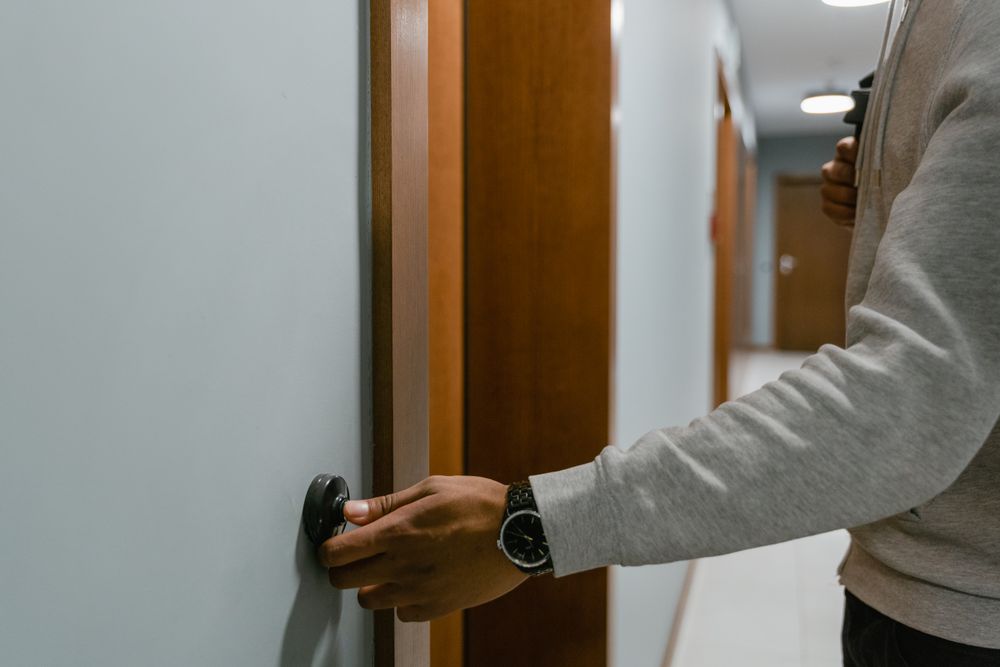
Serena’s hand froze halfway between the brass door knocker and her cream coat.
Wesley saw the folder first.
Not the porch light. Not my face. Not the cup of tea I had set carefully on the little table beside the door. The folder. It sat tucked under Lydia’s arm, thick enough to bend the corner of her navy blazer. My son’s name was printed across the tab in my own handwriting, the same handwriting that had signed his school permission slips, college checks, car insurance forms, mortgage guarantees, and every rescue he had learned to call temporary.
WESLEY.
Serena’s eyes moved from the folder to Lydia’s face. “Why is she here?” Her voice was low and clean. No panic yet. Serena always reached for control before she reached for truth.
Lydia did not answer. She stood on my porch with rain beading on her shoulders, her gray-streaked hair pinned at the nape of her neck, one hand steady around the file.
Wesley swallowed. “Mom,” he said, “this got out of hand.”
I looked at him.
At forty-eight, he still had Arthur’s eyes when he was frightened. That was the cruel part. A mother can look at a grown man and still see the child who once cried because his kite tore in the wind, because his team lost, because the cat knocked his birthday cake off the counter and he could not understand why the world allowed such unfairness. I had spent decades being undone by those eyes. They had cost me more than any number Lydia carried in her folder.
But that child had become a man who let his wife remove me from a dinner I helped make possible.
I stepped back from the doorway. “Come in.”
Serena moved first, brushing past the threshold as if accepting an invitation she had been owed all along. Her perfume carried into the hall, sharp and expensive, mixing with the smell of lemon polish and rain-damp wool. Wesley followed more slowly. Lydia came last. I closed the door.
The sound was soft, but Wesley flinched.
In the sitting room, Arthur’s photograph still watched from the mantel. The grandfather clock ticked beside the bookcase. Three wet coats shifted and settled in the quiet. Arthur had wound that clock every Sunday evening for thirty-four years. The week after he died, it ran down and I let it stay silent for almost a month before I could bring myself to open the glass case again. Now it kept time so precisely that Lydia once asked if I had it serviced. I told her no. Some things run best when someone simply refuses to let them stop.
Serena did not sit. She never sat willingly in my house. I had noticed that years ago, the way she kept herself upright and angled as if my furniture were borrowed, as if staying on her feet preserved some distinction between visiting and arriving.
“This is a family matter,” she said to Lydia.
Lydia placed the folder on my coffee table. “It became a banking matter at 8:11 this morning.”
Wesley rubbed the back of his neck. “Mom, we were going to call you.”
“At 6:18 last night,” I said, “you did.”
His face tightened.
Serena turned toward him. “You sent the second text?”
He did not answer fast enough. That was answer enough.
Her cream coat looked too bright against my old green chair. One rain droplet slid from her sleeve to the hardwood floor. I picked up my teacup and set it on a coaster. No shaking. No raised voice. No begging. That alone seemed to unsettle them both.
Let me tell you about the text.
It arrived the night before at 6:18 p.m., while I was sitting in this same chair with a bowl of soup and the kind of quiet that sometimes feels like peace and sometimes feels like absence depending on which way you turn your head. The message was from Wesley, though it did not read like Wesley. It read the way Wesley wrote when Serena was in the room and he was choosing her version of the words.
You weren’t invited. My wife doesn’t want you there.
I had known something was wrong before that. I had known the way you know weather before the rain actually arrives. The signs had been accumulating for months. A family dinner I was told was canceled, then saw photographs from on my granddaughter’s tablet screen two days later. An invitation to the school’s spring performance that somehow never came, though Serena was photographed front and center in the row I would have occupied. A birthday gathering for Wesley’s work colleagues where I was described, later and offhandedly, as not really that kind of crowd.
Not really that kind of crowd.
Seventy-seven years old, widowed three years earlier, co-signer on their mortgage, quiet funder of their country club membership and their daughter’s private school education and their kitchen renovation and the business equipment charges I had not yet traced to their source. Not really that kind of crowd.
But the text was different. The text put the door in writing.
I read it twice, ate the rest of my soup, washed the bowl, dried it, put it back in the cabinet, and called Lydia.
Lydia Marsh had been my financial advisor for eleven years. She had the particular steadiness of a person who had heard every possible human combination of fear and greed and still managed to show up Monday morning without cynicism. When I told her I needed to see every outgoing transfer from my trust account for the past three years, she did not ask why. She said she would have the report ready by morning.
She arrived at my door at seven forty-five with rain on her shoulders and a folder thick enough to tell its own story.
Now she opened it.
“Mortgage assistance draft,” Lydia began. “Monthly amount: $4,850. Originating account: Margaret Hale Living Trust. Beneficiary household: Wesley and Serena Hale. Active for thirty-one months.”
Serena blinked. “That’s not”
Lydia turned the page.
“Private school tuition support. Monthly amount: $2,800. Active for eighteen months.”
Wesley stared at the carpet.
Serena’s lips parted. “Wesley told me that was from his bonus structure.”
I watched my son’s shoulders rise, then sink. The gesture of a man who has run out of road.
Lydia continued. “Homeowners insurance. Two vehicles. Country club family membership. Emergency repairs listed under residential improvement. Business line tied to an entity called Hale Strategy Group.”
At that, Serena’s face changed. Not guilt. Alarm. “What business line?” she asked.
Wesley pressed his fingers to his forehead.
“What business line?”
Lydia looked at me for permission. I gave a small nod. She slid a page across the coffee table. Serena snatched it up. Her manicured thumb trembled against the corner. The page showed $1,950 a month, withdrawn from my account for twenty-six months, marked as business telecommunications and client management software.
Serena read the company name once. Then again. “Hale Strategy Group,” she said. Her voice had lost its polish.
Wesley looked toward the mantel, not at her.
“You told me the firm paid for that.”
He rubbed both hands over his face. “I was going to fix it.”
“Fix what?”
He said nothing. The house seemed to grow smaller around us. The clock ticked. Rain tapped the windows. Somewhere in the kitchen, the refrigerator hummed steadily, indifferent to the collapse taking place ten feet away.
I had never heard of Hale Strategy Group until Lydia turned the screen toward me that morning. It had been one of the lines buried between utilities and membership fees, quiet and patient, waiting for daylight. Twenty-six months. I had been paying for a business I did not know existed for over two years. Whether it was a real operation or a vanity project or something more deliberate than either, I did not yet know. What I knew was that my name was on the account and my knowledge had not been required.
That was the pattern, wasn’t it. My name, but not my knowledge. My money, but not my presence. My generosity, but not my company.
Lydia removed another sheet. “This is the notice generated today when access was revoked. Mr. Hale is no longer authorized to initiate transfers, create payment instructions, or use Margaret Hale’s trust account for any household or business-related charge.”
Serena stared at Wesley. “You had access?”
His face reddened. “For emergencies.”
“For years,” I said.
He turned to me. “You gave it to me.”
“I did.”
The words came out calm. That mattered. I had given him access two months after Arthur died, when Wesley was grieving too, when he said the mortgage company needed a quick bridge and Serena was overwhelmed and the baby’s expenses had doubled and he sounded so much like the boy who used to stand in the kitchen doorway asking if everything would be okay.
I gave him access because I mistook trust for closeness. Then I kept giving because stopping would have forced me to see what I had become to them.
A safety net with a pulse.
Arthur would have stopped it sooner. He had a way of saying the quiet uncomfortable true thing without making it sound like an attack. He would have poured a cup of coffee and sat down with Wesley and said something like, “Son, I think we need to look at some numbers,” and somehow made it feel like kindness rather than accusation. I never had that gift. I expressed love through provision, through showing up, through making problems smaller before anyone else noticed them. It had served our family well for decades. Then Arthur died, and without him to balance the ledger of closeness, my way of loving became an open account with no ceiling.
Serena folded the page slowly. Her eyes moved over my sitting room for the first time, really seeing it. The worn rug Arthur and I had bought at an estate sale in 1991, arguing cheerfully about the color in the parking lot. The framed photo on the mantel from our thirty-fifth wedding anniversary, the one where we were both laughing at something outside the frame that I could no longer remember and did not need to. The quilt over the arm of the sofa, made by Arthur’s mother, handed down to me because she said I was the one who would keep it. The good porcelain cup beside my chair.
All the things she had dismissed as old.
All the things that had funded her new.
“Wesley,” she said, “how much?”
He shook his head.
Lydia answered because numbers do not protect anyone’s pride. “In the past calendar year, $93,600.”
Serena took one step back. Her heel struck the leg of the coffee table. The folder shifted. A few papers slid loose, spreading across the table like white cards in a losing hand.
“Mom,” Wesley said, and his voice cracked on that single word.
I waited. For once, I did not rush to save him from discomfort. I sat in Arthur’s chair and watched my son stand in the middle of the room he had grown up visiting, the room where he had opened Christmas presents and celebrated birthdays and brought his daughter to meet her grandfather just in time for Arthur to hold her once before he got too sick to hold anything.
He looked older than he had the night before. The skin beneath his eyes sagged slightly. His expensive sweater was damp at the collar. His phone kept vibrating in his hand.
Declined charge.
Declined charge.
Declined charge.
Each vibration sounded small and ugly in the room.
Serena’s eyes snapped to the phone. “What is that?”
Wesley looked down. He did not speak. She took the phone from his hand. I saw the screen glow against her face. The color drained from her cheeks.
“Club dining account declined,” she read. “Preschool payment failed. Auto renewal failed. Mortgage draft returned pending review.”
Her breath came through her nose in sharp little pulls. Then she looked at me. Not like a daughter-in-law. Not like a woman who had excluded an old widow from a dinner. Like someone seeing the locked door behind the person she had pushed too far.
“You can’t do this,” she said.
I folded my hands in my lap. “My name is on the accounts.”
“It affects the child.”
There it was. The word she saved for leverage. Child. My granddaughter. The little girl who had texted me at 6:47 the previous evening, seven minutes after Wesley’s message, asking if I was still coming. She had not been told I was not invited. She had found out the way children find out the things adults try to manage around them, in pieces, from the wrong direction, too late to make sense of and too early to understand. She still pressed stickers onto my envelopes and called Arthur’s picture Grandpa Star because when she was three and learning to talk, she asked where he was and I pointed at the frame and said he was up in the stars and she looked at the photograph and then at the ceiling and back at me and said grandpa star and that was that, the name settled into her language and refused to leave.
My throat tightened. But I did not move.
“I have already arranged a separate education account for her,” I said. “One neither of you can touch.”
Wesley lifted his head. Serena went still. Lydia placed one final document on top of the folder.
“This was completed at 9:32 this morning,” she said. “A custodial education trust. Direct school payments only. No parental withdrawal access.”
Serena stared at the paper. For the first time since she entered my house, she had no immediate sentence ready. The silence was not empty. It was full of every dinner I had missed, every bill I had paid, every thank-you that had become an expectation and every expectation that had become invisible to the people it benefited.
I want to be precise about something. I did not cut off the accounts because of the text. One sentence does not undo thirty years of love, even a sentence like that one. I cut them off because the text was a door opening onto a room I had not been willing to enter, and once the door was open, I had no choice but to look at what was inside.
What was inside was a version of my life I had arranged carefully so I would not have to see it directly. A version where I was useful but not central. Present but not necessary. Generous but not, apparently, fit for a Tuesday dinner with coworkers who had not earned the right to know my face. I had done what mothers of my generation were trained to do. I had made myself small enough that the people around me could feel large. I had mistaken disappearance for love.
Arthur used to say, “Maggie, you give people so much room they forget you’re in the house.” I used to think he was teasing me. He was not.
Wesley stepped toward me. “Mom, I’m sorry.”
His eyes were wet. A younger version of me would have stood. Touched his face. Told him we would talk. Told him I understood. Told him Serena pressured him, life was hard, marriage was complicated, money made people afraid. A younger version of me would have turned his apology into my responsibility. I stayed seated.
“What are you sorry for?” I asked.
He blinked. “For the text.” I waited. “For letting it happen.” I waited again. “For using the accounts.”
Serena made a sound under her breath. He looked at her, then back at me.
“For lying.”
That one landed. Not beautifully. Not enough to mend anything. But it landed in the right place, which is the first requirement for landing at all.
Serena straightened. “We should discuss this privately.”
“We are,” I said.
Her eyes cut toward Lydia. “Without the banker.”
Lydia closed the folder with both hands. “I’m here because Mrs. Hale requested a witness for the receipt of account revocation and notice of independent trust protection.”
Serena’s mouth tightened. “A witness.” The word sounded like something she wanted to drop on the floor.
“Yes,” Lydia said. Her voice remained even. That made Serena angrier than shouting would have.
Wesley sank onto the edge of the sofa without asking. His knees looked weak. His wet shoes left dark marks on the rug. Arthur would have hated that rug being marked. Then again, Arthur would have hated what his son had become far more.
Serena remained standing. “You’re punishing us because of one awkward dinner,” she said.
I picked up the townhouse brochure from the side table. I had left it there on purpose, placed it the previous morning when I was still deciding whether to go through with any of this, when some part of me hoped the folder would tell a different story and I could put the whole thing down and go back to being the woman who made space. The pages showed the brick walkway, the staged lamps, the smiling kind of emptiness real estate photographers sell as home.
I opened to the page with the kitchen. The one Serena had called perfect the night she showed it to me, her voice bright with the warmth she used exclusively when she needed something. The one Wesley had said was for me too, which I understood even then was not entirely true but wanted badly enough to not examine.
I placed it on top of the folder. “I paid part of the down payment on a house where I was not welcome for dinner,” I said.
Serena’s gaze dropped to the glossy page. For a moment, her face looked almost naked. Not sorry. Exposed. The difference between those two states is larger than people imagine.
Wesley covered his eyes with one hand. “I didn’t think you’d actually stop everything,” he said.
That sentence told the whole truth. Not that he loved me. Not that he forgot. Not that he was trapped by Serena’s demands or his own weakness or the complicated arithmetic of a marriage. He simply believed I would absorb the wound and keep paying. He believed it the way people believe in gravity, not because they have tested it recently but because it has always been true and they have stopped noticing it is a law rather than an inevitability.
My fingers tightened once around the armrest. Then relaxed. At seventy-seven, the body teaches you what the heart refuses. Tightness hurts. Release hurts less.
“I know,” I said.
Serena’s phone rang. She looked down and silenced it. It rang again immediately. Then Wesley’s buzzed. Then hers again. Their life, built on automatic yes, had begun asking manual questions. The machinery of assumption was grinding without its fuel.
Serena glanced toward the front door. “Wesley, we need to go.” But he did not stand. He looked at me like a boy waiting outside the principal’s office, hoping his mother would come and make the consequences softer. I had done that too many times. Gone in. Smoothed it over. Come home with the problem still mine.
Lydia gathered the loose pages back into order, clipped the folder shut, and passed me a receipt copy. “The revocations are complete,” she said. “The trust protections are active. The business authorization has been flagged for review.”
Wesley’s head snapped up. “Flagged?”
Lydia looked at him. “Mrs. Hale did not recognize the business expenses. That required notation.”
Serena turned slowly toward Wesley.
There are moments when a marriage does not break loudly. No thrown glass. No screaming. Just one spouse realizing the other has been lying in a direction they never bothered to check, that the ground they were standing on was borrowed without disclosure, that the version of the story they believed had an entire chapter missing.
“What review?” Serena asked.
Wesley stood. “Not now.”
“Yes,” she said. “Now.”
I rose from Arthur’s chair. Not quickly. My knees complained. My hand found the armrest first, then the air, then balance. All three of them watched me rise in that way people watch older women move, waiting to see whether assistance will be needed, ready to offer it and equally ready to use the moment as evidence of diminishment. I did not need assistance. I had not needed it for the three years since Arthur died, through every difficult morning and every harder evening and every decision I had made alone in this house without anyone asking whether I was managing.
I walked to the mantel and touched Arthur’s frame. The silver was cool. “You should leave,” I said.
Wesley took one step toward me. “Mom, please.”
I looked at my son. His face blurred slightly at the edges, but I did not let the tears fall. “You may call me when you are ready to speak without needing something.”
He stopped.
Serena pulled her coat closed, though the room was warm. Lydia lifted the folder. “No,” I said softly. She paused. I held out my hand. She gave it to me. The folder was heavy. Heavier than paper should be, heavier than the simple weight of its contents could explain.
I walked to the front door and opened it. Cold damp air slipped into the hall. The porch light caught the rain in thin silver threads.
Serena stepped out first, fast now, her heels sharp against the boards. Wesley lingered in the doorway for a moment with the particular hesitation of a person who has just understood that the version of things he has been living in was built on someone else’s silence and is not certain what the structure looks like now that the silence has ended.
“Did you ever love me without the money?” he asked.
The question struck harder than I expected.
I held the folder against my chest. “Yes,” I said. “That was the problem.”
His face folded. For one second, I saw the little boy with the torn kite standing in the yard looking at the broken thing in his hands like it had betrayed him. Then I saw the man who had written, You weren’t invited, and sent it from a house I had helped him buy on a street I would not have chosen for him but supported anyway because it was what he wanted and I had taught myself that what he wanted was the same as what I wanted for him.
He stepped onto the porch. I closed the door. This time, he was on the other side of it.
The house settled around me. No applause. No victory music. No clean happiness. Just the clock, the rain, and my own breathing, which was steadier than I had expected and shakier than I wished.
Lydia stood beside the sitting room archway, quiet as a witness in a church. “Are you all right?” she asked.
I looked at the good teacup on the table. The tea had gone cold.
“I will be.”
Through the window, I saw Serena and Wesley standing beside their car. She was speaking fast, her hands moving in the particular way they moved when she was managing rather than communicating. He kept looking back at the house, at the lit window where my shape was probably visible through the glass.
Then Serena opened the passenger door and stopped.
Because another car had turned into my driveway.
A small blue sedan.
My granddaughter climbed out holding a backpack against her chest. Behind her, her teacher stepped into the rain with one hand raised, uncertain, the expression of someone who has delivered a child somewhere and is not entirely sure the delivery is welcome.
I moved to the window.
My granddaughter looked past her parents, straight at my door. She was nine years old and small for her age, with Arthur’s coloring and my stubbornness and a habit of chewing the end of her pencil when she was trying to say something she was not sure she had the words for yet. Her small face was pale.
Then she lifted her phone. The screen lit briefly. A message arrived on my screen.
Grandma, Mom said you ruined everything. Can I come inside?
I opened the door before the second buzz.
She ran across the wet driveway without looking at her parents, her backpack swinging, her sneakers splashing through the shallow puddle at the base of my porch steps, and she came through my door and into my arms with the uncomplicated urgency that belongs exclusively to children who trust you completely and do not know yet how unusual that is.
I held her.
Over her head, I could see Wesley standing in the rain. He was not looking at Serena. He was looking at his daughter in my arms, and his face was doing something I had not seen it do in years.
Not guilt exactly.
Not calculation.
Something older and more honest than either.
I did not hold the door open for him. I did not wave him in or signal any kind of conclusion. There were things that would need to be said between us, real things, the kind that required him to come without needing anything and stay without expecting rescue. That was not a conversation for a rainy driveway on a day when everything had just been overturned.
But it was a conversation that might happen. That possibility was new.
My granddaughter pulled back and looked at me. She had rain on her eyelashes.
“Were you crying?” she asked.
“A little,” I said.
“Why?”
I looked at her face, at the earnest worried nine-year-old attending closely to my answer, at the child who texted her grandmother at 6:47 p.m. asking if she was still coming because nobody had thought to tell her in advance that she was not wanted at the table.
“Because some things that were wrong are being made right,” I said. “And that always costs something.”
She considered this with the seriousness she brought to difficult questions. Then she nodded. She accepted imperfect explanations with more grace than most adults I had known.
“Can I have tea?” she asked.
“Yes,” I said.
I closed the door.
Lydia caught my eye from the sitting room. She gave one quiet nod. Then she gathered her coat and her umbrella and let herself out through the kitchen door, the way she always left when she understood that her part was finished and the rest belonged to someone else.
The kettle was still warm. I filled two cups. My granddaughter dropped her backpack in the hall where Arthur used to drop his briefcase and climbed into the green chair with her knees up, making herself comfortable in my house with the ease of someone who had never needed to think about whether she was welcome there.
She looked at Arthur’s photograph on the mantel.
“Hi, Grandpa Star,” she said.
The clock ticked.
The rain kept on.
I set the cups on the table, sat in my chair, and watched my granddaughter pick up her tea with both hands.
Some things had ended that afternoon. Some had not yet begun. The space between those two facts was where real life usually happened, not in the large confrontations or the dramatic moments but in the quiet afterwards, in the ordinary room, in the cups on the table, in the small person across from you who does not yet understand everything that has just changed but trusts that you do and trusts that you will say so when the time comes.
I drank my tea.
It was the right temperature this time.
For the first time in as long as I could remember, so was everything else.

Emily Johnson is a critically acclaimed essayist and novelist known for her thought-provoking works centered on feminism, women’s rights, and modern relationships. Born and raised in Portland, Oregon, Emily grew up with a deep love of books, often spending her afternoons at her local library. She went on to study literature and gender studies at UCLA, where she became deeply involved in activism and began publishing essays in campus journals. Her debut essay collection, Voices Unbound, struck a chord with readers nationwide for its fearless exploration of gender dynamics, identity, and the challenges faced by women in contemporary society. Emily later transitioned into fiction, writing novels that balance compelling storytelling with social commentary. Her protagonists are often strong, multidimensional women navigating love, ambition, and the struggles of everyday life, making her a favorite among readers who crave authentic, relatable narratives. Critics praise her ability to merge personal intimacy with universal themes. Off the page, Emily is an advocate for women in publishing, leading workshops that encourage young female writers to embrace their voices. She lives in Seattle with her partner and two rescue cats, where she continues to write, teach, and inspire a new generation of storytellers.