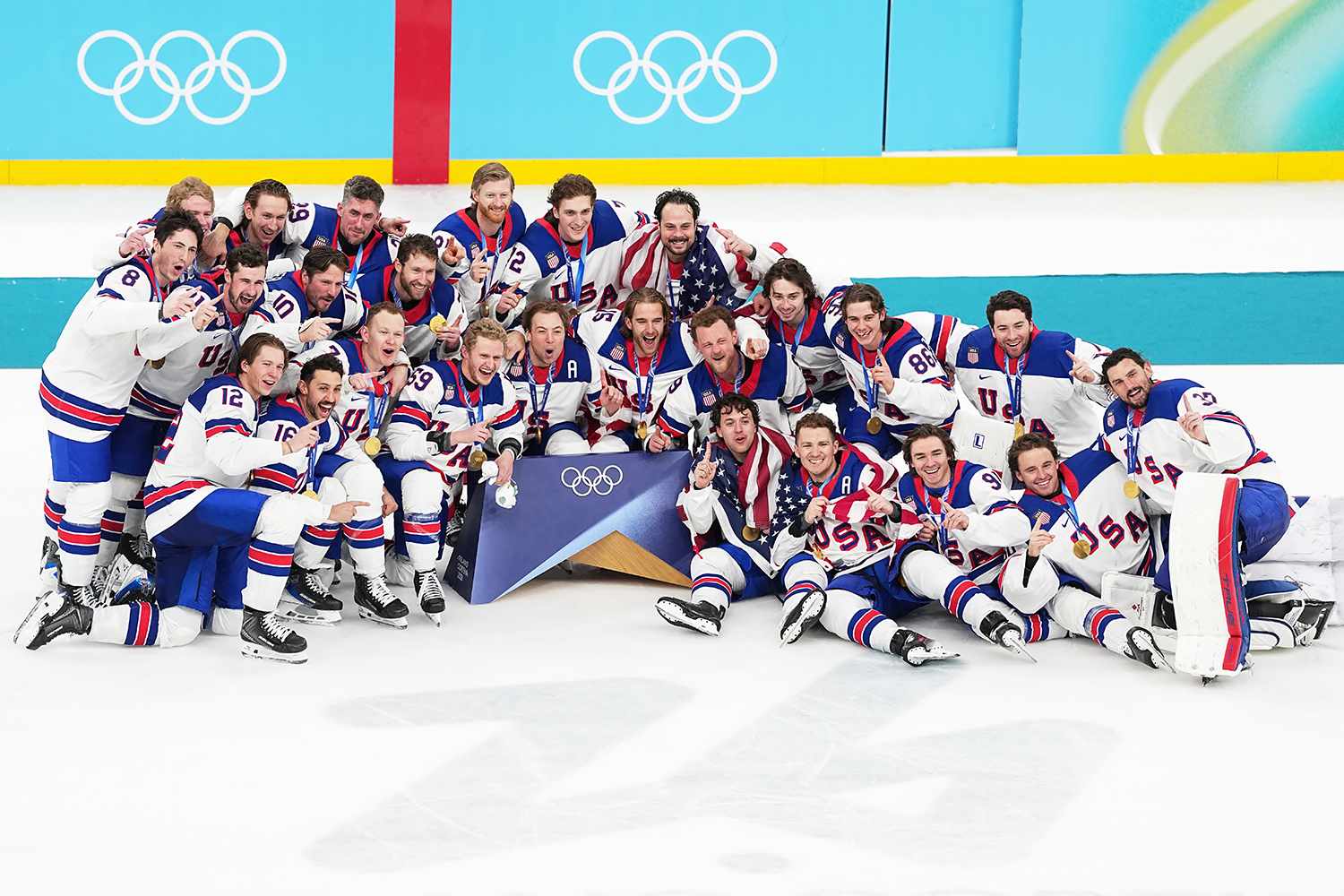
United States men’s national ice hockey team made headlines this week after visiting the White House — but not every player chose to attend.
The team, fresh off a dramatic 2–1 victory over Canada to secure Winter Olympic gold, received a high-profile invitation from Donald Trump to attend his State of the Union address on Tuesday, February 24. What began as a celebratory gesture quickly evolved into a politically charged moment, drawing scrutiny from fans and critics alike.
The Invitation That Sparked Debate
Shortly after their championship win on Sunday, February 22, footage emerged showing a post-game locker room video call between the president and the victorious players. In the clip — which rapidly accumulated millions of views across social media platforms — Trump congratulated the team and extended a personal invitation to attend his major address in Washington, D.C.
“We’re giving the State of the Union speech on Tuesday night,” Trump told the athletes. “I could send a military plane or something, if you would like to. It’s the coolest night. It’s the biggest speech.”
At first, the exchange appeared lighthearted and celebratory. The players, still energized from their win, smiled and listened as the president praised their performance.
However, the tone shifted when Trump added another remark.
“And we have to — I must tell you — we’re going to have to bring the women’s team. [If I don’t] do that, I do believe I probably would be impeached, OK?”
The comment prompted laughter from several players in the room — and almost immediately ignited backlash online. Critics labeled the remark “misogynistic” and “sexist,” arguing it trivialized both impeachment and the accomplishments of the women’s team.
The controversy only deepened as the clip continued circulating.
The Women’s Team Responds
The United States women’s national ice hockey team, who also claimed Olympic gold this year and have medaled at every Games since women’s hockey was introduced, were quick to respond through a spokesperson.
Speaking to NBC, a representative explained that due to “timing and previously scheduled academic and professional commitments,” the women’s team would decline the president’s invitation to attend the address.
The statement was measured and professional, avoiding direct commentary on the president’s remarks.
Interestingly, reports later indicated that members of the women’s squad accepted a separate celebratory invitation from rapper Flavor Flav, who has publicly supported women’s sports initiatives in recent years.
With the women opting out, attention shifted squarely to the men’s team — particularly whether they would attend and, if so, who would appear alongside the president in Washington.
All Eyes on the White House Visit
On Tuesday evening, the majority of the 25-player roster arrived in Washington, D.C., for the State of the Union event. Photographs and footage from the White House showed players in suits, posing for pictures and greeting officials.
During remarks to the team, Trump told the athletes: “I recognize every one of you. I know every one of you. Big guys.”
The atmosphere appeared cordial, and many players smiled for cameras as they stood behind the president.
But as images from the event circulated, observers quickly began counting faces — and noticed that not every player was present.
Five members of the championship-winning roster were absent from the White House gathering.
Their identities were not immediately highlighted in official statements, but media outlets soon confirmed who had opted not to attend.
The five players missing from the visit were Brock Nelson, Jackson LaCombe, Jake Guentzel, Jake Oettinger, and Kyle Connor.
Why Were They Absent?
Speculation about their absence began almost immediately.
According to reporting from The Guardian, four of the players — Nelson, LaCombe, Guentzel, and Oettinger — have ties to Minnesota, either by birth or upbringing. In recent months, Minnesota has experienced heightened tensions surrounding federal immigration enforcement actions.
There has reportedly been an increased presence of ICE agents in certain communities, along with protests following the deaths of Alex Pretti and Renee Good. Some social media users drew connections between the state’s political climate and the players’ decision not to attend the White House event.
However, it is important to stress that none of the players publicly cited political reasons for their absence. No official statement from the team or the athletes themselves confirmed that Minnesota’s situation influenced their decision.
In fact, one of the absent players did offer a straightforward explanation.
Kyle Connor, who plays professionally for the Winnipeg Jets in Canada, told The Athletic that his focus was on preparing for the remainder of the NHL season.
“I’m just getting ready,” Connor said. “We play on Wednesday. It’s a big second half, so I just wanted to make sure I was ready.”
Connor’s reasoning underscored a practical reality: the NHL season was in full swing, and several of the absent players were scheduled to compete in games the following day.
Like Connor, Nelson, LaCombe, Guentzel, and Oettinger are also active NHL players with midweek matchups. Travel to Washington for the event would have added additional strain to already demanding schedules.
A Tradition That’s Become Political
Championship teams visiting the White House has long been a bipartisan American tradition. Presidents from both parties have hosted athletes across sports to celebrate national achievements.
In recent years, however, such visits have become increasingly politicized. Some athletes have declined invitations during both Democratic and Republican administrations, citing personal beliefs, scheduling conflicts, or broader political disagreements.
The debate surrounding this particular visit reflects that broader national trend.
Supporters argue that attending the White House is about honoring athletic achievement, not endorsing political positions. Critics contend that participation can carry symbolic weight, particularly during times of heightened political tension.
In this case, the added controversy surrounding Trump’s remarks about the women’s team intensified scrutiny on the men’s decision to attend.
Team member Jack Hughes later addressed the laughter heard in the locker room video, defending his teammates’ reaction and suggesting it was a spontaneous response in an informal setting rather than a reflection of any deeper stance.
The Bigger Picture
Ultimately, most of the U.S. men’s hockey team did attend the State of the Union address, standing as guests of honor during what became the longest speech of its kind in modern history.
But the absence of five players ensured the story did not end there.
Whether their decisions were driven purely by professional commitments or influenced by other factors remains a matter of public speculation. What is clear is that even moments meant to celebrate sporting triumph can quickly intersect with political debate.
The team’s Olympic victory was a unifying moment on the ice — a hard-fought win that thrilled fans nationwide. Yet off the ice, the White House visit demonstrated how sports and politics often overlap in complex and sometimes controversial ways.
For some, the story is about scheduling logistics during a packed NHL season. For others, it represents something more symbolic.
Either way, the image of the team standing behind the president — with five noticeable gaps in the lineup — became almost as widely discussed as the championship win itself.