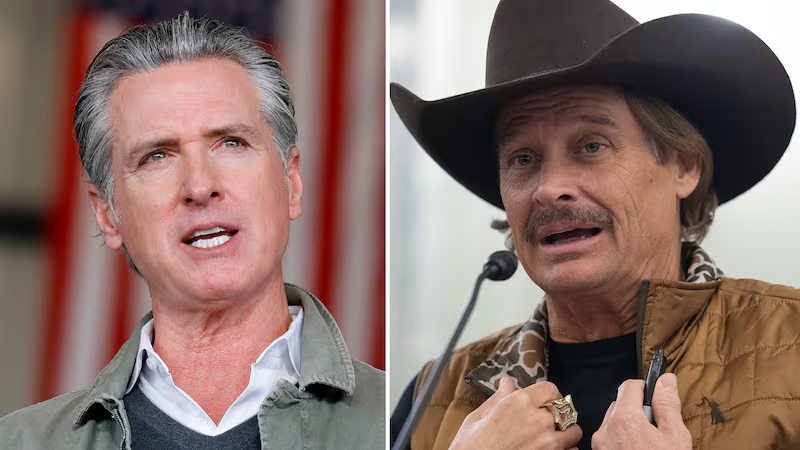
California Governor Gavin Newsom has made waves on social media and across the entertainment world after announcing what many are calling an unprecedented move: a ban on singer and musician Kid Rock from entering the state. The decision comes after a viral video featuring Rock and U.S. Health and Human Services Secretary Robert F. Kennedy Jr. raised eyebrows for its unconventional — and some argue, inappropriate — content.
Rock, whose career has been marked by a series of controversial moments, including accusations of lip-syncing at an alternative Super Bowl halftime show, now finds himself under scrutiny for his latest public appearance. Earlier this month, clips surfaced of Rock’s performance, prompting public commentary from figures such as comedian and talk-show host Bill Maher. But it was a completely separate video that ignited the ire of Governor Newsom and thrust Kid Rock into national headlines once again.
The video, which quickly went viral on social media platform X, shows Rock and Kennedy Jr. engaging in a shirtless workout session, with the pair hopping between gym machines, sauna sessions, and eventually a pool, all while promoting fitness and healthy eating. The caption accompanying the video read: “I’ve teamed up with Kid Rock to deliver two simple messages to the American people: GET ACTIVE + EAT REAL FOOD.”
Though the stated intent was wholesome — encouraging Americans to exercise and maintain a healthy diet — reactions online were far from positive. Many viewers called the video “bizarre,” “creepy,” and “unsettling,” while others criticized the celebrity endorsement approach. One X user commented bluntly: “This is weird,” while another described it as “a f**king joke and embarrassment.”
Amidst the social media storm, Governor Newsom took action, announcing via the official press office account that he had “seen enough” and was officially banning Kid Rock from California. The post, shared on February 21, read:
“I HAVE SEEN ENOUGH. AS GOVERNOR OF THE FREE WORLD, I, GAVIN C. NEWSOM, AM OFFICIALLY BANNING ‘KID ROCK’ FROM CALIFORNIA. HIS SHIRTLESS VIDEO WITH ‘SECRETARY BRAINWORM’ WAS INAPPROPRIATE, CREEPY, AND VERY LOW ENERGY. NOT WHAT YOU WANT AROUND OUR CHILDREN! ALSO, SOME OF THE WEAKEST WORKOUT FORM I’VE EVER WITNESSED.”
Newsom did not stop at banning Rock from the state. He also addressed what he called “questionable exercise attire,” stating:
“CALIFORNIA ONLY ALLOWS WINNERS! I AM ALSO BANNING WORKING OUT IN JEANS, VERY STRANGE! THANK YOU FOR YOUR ATTENTION TO THIS MATTER! — GOVERNOR GCN.”
https://twitter.com/GovPressOffice/status/2025259841258737813
The governor’s tongue-in-cheek yet firm statement has drawn attention both for its content and for the unusual nature of a political figure “banning” a musician from a state. While the announcement was widely shared and met with amusement, it has also sparked debate about the limits of political influence over public figures and the nature of viral internet culture.
Kid Rock’s career has always included a fair share of controversy, ranging from his outspoken political stances to highly publicized performances. From lip-syncing accusations at high-profile events to a string of provocative social media posts, the musician has consistently operated on the edge of mainstream acceptability. His recent collaboration with Kennedy Jr., however, appears to have reached a tipping point.
The video itself shows Rock and Kennedy Jr. executing a variety of exercises in a gym setting, including push-ups, pull-ups, and weight training. Both appear to encourage each other, with playful banter and exaggerated gestures throughout the session. At one point, they remove their shirts while in the sauna, prompting a chorus of reactions online, with many viewers expressing discomfort at the casual nudity. The pair then move to a pool and toast with glasses of whole milk, emphasizing their commitment to a “natural” approach to nutrition.
Despite the apparent intent to inspire healthier habits, the video’s unusual presentation has dominated headlines for days. Critics argue that the combination of shirtless workouts, unconventional props, and a public figure like Kennedy Jr. participating in such antics made the content jarring and inappropriate for certain audiences, particularly children. Newsom’s response framed the issue not only as a matter of propriety but also as a reflection of energy, posture, and exercise form — elements he highlighted as subpar.
The ban announcement, while largely symbolic, has sparked a heated debate online and in traditional media. Some commentators have praised Newsom for taking a stand against what they see as poor judgment and a lack of decorum, particularly from public figures who can influence young audiences. Others see the governor’s response as overblown or performative, highlighting the surreal nature of a state executive “banning” a celebrity based on a viral video.
Reaction from the public has been mixed. On social media platforms, memes, jokes, and commentary have spread rapidly, with some users expressing amusement at the dramatic language of the press release. One X user joked, “Better watch out, Kid Rock — California’s gym police are coming for you,” while another wrote, “I guess Rock can still tour everywhere else, just not where the sun shines brightest.”
At the same time, some fitness and media commentators have attempted to extract a more serious point from the incident, noting that celebrity-driven messaging around health can often backfire when delivered in unconventional or shocking ways. They argue that while the goal of promoting exercise and better nutrition is commendable, presentation matters, especially when addressing broad audiences, including children.
The governor’s comments about attire and form, in particular, have sparked additional discussion. His critique of Rock working out in jeans and displaying what he called “the weakest push-up form” has inspired debates over what constitutes appropriate fitness guidance from public figures. Fitness professionals noted that while casual and unconventional workouts are acceptable in private settings, public demonstrations involving celebrities carry additional responsibilities.
In a larger context, this incident underscores the power of viral content in shaping public discourse. A single video, whether intended as a lighthearted promotional effort or not, can generate widespread criticism, trigger official responses, and become a defining moment in a public figure’s career. Kid Rock’s experience exemplifies how quickly online attention can escalate and how state officials can weigh in on content perceived as crossing lines of decency.
While the “ban” itself is largely symbolic — California does not have legal authority to physically prevent entry to residents or visitors — the governor’s announcement has cemented the story’s status in national headlines. Media outlets from coast to coast have covered the event, analyzing both the content of the video and the governor’s dramatic response. Talk shows, podcasts, and online news platforms have debated whether Newsom’s statement represents genuine concern or performative media strategy.
Despite the controversy, Rock’s fanbase remains engaged. Supporters have rallied around him online, defending his right to creative expression and emphasizing the health messages promoted in the video. Some have dismissed the governor’s criticism as overreaction, arguing that the collaboration with Kennedy Jr. should be interpreted as an attempt to raise awareness of wellness, rather than an invitation for scandal or ridicule.
The story also raises broader questions about the intersection of politics, celebrity culture, and social media. Governors and elected officials increasingly use platforms like X (formerly Twitter) to communicate directly with the public, and these channels can amplify reactions to viral moments almost instantly. In this case, Newsom’s office leveraged social media both to comment on behavior and to engage in a performative critique of a high-profile musician.
As the debate continues, the video remains accessible online, drawing millions of views, reactions, and commentary. Analysts note that, whether criticized or celebrated, content that captures public attention in this way has long-term implications for celebrity branding, public perception, and media narratives. Kid Rock’s unconventional collaboration with Kennedy Jr. is now firmly part of that discourse.
For parents, viewers, and fitness enthusiasts, the incident serves as a reminder that celebrity messaging carries weight, and that presentation and context can be just as important as intent. While Rock and Kennedy Jr. sought to encourage Americans to exercise and consume healthier foods, the dramatic response from California’s governor underscores the potential pitfalls of combining entertainment, politics, and viral social media content.
In the end, the story is a confluence of pop culture, political commentary, and online virality. Whether Kid Rock’s future performances and public appearances will be influenced by Newsom’s announcement remains to be seen, but the moment will undoubtedly be remembered as a unique instance of a state leader publicly “banning” a celebrity over a viral video.

Emily Johnson is a critically acclaimed essayist and novelist known for her thought-provoking works centered on feminism, women’s rights, and modern relationships. Born and raised in Portland, Oregon, Emily grew up with a deep love of books, often spending her afternoons at her local library. She went on to study literature and gender studies at UCLA, where she became deeply involved in activism and began publishing essays in campus journals. Her debut essay collection, Voices Unbound, struck a chord with readers nationwide for its fearless exploration of gender dynamics, identity, and the challenges faced by women in contemporary society. Emily later transitioned into fiction, writing novels that balance compelling storytelling with social commentary. Her protagonists are often strong, multidimensional women navigating love, ambition, and the struggles of everyday life, making her a favorite among readers who crave authentic, relatable narratives. Critics praise her ability to merge personal intimacy with universal themes. Off the page, Emily is an advocate for women in publishing, leading workshops that encourage young female writers to embrace their voices. She lives in Seattle with her partner and two rescue cats, where she continues to write, teach, and inspire a new generation of storytellers.