



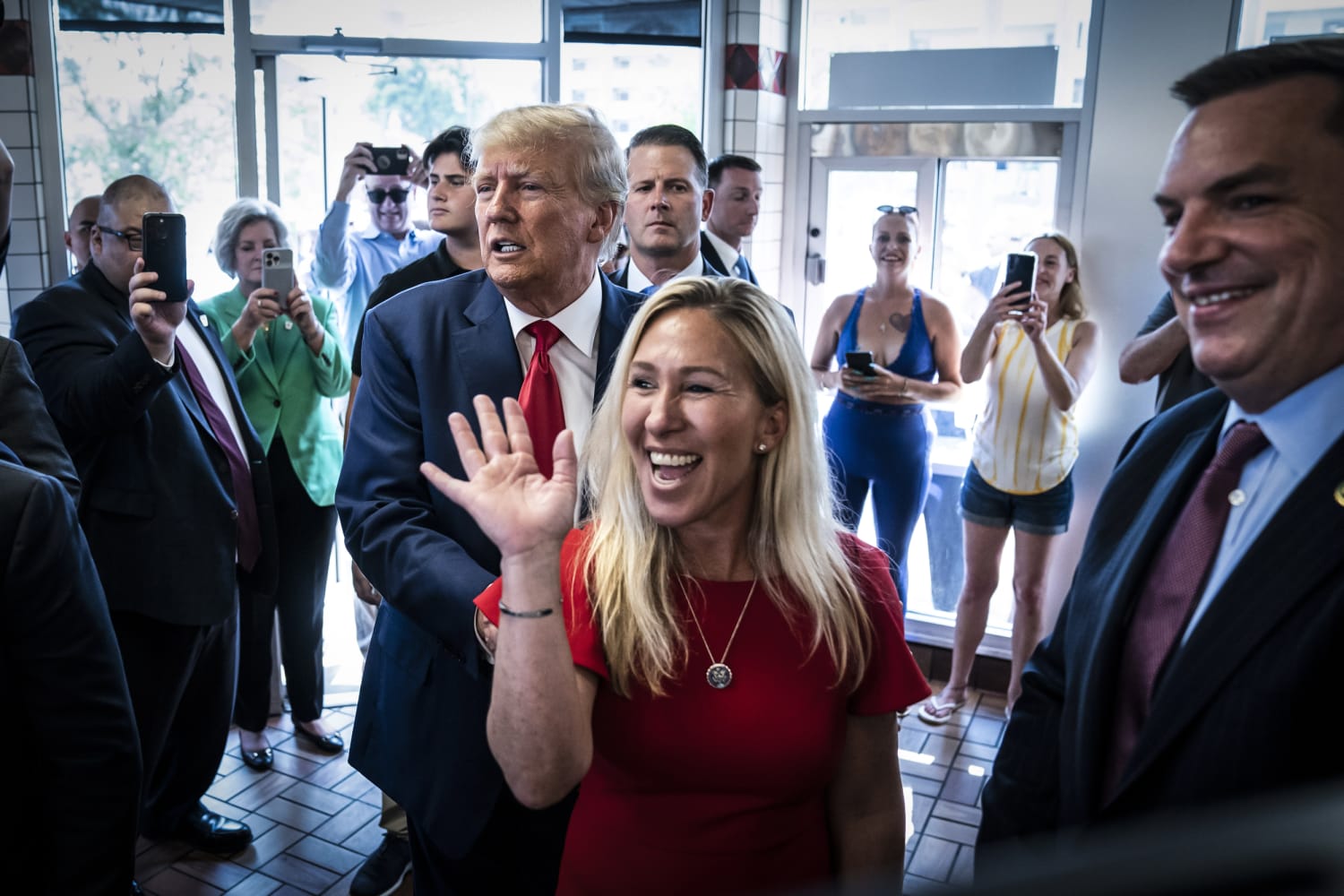
The sudden resignation of Marjorie Taylor Greene from Congress in early 2026 did not come out of nowhere, even if it initially appeared abrupt. Behind the headlines and the political shockwaves was a convergence of pressures that had been building for months: a dramatic rupture with Donald Trump, growing hostility inside her own party, and a strategic calculation about her political survival.
At the center of everything was Greene’s relationship with Trump. For years, she had been one of his most visible and loyal allies in Congress, aligning herself tightly with his messaging, his political battles, and his voter base. That alignment gave her influence and protection. It also tied her political fate directly to his standing within the Republican Party.
That relationship began to fracture in late 2025. Greene took a series of positions that diverged from Trump on issues that mattered deeply to his core political identity. Among them were her push for transparency on high-profile investigations, including the release of long-sought documents tied to the Epstein case, and her criticism of Trump’s foreign policy focus. Greene argued that too much attention was being placed on global conflicts while domestic concerns were being neglected. These disagreements, which initially seemed like minor policy disputes, quickly escalated into a full-blown political split.
Trump responded forcefully and publicly. His criticism of Greene was not subtle or restrained. He questioned her loyalty, attacked her judgment, and, most importantly, withdrew his political support. In the current Republican ecosystem, Trump’s endorsement still carries enormous weight. Losing it is not just a symbolic blow; it has immediate and practical consequences.
Within days of the public fallout, signals began to emerge that Trump was prepared to support a primary challenger against Greene in her own district. That development changed everything. Greene’s seat, once considered safe, suddenly became vulnerable. Without Trump’s backing, her path to reelection was no longer secure, and the prospect of a bruising intra-party fight became very real.
Greene herself acknowledged this dynamic in her resignation statement, referencing her desire to avoid putting her district through what she described as a “hurtful and hateful primary.” While that phrasing was framed as concern for her constituents, it also reflected a clear-eyed understanding of the political terrain. A Trump-backed challenger would not just be another opponent; it would be a direct test of loyalty within the MAGA base, a fight that could quickly turn against her.
At the same time, Greene was facing mounting pressure from within the Republican Party beyond Trump’s circle. Her break with Trump did not win her significant new allies among establishment Republicans, many of whom had long viewed her as a disruptive figure. Instead, she found herself in a precarious middle ground: no longer protected by Trump’s inner circle, but still not embraced by the more traditional wing of the party.
In interviews and statements leading up to her resignation, Greene described feeling undermined and isolated. She pointed to internal party dynamics that she said were designed to marginalize her influence. Committee assignments, legislative priorities, and internal leadership battles all became points of friction. The sense that she was being squeezed from both sides — by Trump-aligned forces on one end and skeptical party leadership on the other — contributed to an increasingly untenable position.
There were also personal and security concerns that added to the pressure. High-profile political splits in the current climate often bring heightened threats and intense public backlash. Greene’s break with Trump triggered a wave of criticism from some of the same supporters who had once been her strongest backers. Managing that fallout, both politically and personally, became another factor in her decision-making.
Beyond the immediate conflict, Greene also framed her departure as a broader critique of Congress itself. In her final remarks, she spoke about frustration with what she characterized as a dysfunctional system driven by entrenched interests and performative politics. She argued that the legislative process had become more about power struggles and less about delivering results for voters. While such critiques are common in resignation speeches, in Greene’s case they were tied directly to her lived experience of internal party battles and shifting alliances.
Taken together, these factors created a clear strategic calculation. Remaining in Congress would have meant entering a high-stakes primary without Trump’s support, facing opposition from within her own party, and operating in an environment where her influence was diminishing. Resigning allowed her to avoid a likely political defeat, preserve her national profile, and potentially reposition herself for a future role outside of Congress.
From a purely tactical perspective, the decision makes sense. A loss in a primary, especially one framed as a referendum on loyalty to Trump, could have severely damaged her standing with the political base she had spent years cultivating. By stepping down on her own terms, she maintained a degree of control over her narrative and left open the possibility of future political or media opportunities.
The broader implications of her resignation extend beyond her individual career. The episode highlights the continued centrality of Trump’s influence within the Republican Party and the risks faced by figures who break from him, even after years of close alignment. It also underscores the volatility of intra-party dynamics, where alliances can shift quickly and political security can erode just as fast.
In the end, Greene’s departure was not driven by a single scandal or one decisive moment. It was the product of a cascading series of political developments: a high-profile split with Trump, the loss of his endorsement, the threat of a difficult primary challenge, internal party pressures, and a personal assessment of the costs and benefits of staying in office. Each factor reinforced the others, narrowing her options until resignation became the most rational path forward.
What comes next for Greene remains an open question. She retains a national following and a recognizable political brand, both of which could be leveraged in future campaigns, media ventures, or advocacy roles. But her exit from Congress marks a significant turning point — not just for her career, but for the ongoing evolution of the political movement she once helped lead from within the halls of power.

Emily Johnson is a critically acclaimed essayist and novelist known for her thought-provoking works centered on feminism, women’s rights, and modern relationships. Born and raised in Portland, Oregon, Emily grew up with a deep love of books, often spending her afternoons at her local library. She went on to study literature and gender studies at UCLA, where she became deeply involved in activism and began publishing essays in campus journals. Her debut essay collection, Voices Unbound, struck a chord with readers nationwide for its fearless exploration of gender dynamics, identity, and the challenges faced by women in contemporary society. Emily later transitioned into fiction, writing novels that balance compelling storytelling with social commentary. Her protagonists are often strong, multidimensional women navigating love, ambition, and the struggles of everyday life, making her a favorite among readers who crave authentic, relatable narratives. Critics praise her ability to merge personal intimacy with universal themes. Off the page, Emily is an advocate for women in publishing, leading workshops that encourage young female writers to embrace their voices. She lives in Seattle with her partner and two rescue cats, where she continues to write, teach, and inspire a new generation of storytellers.