


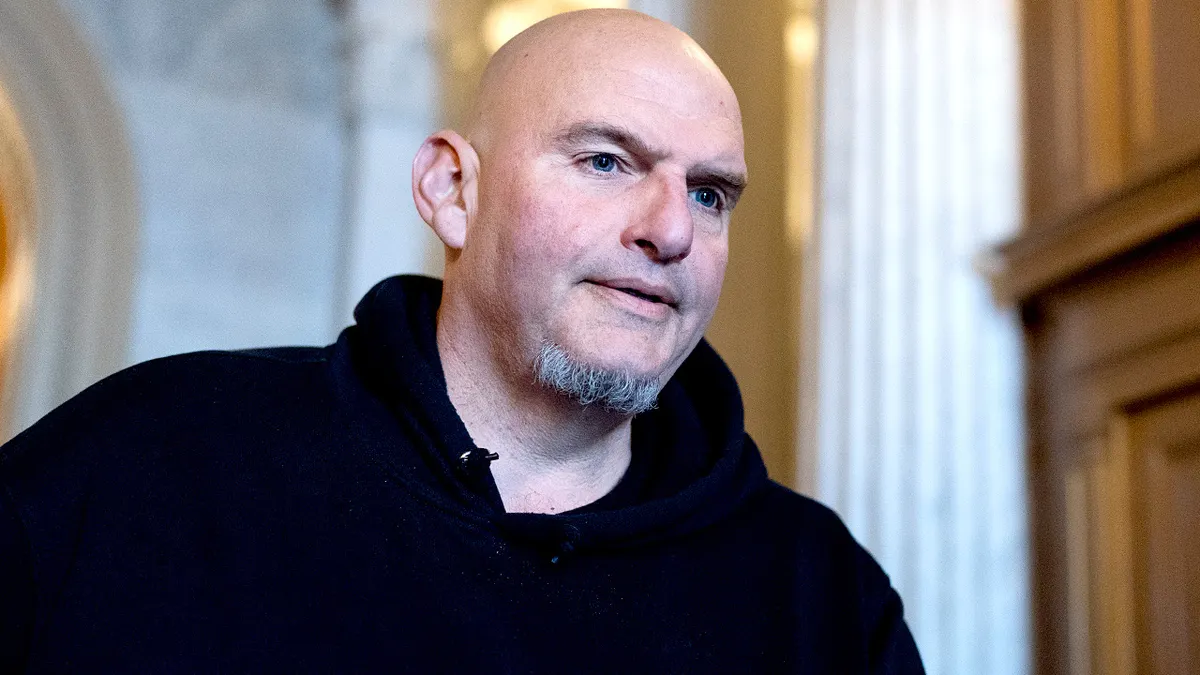
As Washington prepares for President Donald Trump’s upcoming address to a joint session of Congress, a prominent Democratic senator is urging his party to tread carefully. In remarks that underscore ongoing tensions within the Democratic caucus, Sen. John Fetterman (D-Pa.) warned colleagues against turning the event into a spectacle, arguing that visible protests during a presidential speech risk diminishing both the institution and the party’s broader message.
Speaking Thursday in an interview with Jesse Watters on Fox News, Fetterman said that while lawmakers are free to boycott the speech if they choose, those who attend should conduct themselves with restraint.
“A boycott is fine,” he said. “But I just hope they don’t do the kinds of things that some did last year.”
President Donald Trump is scheduled to deliver his annual State of the Union address before a joint session of Congress on Tuesday evening. The speech, one of the most high-profile moments in the political calendar, traditionally serves as an opportunity for presidents to outline policy priorities and frame the national conversation for the year ahead.
In recent years, however, the address has also become a venue for visible partisan protest. Lawmakers have occasionally used signs, symbolic gestures, or interruptions to signal opposition. For Fetterman, that approach risks crossing a line.
“I mean, there’s just no dignity if you have paddles, if you are yelling and saying those kinds of things,” he said. “You can agree or disagree on things, but if you’re going to show up, just do it with dignity because, you know, we really need to respect the office.”
His comments reference scenes from last year’s address, when Rep. Al Green (D-Texas) interrupted the president during the speech. Green repeatedly heckled Trump from the House floor and refused to comply with requests to maintain order. Then-Speaker Mike Johnson (R-La.) ultimately directed that Green be escorted from the chamber.
The incident did not end there. In the days that followed, the House voted to censure Green for what lawmakers described as a “breach of proper conduct.” Ten Democrats joined Republicans in supporting the censure resolution, signaling bipartisan frustration with the disruption.
Other Democrats engaged in quieter but still conspicuous forms of protest. Several held up small signs during the speech with messages such as “FALSE” and “SAVE MEDICAID,” attempting to fact-check or counter the president’s remarks in real time.
Fetterman was openly critical of those tactics. In a post on X following the 2025 address, he described the display as “a sad cavalcade of self owns and unhinged petulance.” He argued that such demonstrations made the president appear “more presidential and restrained” by comparison.
“We’re becoming the metaphorical car alarms that nobody pays attention to,” he wrote at the time, “and it may not be the winning message.”
That critique reflects a broader debate within the Democratic Party about strategy and tone. As Trump continues to dominate headlines and energize his political base, Democrats face competing pressures: to express forceful opposition and to project seriousness and stability.
For some lawmakers and activists, public protest during high-visibility moments is an effective way to draw attention to policy disagreements. They argue that silence during a presidential address can be interpreted as acquiescence. Others contend that highly theatrical protests risk alienating moderate voters and overshadowing substantive critiques.
The upcoming address has already prompted alternative plans from some Democrats. Several members intend to skip the speech entirely, instead participating in a “People’s State of the Union” rally near the U.S. Capitol. Organizers say the event will highlight what they describe as the harmful impacts of the administration’s policies, including concerns about healthcare, economic inequality, and social services.
Another event, branded “State of the Swamp,” is scheduled for the same evening at the National Press Club. That gathering will feature lawmakers and advocates who plan to offer a pointed critique of the administration’s agenda.
Fetterman dismissed the effectiveness of such counterprogramming.
“Regardless of who the president is, the counter never really lands, and it just doesn’t compare,” he said in his interview. He suggested that alternative events, however well-intentioned, rarely command the same public attention as the official address and may ultimately preach to the choir.
His position places him somewhat at odds with colleagues who view parallel events as necessary platforms for dissent. Yet Fetterman has increasingly carved out a reputation as an independent voice within his party, occasionally breaking with progressive activists and cautioning against what he sees as counterproductive theatrics.
The senator’s remarks also touch on a deeper institutional question: how lawmakers should balance partisan opposition with respect for the presidency as an office. State of the Union addresses have historically included moments of visible disagreement—lawmakers declining to clap, remaining seated, or subtly signaling dissent. But overt disruptions remain relatively rare and often controversial.
Political scientists note that decorum during presidential addresses serves both symbolic and practical purposes. The joint session format underscores the coequal branches of government, even amid policy disputes. Visible breakdowns in decorum can reinforce perceptions of dysfunction at a time when public trust in institutions is already strained.
At the same time, critics of strict decorum argue that protest has long been part of democratic expression. They point to historical examples of lawmakers using symbolic gestures to highlight moral or policy disagreements. The question, they say, is where to draw the line between principled dissent and counterproductive spectacle.
Fetterman appears to believe that last year’s actions crossed that threshold.
By urging restraint, he is also signaling a strategic calculation. Democrats are preparing for upcoming electoral contests in which swing voters could prove decisive. In competitive districts and states, images of lawmakers shouting or waving signs during a presidential speech may not resonate positively with voters seeking stability.
Whether his advice will be heeded remains to be seen. Party leaders have not announced formal guidance on conduct during the address, and individual lawmakers retain discretion over their participation.
The president’s speech itself is expected to cover a broad array of issues, including the economy, border security, foreign policy, and legislative priorities for the coming year. In that sense, it will offer ample opportunities for disagreement on substance.
For Fetterman, however, the manner of opposition matters as much as the message.
“You can agree or disagree on things,” he reiterated. “But if you’re going to show up, just do it with dignity.”
As Tuesday approaches, attention will focus not only on what the president says but also on how lawmakers respond. In a hyperpartisan era, the choreography of applause, silence, and dissent can carry political weight.
Fetterman’s appeal for decorum highlights an enduring tension within American politics: the challenge of maintaining institutional respect amid fierce ideological conflict. Whether his colleagues choose protest, boycott, or quiet dissent, their actions will shape not only the optics of the evening but also the broader narrative about how Congress conducts itself in moments of national visibility.

Emily Johnson is a critically acclaimed essayist and novelist known for her thought-provoking works centered on feminism, women’s rights, and modern relationships. Born and raised in Portland, Oregon, Emily grew up with a deep love of books, often spending her afternoons at her local library. She went on to study literature and gender studies at UCLA, where she became deeply involved in activism and began publishing essays in campus journals. Her debut essay collection, Voices Unbound, struck a chord with readers nationwide for its fearless exploration of gender dynamics, identity, and the challenges faced by women in contemporary society. Emily later transitioned into fiction, writing novels that balance compelling storytelling with social commentary. Her protagonists are often strong, multidimensional women navigating love, ambition, and the struggles of everyday life, making her a favorite among readers who crave authentic, relatable narratives. Critics praise her ability to merge personal intimacy with universal themes. Off the page, Emily is an advocate for women in publishing, leading workshops that encourage young female writers to embrace their voices. She lives in Seattle with her partner and two rescue cats, where she continues to write, teach, and inspire a new generation of storytellers.