


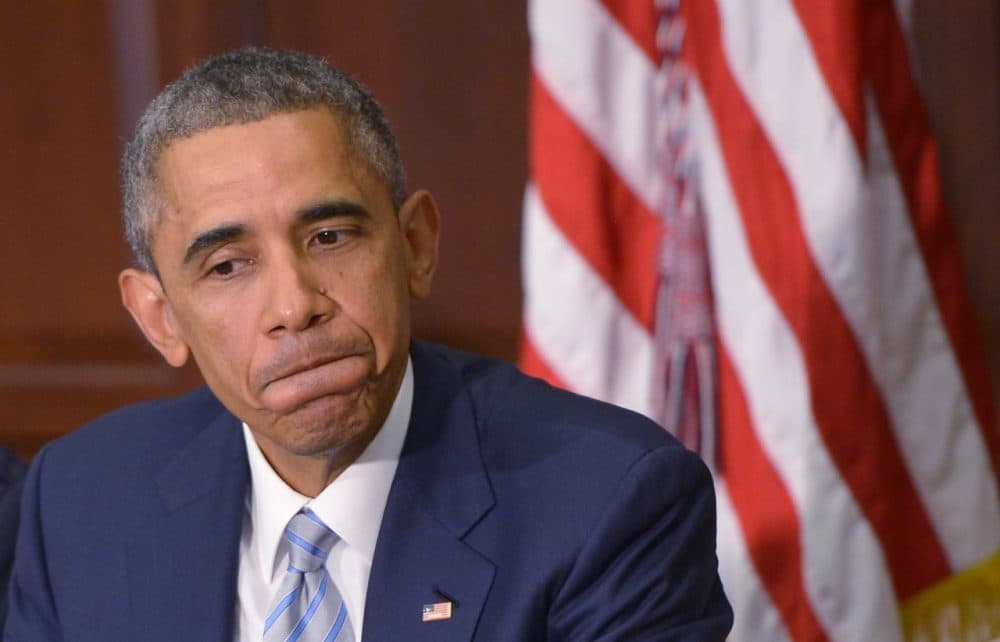
Aboard Air Force One on Thursday, President Donald Trump escalated a simmering political exchange by suggesting that former President Barack Obama may have revealed classified information during a recent podcast interview. Calling the remarks a “big mistake,” Trump told reporters that Obama “gave classified information” and implied that such disclosure could carry serious legal consequences.
The comments stem from Obama’s appearance on a podcast hosted by progressive political commentator Brian Tyler Cohen. The wide-ranging conversation touched on campaign strategy, the state of the Democratic Party, and the policy direction of the current administration. But it was a brief exchange during a rapid-fire segment of the interview that drew outsized attention.
When asked whether aliens are real, Obama responded in a casual tone: “They’re real, but I haven’t seen them, and they’re not being kept in, what is it, Area 51?” He added that there was “no underground facility” hiding extraterrestrials “unless there’s this enormous conspiracy, and they hid it from the president of the United States.”
The clip spread quickly across social media, generating both humor and speculation. Within hours, commentators began debating whether the former president had offered new insight into government knowledge of unidentified flying objects—now formally referred to as unidentified anomalous phenomena, or UAPs.
Soon after the clip went viral, Obama issued a clarification on social media, emphasizing that his answer had been delivered in the spirit of a lighthearted “speed round.”
“I was trying to stick with the spirit of the speed round, but since it’s gotten attention let me clarify,” he wrote. “Statistically, the universe is so vast that the odds are good there’s life out there. But the distances between solar systems are so great that the chances we’ve been visited by aliens is low, and I saw no evidence during my presidency that extraterrestrials have made contact with us. Really!”
Despite the clarification, President Trump seized on the moment. Speaking to reporters mid-flight, he suggested that Obama may have crossed a legal line.
“He gave classified information, he’s not supposed to be doing that,” Trump said. “I don’t know if they’re real or not, I can tell you he gave classified information. He’s not supposed to be doing that. He made a big mistake. He took it out of classified information.”
Trump did not specify which portion of Obama’s remarks he believed constituted classified material, nor did he cite any intelligence findings contradicting Obama’s clarification. Nonetheless, his statement introduced a legal dimension to what had initially appeared to be a casual exchange.
The accusation arrives against a backdrop of heightened public and congressional interest in UAPs. In recent years, the federal government has taken steps to standardize the collection and analysis of reports involving unexplained aerial phenomena. In 2021, the Office of the Director of National Intelligence released an unclassified report summarizing UAP incidents documented by military personnel. That report, mandated by provisions in a COVID-19 relief package, acknowledged numerous unexplained sightings but found no confirmed evidence of extraterrestrial origin.
Subsequently, Congress codified the creation of the All-Domain Anomaly Resolution Office (AARO) within the Department of Defense through the National Defense Authorization Act for Fiscal Year 2022. AARO is tasked with investigating UAP reports across air, sea, space, and other domains, using a data-driven methodology. The office collaborates with intelligence and defense agencies and provides annual reports to Congress.
Against this evolving institutional framework, public statements by current or former presidents naturally draw scrutiny. Presidents receive highly classified briefings while in office, and former presidents remain bound by legal restrictions concerning the disclosure of sensitive national security information.
However, legal experts note that determining whether a public remark constitutes the release of classified information depends heavily on context. Classified status attaches to specific documents, intelligence sources, and operational details—not broad expressions of belief or general scientific speculation. Obama’s clarification explicitly stated that he saw no evidence of extraterrestrial contact during his presidency.
The Constitution does not prohibit former presidents from speaking publicly about their time in office, but statutes governing classified information continue to apply. Enforcement, however, requires demonstrating that specific classified content was disclosed knowingly and improperly.
Trump’s comments also underscore the persistent political tensions between the two presidents. Since leaving office, Obama has occasionally weighed in on domestic political debates, particularly during election cycles. Trump, in turn, has frequently criticized his predecessor on issues ranging from foreign policy to intelligence matters.
This latest exchange touches on a subject that has long straddled the line between public curiosity and national security: government transparency regarding unexplained aerial phenomena. Bipartisan members of Congress have pressed for greater disclosure, arguing that public trust depends on openness. Others caution that excessive transparency could expose sensitive surveillance capabilities or intelligence methods.
Public fascination with extraterrestrial life predates modern politics. From Cold War-era rumors surrounding military installations to contemporary viral footage of unidentified objects, the topic has repeatedly resurfaced in American discourse. Presidents have occasionally been asked about the matter in interviews, often responding with humor or careful ambiguity.
Obama himself addressed similar questions during his presidency, generally emphasizing scientific curiosity about life beyond Earth while dismissing conspiracy theories about hidden alien facilities. His recent podcast answer followed that familiar pattern, albeit in a less formal setting.
Trump’s assertion that classified information was disclosed raises additional questions about executive authority and the politicization of intelligence topics. Historically, disputes over classified material have involved documented leaks or mishandling of sensitive documents. Whether a generalized denial of alien contact rises to that threshold remains uncertain.
Legal analysts caution that public accusations without formal investigative action may serve more as political messaging than as precursors to prosecution. At present, there is no indication of a Justice Department inquiry into Obama’s remarks.
Meanwhile, congressional interest in UAP transparency continues. Lawmakers from both parties have held hearings featuring military witnesses and intelligence officials. Some have called for declassification of additional materials, arguing that public speculation thrives in the absence of information.
The broader debate reflects a tension inherent in democratic governance: balancing transparency with security. Citizens expect accountability from public officials, yet national defense and intelligence operations often require secrecy.
For now, the exchange between Trump and Obama appears likely to remain in the realm of political rhetoric rather than legal proceedings. Still, the episode illustrates how even a lighthearted podcast response can reverberate through the corridors of power when it touches on subjects shrouded in secrecy.
As interest in UAPs persists and institutions like AARO continue their work, future disclosures—whether confirming mundane explanations or uncovering new anomalies—will likely attract intense scrutiny. Presidents, past and present, operate under the weight of classified briefings and public curiosity alike.
In that intersection of secrecy and speculation, even a casual remark can ignite a broader debate about law, accountability, and the boundaries of presidential speech.

Emily Johnson is a critically acclaimed essayist and novelist known for her thought-provoking works centered on feminism, women’s rights, and modern relationships. Born and raised in Portland, Oregon, Emily grew up with a deep love of books, often spending her afternoons at her local library. She went on to study literature and gender studies at UCLA, where she became deeply involved in activism and began publishing essays in campus journals. Her debut essay collection, Voices Unbound, struck a chord with readers nationwide for its fearless exploration of gender dynamics, identity, and the challenges faced by women in contemporary society. Emily later transitioned into fiction, writing novels that balance compelling storytelling with social commentary. Her protagonists are often strong, multidimensional women navigating love, ambition, and the struggles of everyday life, making her a favorite among readers who crave authentic, relatable narratives. Critics praise her ability to merge personal intimacy with universal themes. Off the page, Emily is an advocate for women in publishing, leading workshops that encourage young female writers to embrace their voices. She lives in Seattle with her partner and two rescue cats, where she continues to write, teach, and inspire a new generation of storytellers.